


Germany just ran its first public wargame simulating a Russian attack on NATO's eastern flank—and the results were uncomfortable. The exercise, conducted by Die Welt and the Bundeswehr's Wargaming Center, modeled a crisis around the Suwalki Gap, the narrow corridor connecting Poland to the Baltic states.
Berlin froze under consensus-seeking. Moscow created military facts on the ground faster than NATO could respond politically. But the simulation left out something critical: Russia's gray-zone operations—the sabotage of shipyards, railways, and undersea cables already underway across Europe.
In an interview with Euromaidan Press, retired Lt. Gen. Ben Hodges—former Commanding General of United States Army Europe—explains why that omission matters more than the wargame's headline findings, and why Europe's real deficit isn't military capability but political confidence.
Key takeaways:
- The German wargame didn't model air power or gray zone warfare—two factors that would fundamentally change its outcome
- Sabotage of ports, railways, and cables isn't random harassment—Russia is rehearsing how to paralyze NATO reinforcement routes
- Ukraine and Finland show what societal resilience looks like: media literacy from preschool, trust in institutions, and civil defense as routine
- Combined European NATO allies' capabilities dwarf Russia's—the real gap is political confidence, not military power
Interview edited for length and clarity.
The wargame: useful, not prophetic
Daniel Thomas: The Die Welt/Bundeswehr exercise saw Berlin freeze while Moscow created facts on the ground. What should readers take from it?
Ben Hodges: Wargames are not meant to be predictive. They're a device for examining courses of action, logistics, and time-space factors. Nobody should walk away thinking "we're doomed because the Germans aren't gonna be there." You make assumptions, you change them, you run it again. That's why they're useful for policymakers and commanders.
It is useful, of course, to see that if Germany hesitates, that puts enormous pressure on everybody else. Same if the US hesitates. What I'd want our Baltic, Nordic, and German allies to take from this: if there is no American presence or decisive action, how do we, the rest of us, protect Europe?
And there was no mention of air power. There's a huge amount just in Finland, Sweden, and Norway, let alone Poland, Germany, the UK, and others who would respond in any Baltic scenario.
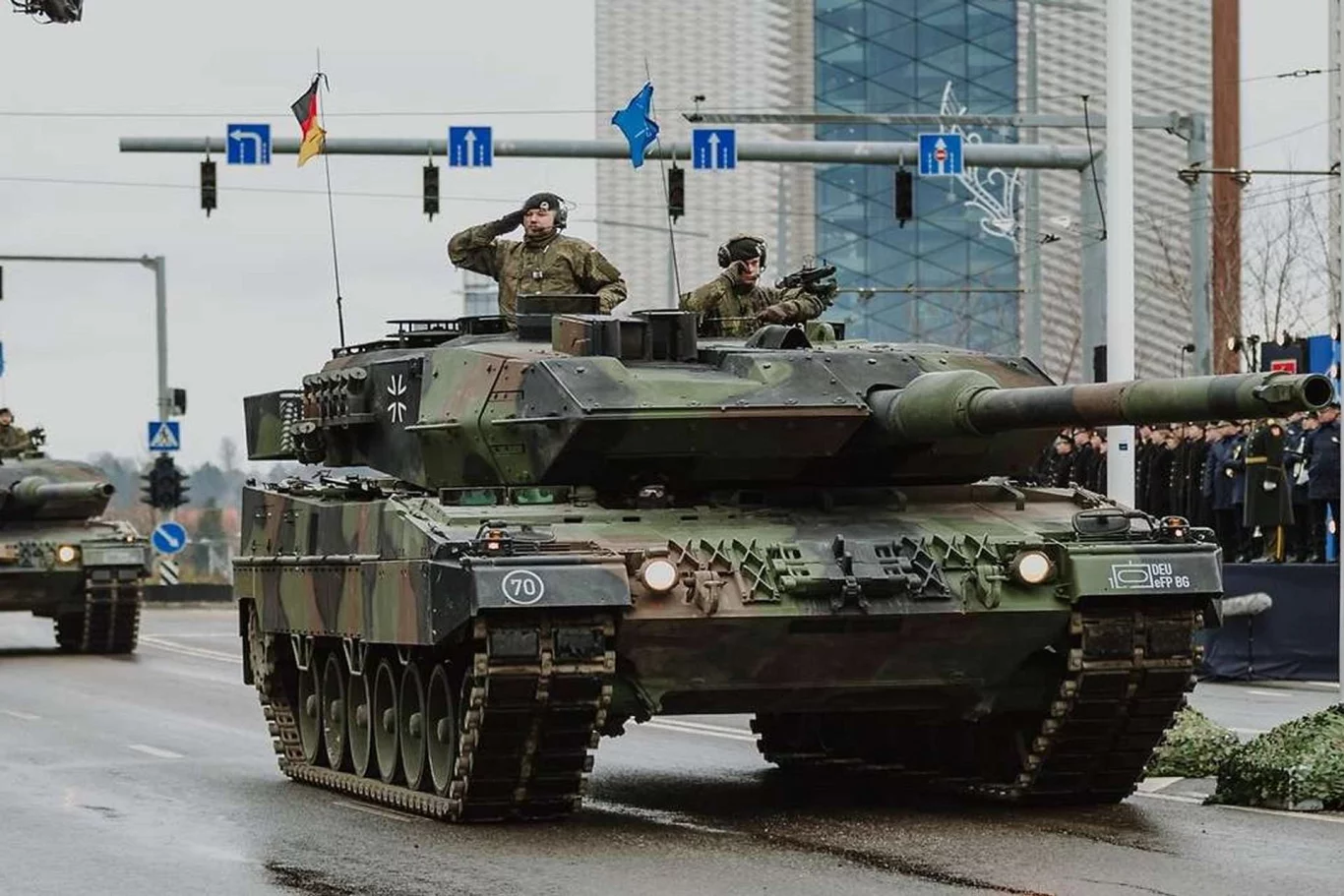
Wargame reveals Germany would freeze as Russia seizes Lithuanian territory in three days
I spoke to someone involved with the wargame. The whole idea was to show Russians attempting to find that limit—how far they could push without triggering Article 5. That's why there were no big air strikes, no conventional attack. And that's exactly why gray zone operations matter so much. If we keep refusing to impose consequences for drones, airspace violations, sabotage, constant border probing—you can end up with a scenario like this one. We have to stop treating these like a crime scene where you need absolute 100% proof it was Russia, because that's the whole point of gray zone operations—to make attribution difficult.
"We have got to get serious about inflicting consequences on the Russians for gray zone operations. Stop treating these like a crime scene where you have to have absolute 100% proof that it was Russia that did it."
Russia's shadow war: already underway
Daniel Thomas: What do gray zone operations actually look like, and how could they have been modeled in the wargame?
Ben Hodges: The Russians are already at war with us. They just do it in a way that makes it difficult for politicians to say, "This is the Russians. Stop, or we'll do the following." No missiles flying at NATO cities—but NATO's deterrence depends on rapid reinforcement. So all that sabotage against airports, seaports, rail lines—they're probing, practicing, doing reconnaissance to find out how we respond when they disrupt our transportation network. That would be part of any major Russian attack.
There's also labor disruption. If they can get the workforce to refuse to operate the rails or the seaports... Two port employees in Hamburg were just arrested for sabotaging a German navy ship under construction. The fact that they could do that exposes the vulnerabilities.

Undersea cables necessary for communications across the Baltic, up to Svalbard, all the transatlantic cables—these are constantly being probed. I was on a train in the Netherlands last summer during the NATO summit—five different railroads were hit that afternoon, including mine. According to Dutch police, five simultaneous attacks. Not teenagers doing vandalism.
And of course, part of the purpose is to create fear—so populations pressure their governments to stop supporting Ukraine and "stop provoking" the Russians.
"The Russians are already at war with us now. But they do it in such a way that makes it difficult for politicians to respond."
What Ukraine and Finland can teach the rest of Europe
Daniel Thomas: What can NATO learn from Ukraine's experience countering these tactics?
Ben Hodges: Societal resilience. Russian gray zone operations are designed to create fear and distrust—manipulating elections, planting false stories in the international press. Societies have to be inured against that.
Ukraine is a perfect example. Even if people aren't happy with some policies, most Ukrainians trust President Zelenskyy. They trust what their soldiers are doing, even if they're not happy with every aspect of it. And this is while getting pounded every night.
A Finnish friend told me, "Ben, you know why the Finns are never scared? Because they're always prepared." They trust that somebody in government has anticipated the problems and taken steps. Finland, with 5 million people and an enormous Russian border, has to be that way. They can mobilize quickly. Even children start learning to identify fake news at a very young age. These are things the rest of us should be learning from Ukraine and from Finland.
"You know why the Finns are never scared? Because they're always prepared."
Trending Now
Lithuania is moving toward a total defense concept now. In a worst case, it might be two weeks before ground reinforcements reach the Baltic states. For those two weeks, Lithuanian troops with the German brigade and whatever Americans are there would have to hold without ground reinforcement. That means society has to be ready: hardened power grids, protected banking and fuel systems, everything that's digitalized and vulnerable to cyber attacks.
"It might be two weeks before reinforcements arrive from outside of the Baltic States."
Our ports are more digitalized than people imagine. There was an article in Wired about the NotPetya attack that shut down Maersk shipping. Maersk wasn't even the target—it was a Ukrainian tax service [M.E.Doc]. Yet it crippled one of the world's biggest shipping companies for weeks. Now imagine the Russians hitting NATO seaports with the same ferocity they use against Kherson or Kyiv every night—drones at that kind of volume. We're not prepared for that. We haven't practiced it.

Daniel Thomas: You've said shooting down drones isn't always the right move. What is?
Ben Hodges: Find out where they're coming from. If we can track an asteroid from eight gazillion miles out in space, we ought to have the capability to track these drones and figure out where they originate. It's gonna be some park or parking lot or farm or some vessel out in the Baltic Sea.
Then you do Counterterrorism 101. You figure out where they're coming from, put surveillance on those places, and start arresting people.
And you have to practice. Practice air defense, practice responding to drone incursions. Populations shouldn't get scared seeing civil defense exercises—they should feel better. It gives confidence, the same way you feel better when you see the fire department practicing. But politicians are scared to do this because they don't want to alarm people.
I'd say: do the opposite.
Europe without America: stronger than it thinks
Daniel Thomas: In a Trump 2.0 world, what's holding European allies back?
Ben Hodges: If I may—if you're talking about countries inside NATO, they are allies, not partners. That's an important distinction. Allies have obligations.
Three things. First, despite all the noise and doubt, it's still in America's interest that Europe is stable—Europe is America's biggest trading partner. European leaders should think long-term.
Second, don't assume things will go back to the way they were. The rules-based order is changing. This administration expects European allies to take on more responsibility. European leaders need that candid conversation with their populations: "Let's do this." You can't just hang in there, assuming everything will be okay in two or three years.
Personally, I think this will be a negative outcome for the US long-term—it's going to hurt American business as Europe becomes less dependent on the United States. But nonetheless, this is what European leaders and Canada have to do.
And this is critical: Europe working with Canada, Norway, the UK, Ukraine, and Türkiye is more than enough to counter Russia. Add together the economies, technology, wealth, and populations of those countries, and it dwarfs Russia.
"I don't know why Europeans are so worried about provoking Russia. Russia should be terrified of provoking Europe."

Deterrence requires both capability and will. The US, the UK, and some other allies have greater offensive cyber capabilities than is publicly acknowledged. The Russians probably know that devastating retaliation would follow a serious cyber attack, which is why we haven't seen one against NATO allies. But European allies need to build their own capabilities too, in case the US isn't there.
After the Baltic shadow fleet incidents, Finland's President Stubb hosted a summit in Helsinki with the Nordics, Baltics, Poland, Germany, and the NATO Secretary General. They laid out tangible steps—increased surveillance of underwater infrastructure, and one key reminder: nations have sovereign authority to protect their coastlines. In other words, use the law to protect yourself from what the Russians are doing.
Lt. Gen. Ben Hodges (ret.) served as Commanding General of United States Army Europe from 2014 to 2017. He currently holds the Pershing Chair in Strategic Studies at the Center for European Policy Analysis (CEPA).
Read also
-
“Not if, but when”: NATO prepares for Russian attack on Finland, Baltics and Norway
-
Estonia’s top spy: Russia limits Baltic Sea provocations to protect oil shipments by shadow fleet
-
“Classic Russian spy tactics” turn victims of Putin’s war into weapons against their own allies
-
Russia recruits German citizens as “single-use agents” via social media to sabotage Ukrainian military training sites
-
Russia spy chief warns NATO: Poland and Baltic States to “suffer first” in event of war


