

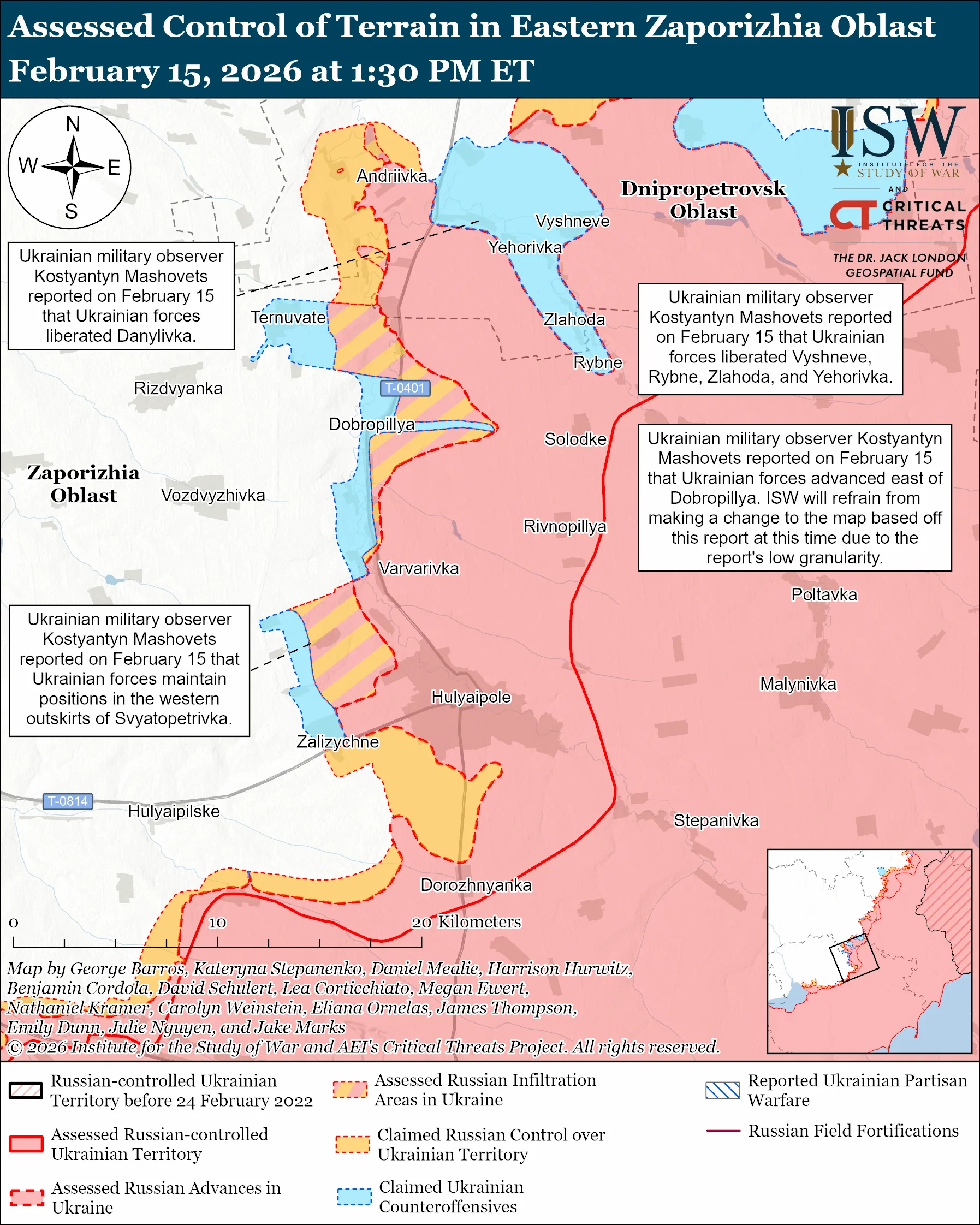
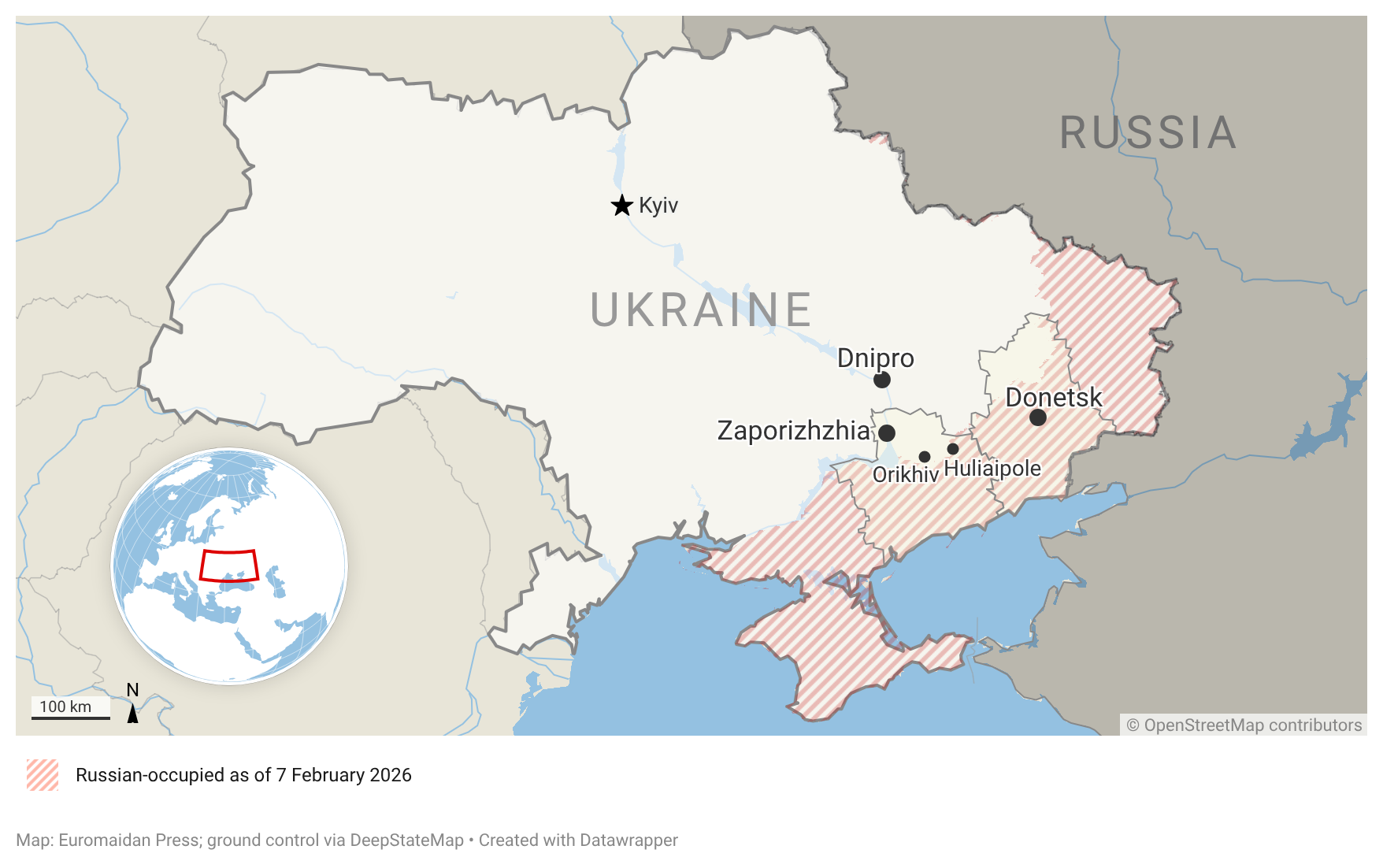
Ukrainian forces have pushed Russian forces back up to 9.5 km in some areas and liberated over a dozen settlements in Zaporizhzhia Oblast through tactical counterattacks, likely hindering Russia's preparation for a hypothetical summer offensive toward Zaporizhzhia City, according to the Institute for the Study of War (ISW) citing Ukrainian military observer Kostyantyn Mashovets. The counterattacks likely exploited Russia's loss of Starlink access, but Mashovets cautions these are limited stabilizing actions, not a counteroffensive.
Ukrainian counterattacks roll back two months of Russian advances
Russian forces had spent roughly two months on the offensive in the Oleksandrivka and Huliaipole directions, seizing Huliaipole and pushing west and northwest. Around 8 February, the tempo of those advances dropped sharply, then nearly stopped, Mashovets reported on 15 February.
Ukrainian troops then struck across multiple axes. Southeast of Oleksandrivka, they pushed Russian forces from Oleksiivka and Orestopil and advanced toward Berezove and Ternove. Along the Yanchur River, they liberated Vyshneve, Yehorivka, Pershortravneve, Zlahoda, and Rybne, and began fighting for Pryvilne.
Northwest of Huliaipole, Ukrainian forces drove Russian troops from Ternuvate and Kosivtseve, crossed the Haichur River, and liberated Dobropillia — with units already spotted east of it by 14 February. In a parallel push, they cleared Pryluky and Olenokostiantynivka, crossed the Haichur again, and began fighting for Varvarivka, part of which appeared already under Ukrainian control.
Along the Tsvitkove-Zaliznychne line, counterattacks stopped but did not reverse the Russian advance. Russian forces held Zaliznychne and the eastern outskirts of Tsvitkove but failed to push further for over a week. Russia still advanced up to 1.2 km northward along the railway from Dorozhnianka toward Zaliznychne.
In the zone of Russia's 58th Combined Arms Army, Ukrainian forces pushed Russian units back near Prymorske, Lukianivske, and Stepnohirsk, and stopped Russian advances along the Stepove-Pavlivka axis.

Starlink loss compounded exhaustion of Russian forward units
ISW assesses the counterattacks likely exploited Russia's loss of Starlink access. Russian milbloggers claimed that the shutdown caused communications and command-and-control issues on the battlefield. Separately, Mashovets noted that Russian forward units had been clearly weakened by two months of offensive fighting.
Limited stabilizing actions, not a counteroffensive
Mashovets explicitly rejected the "counteroffensive" label, calling these actions exclusively "stabilizing" and limited to the tactical zone. He listed clear constraints: Ukraine lacks troops to consolidate even current gains, Russia retains at least two brigades in the Vostok grouping alone that have mostly not yet been used, and can pull additional forces from adjacent sectors. Ukraine also lacks air superiority and an artillery advantage in the area.
The real significance, Mashovets assessed, is disrupting Russia's timeline for a hypothetical Orikhiv-Zaporizhzhia offensive operation. He reported on 5 February that Russian command was preparing for a summer 2026 offensive but struggling to reach the necessary staging positions. Ukrainian counterattacks have now forced Russian units off those positions entirely. Instead of advancing to their staging areas, Russian forces are, as Mashovets put it, "spinning their wheels halfway there."


