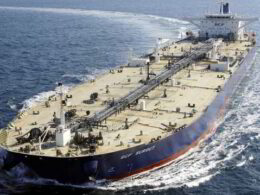

President Volodymyr Zelenskyy on 12 February enacted a decision by the National Security and Defense Council to impose sanctions against 91 vessels that form part of Russia's shadow fleet, according to the Presidential Office website.
Russia used these vessels to transport oil and petroleum products from Russian ports, including Novorossiysk, Ust-Luga, and Primorsk, to third countries in circumvention of sanctions imposed by the European Union, G7, and other states.
The sanctioned vessels sailed under the flags of approximately 20 countries. Only one flew a Russian flag, while the rest carried flags of Panama, Liberia, Cameroon, Barbados, the Marshall Islands, Hong Kong, Sierra Leone, Tonga, Palau, Guinea, the Comoros, the Bahamas, Indonesia, Malawi, Guinea-Bissau, Djibouti, Guyana, and Eswatini.
Ukraine will transmit relevant information to these states and will work with partners on further synchronization of sanctions in their jurisdictions.
Twenty-seven vessels from this list are already under sanctions by partners: the United States, Great Britain, Switzerland, and the European Union.
"Shadow fleet tankers are a key tool for circumventing oil sanctions, so their identification and imposition of sanctions against them must occur quickly and without exceptions. Each such vessel should be viewed as an element of financing the Russian war machine," said Vladyslav Vlasiuk, the president's advisor and commissioner for sanctions policy.
Earlier, EU sanctions representative David O'Sullivan stated that Russia's war-based economy may be approaching a point where it becomes "unsustainable."