


Ukraine is preparing to hold presidential elections alongside a peace referendum as early as May, the Financial Times reported on 11 February, citing Ukrainian and European officials. According to the paper, President Volodymyr Zelenskyy is expected to announce the plan on 24 February, the fourth anniversary of Russia’s full-scale invasion, under pressure from Washington to organize a vote by 15 May.
“As long as there is no security, there will be no announcements.”
Within hours after the Financial Times published its article, Kyiv walked it back. “If the Russians are killing people every day, how can we announce or seriously consider elections in the coming weeks?” a source in the President’s Office told Ukrinform.
The Kyiv Post, citing sources close to the president, reported separately that Zelenskyy does not plan to announce elections on 24 February. “As long as there is no security, there will be no announcements,” the source said.
The Kyiv Independent confirmed the denial through its own Presidential Office source: “He wasn’t planning to. When there’s no security, there’s nothing else.”
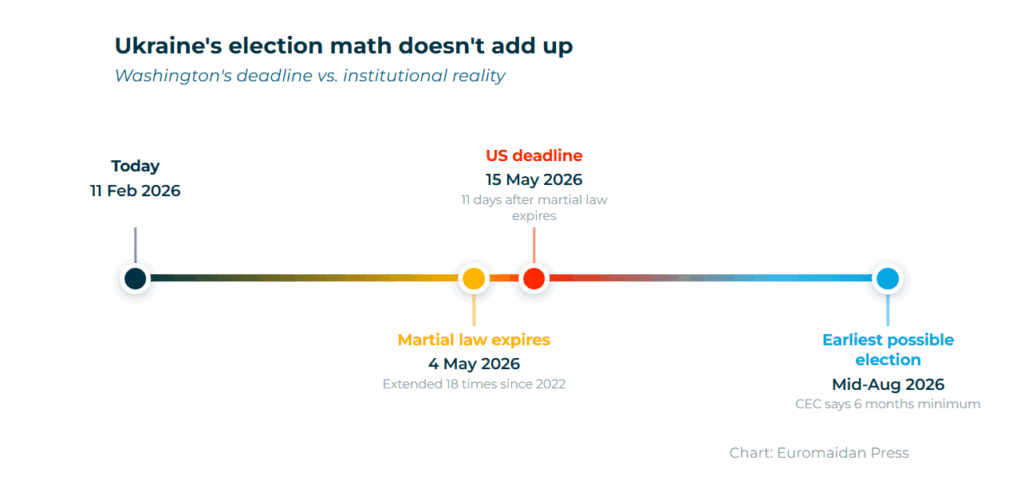
Washington’s reported deadline of 15 May falls just 11 days after martial law is even set to expire.
There is also a basic arithmetic problem. Martial law in Ukraine currently runs through 4 May 2026—the 18th consecutive 90-day extension since Russia’s full-scale invasion. Washington’s reported deadline of 15 May falls just 11 days after martial law is even set to expire.
Ukraine’s Central Election Commission (CEC) has proposed that the Verkhovna Rada would call elections within one month of martial law ending, and that the electoral process cannot begin earlier than six months after that date, with a 90-day constitutional window for the presidential campaign.
Whether those timelines run sequentially or overlap is a matter of interpretation—but under any reading, the earliest possible election falls no sooner than August 2026, months after Washington’s reported deadline.
Everyone says yes. Nobody says how.
This is the pattern. Zelenskyy told reporters on 9 December he was “ready to hold elections in 60 to 90 days” if security could be guaranteed. Servant of the People faction leader Davyd Arakhamia said on 3 January that elections and a referendum could be held within 90 days of a ceasefire.
The Verkhovna Rada formed a working group in December, chaired by First Deputy Speaker Oleksandr Korniyenko, with seven subgroups now working on thematic areas from security to voter registration, New Voice of Ukraine reported.
“Honestly, we are not really ready for this right now.”
All of this signals willingness. None of it explains mechanics. Even Arakhamia, at the same briefing where he proposed the 90-day timeline, conceded to RBC-Ukraine: “We have no modern experience—organizationally, politically, or economically. Honestly, we are not really ready for this right now.”
Oleksandr Salizhenko, editor-in-chief of the civic watchdog Chesno, told Euromaidan Press that this gap between signaling and substance is deliberate. Politicians tell negotiators Ukraine is practically ready for elections, he said, but they avoid getting into how or under what conditions because the details reveal it cannot be done quickly.
CEC Deputy Head Serhiy Dubovyk told CNN in December that Ukraine needs at least six months to prepare for free and safe elections, citing the sheer scale of displaced voters, damaged infrastructure, and military personnel at the front.
One Kinzhal can cancel an election day
The security problem is not abstract, Salizhenko pointed out. When a Kinzhal ballistic missile is detected, the alert goes nationwide—not regional—because Kinzhals can reach any part of the country within minutes. A nationwide air alert means every polling station in Ukraine shuts simultaneously. Voting stops. If the alert lasts hours, as they sometimes do, an entire election day can be lost.
Such provisions require a legal framework that does not yet exist.
The CEC’s January proposal accounts for this. It includes security protocols under which voting can be suspended during threats and resumed afterward—or, if resumption is impossible, existing ballots can be counted. But such provisions require a legal framework that does not yet exist.
E-voting: no framework, no system
Could technology solve the problem? “Electronic voting is an interesting idea, but nothing more,” Salizhenko told Euromaidan Press. No legal framework permits it. The Verkhovna Rada commission discussing e-voting is just that—a discussion. No legislation has been drafted, no system built.
Salizhenko expressed doubts about the security of any electronic voting system, noting it would be vulnerable to cyberattacks and manipulation—risks magnified by Russia’s repeated cyberattacks on Ukrainian state infrastructure.
Playing to Washington
The FT report reveals the driver: the Trump administration reportedly demanded both a presidential election and a peace referendum by 15 May, threatening to withhold security guarantees otherwise.
Multiple sources noted the deadline appears tied to US domestic politics—the Trump administration wants the war wrapped up before American midterm elections later in 2026. Whether 15 May represents a firm deadline, a negotiating position, or merely a trial balloon remains unclear.
The message to Washington: we are not the obstacle.
Trending Now
Kyiv’s response follows a familiar diplomatic logic. Signal willingness. Create working groups. Announce preparations. The message to Washington: we are not the obstacle.
But the institutions responsible for actually conducting elections—the CEC, civic watchdogs like the Civil Network OPORA (Ukraine’s leading election-monitoring organization), and Chesno—keep saying the same thing. They’ve thought of everything—which is precisely why they know it can’t be rushed.
This is not new institutional resistance. In February 2025, the Verkhovna Rada passed a resolution reaffirming that elections should not be held during martial law—a direct rebuff to both Trump and Putin, who had both questioned Zelenskyy’s legitimacy.
In November 2023, all parliamentary factions signed a joint agreement to postpone elections until after martial law ends, with the first post-war vote no earlier than six months after its cancellation.

Sceptical majority
OPORA has declared, together with more than 400 civil society organizations, that democratic elections cannot be held without sustainable peace. The network reiterated on 11 February that the current law prohibits referendums during martial law, as it is impossible to ensure the participation of millions of Ukrainians abroad and military personnel, mitigate security threats and disinformation, and fully restore damaged electoral infrastructure.
Fifty-nine percent said elections are only possible after the war concludes entirely.
Even if hostilities were to cease, preparing would require considerable time and complex reforms. OPORA’s chair, Olha Aivazovska, told Liga.net on 11 February that the parliamentary working group’s seven subgroups have held 32 meetings in a month and still need to continue work on media regulation, campaigning rules, and measures to combat Russian interference.
A poll released in January by the Kyiv International Institute of Sociology (KIIS), conducted between late November and late December 2025, found that only 10% of Ukrainians believe elections should be held before a ceasefire—down from 11% in September. Another 23% said elections should wait until a ceasefire and security guarantees are in place. Fifty-nine percent said elections are only possible after the war concludes entirely.
What the CEC has actually been doing
Ukraine’s election commission has been preparing seriously for post-war elections since autumn 2023—long before Washington started pushing. The CEC’s detailed proposal addresses the hardest questions: how internally displaced people vote when their registered addresses are in occupied or destroyed cities. How soldiers vote at the front. How millions of Ukrainians abroad register and participate. How to prevent Russian interference. How polling stations handle air raids.
The people who know the most about how to run elections are the ones most certain it can’t be done on a three-month timeline.
The commission restored the State Voter Register, which became fully operational on 1 January 2026 for the first time since the full-scale invasion. It now includes approximately 33 million people, of whom 5 to 7.5 million are abroad and more than 1.4 million lack official registration.
The question is not whether Ukraine will hold elections.
These are institutions that have been working on elections for years—not because Washington told them to, but because they understand that elections conducted poorly serve no one. As Chesno’s Salizhenko put it to Euromaidan Press, the people who know the most about how to run elections are the ones most certain it can’t be done on a three-month timeline.
The question is not whether Ukraine will hold elections. It will. The question is whether the timelines being floated—in Washington, in media reports, in diplomatic back channels—respect the difference between signaling readiness and being ready.


