


The IEA says decentralize—spread generation across rooftops and wind farms that no single missile can destroy. But physics doesn’t care about missiles: you can’t run a renewable grid without large-scale storage. Ukraine is learning this the hard way.
The European Bank for Reconstruction and Development signed a €75 million ($88.5 million) loan to help Ukraine rebuild its hydropower—centralized infrastructure that Russia keeps destroying.
Russia resumed its assault on Ukraine’s energy infrastructure overnight on 3 February, launching 71 missiles and 450 drones at Kyiv, Kharkiv, Dnipro, and other cities. In Kharkiv, authorities were forced to drain heating systems in 820 buildings to prevent pipes from freezing in what Mayor Ihor Terekhov called “twenty-degree frost.”
“The goal is obvious: to cause maximum damage and leave the city without heat in severe frost,” Terekhov wrote on Telegram.
Renewable energy needs storage to work.
Attacks like this have become routine. And yet, just weeks earlier, the European Bank for Reconstruction and Development signed a €75 million ($88.5 million) loan to help Ukraine rebuild its hydropower—centralized infrastructure that Russia keeps destroying.
Why bet on something so vulnerable?
Because Ukraine has no choice. Since spring 2024, nearly two-thirds of the country’s dispatchable power capacity—plants that can be turned on or off as needed, unlike solar and wind—has been occupied, damaged, or destroyed.
Thermal plants can be patched between strikes. But for Ukraine’s long-term energy future—one that aims for 50% nuclear and 50% renewables by 2035—there’s a problem that can’t be fixed quickly. Renewable energy needs storage to work. And Russia blew up Ukraine’s most important piece of it.
What Kakhovka really cost
When Russian forces destroyed the Kakhovka Dam on 6 June 2023, the world focused on the humanitarian catastrophe: flooded villages, ecological devastation, and a million people losing access to water. But for Ukraine’s electricity grid, something else was lost.
Without something to absorb excess renewable energy and release it during peak hours, a grid heavy on wind and solar becomes unstable.
The destruction eliminated 343.2 MW of generating capacity and 192 MW of “regulating capacity”—the ability to rapidly ramp power up or down as demand changes—according to Ukrhydroenergo CEO Ihor Syrota. Total losses exceeded $11 billion.
That regulating capacity matters because solar panels produce power at noon, when the sun shines, not at 7 pm, when everyone turns on their lights. Wind turbines spin when the wind blows, not on demand. Without something to absorb excess renewable energy and release it during peak hours, a grid heavy on wind and solar becomes unstable.

Ukraine’s storage gap
Pumped-storage hydropower works like a giant battery: pump water uphill when electricity is cheap, let it flow down through turbines when demand peaks.
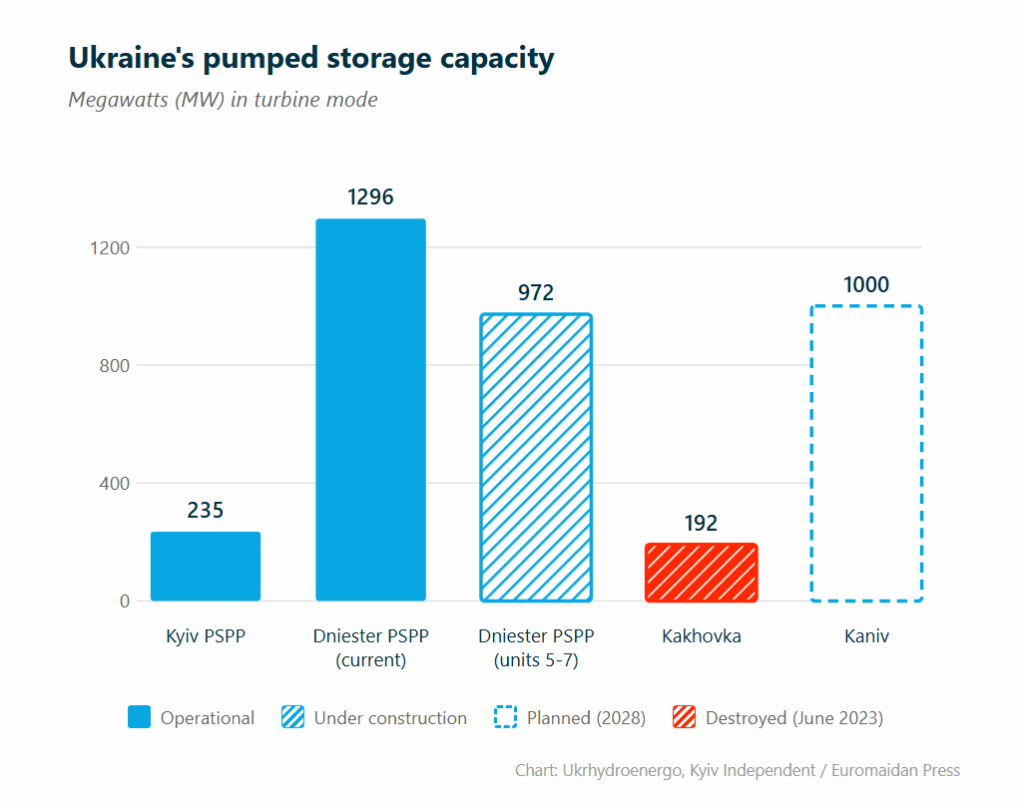
Ukraine currently operates two such facilities—the Kyiv PSPP (235 MW) and the Dniester PSPP (1,296 MW, eventually Europe’s largest at 2,268 MW when complete). Together, they provide the grid-balancing services that keep the lights steady.
But that’s not enough. And Kakhovka—which provided 192 MW of crucial regulating capacity—is gone.
The Kaniv gamble
Ukraine’s answer is Kaniv—a 1,000 MW pumped-storage plant that has been “under construction” for four decades.
The Kaniv Pumped Storage Power Station in Cherkasy Oblast has a troubled history. Construction began in 1986, was suspended in 1991 during Ukraine’s economic collapse, and was formally approved again by Ukraine’s Cabinet of Ministers in 2007.
The project called for four hydropower units with 1,000 MW capacity in turbine mode and 1,120 MW in pump mode, at an estimated cost of nearly 5 billion hryvnias (approximately $1 billion at 2007 exchange rates)—though environmental groups argued the actual cost would be considerably higher.'
“It should be inaccessible to the enemy. Therefore, there are plans to build it underground.”
Critics raised serious concerns. A CEE Bankwatch Network briefing questioned whether the project was worth the environmental and social costs, citing potential impacts on local villages, groundwater, and drinking water supplies, as well as concerns about radioactive sediment from Chornobyl still present in the Kaniv reservoir.
Now, Ukraine is reviving Kaniv with a radical modification: building it underground.
“We are making changes to the Kaniv Pumped Storage Hydropower Plant construction project,” Syrota said in July 2024. “It should be inaccessible to the enemy. Therefore, there are plans to build it underground.”
According to Ukrhydroenergo, the updated timeline targets the launch of the first 250 MW unit in 2028. The project has attracted international interest: Türkiye’s DOLSAR and ÖZALTIN Holding signed memoranda in October 2023, while Canada’s Aecon Construction and Hydro-Québec have also formalized partnerships.
International backing—but is it enough?
The January 2026 EBRD loan is just the latest infusion. It builds on a €200 million ($236 million) package signed with the EBRD and Italian government in February 2024, of which the first €50 million ($59 million) tranche arrived in March 2025.
The European Investment Bank has discussed providing an additional €120 million ($141.5 million) to restore the Kaniv, Kremenchuk, and Dnipro hydropower plants.
Hundreds of millions of euros are flowing toward Ukrainian hydropower.
All told, hundreds of millions of euros are flowing toward Ukrainian hydropower. Ukraine is betting that money on centralized infrastructure. Russia keeps proving it can hit anything it wants.
Trending Now
The decentralization dilemma
Wind farms are hard to destroy—hit one turbine and hundreds remain operational. Solar panels spread across rooftops present no single target worth a cruise missile. The logic of distributed generation is compelling, and Ukraine has 4 GW of wind projects ready to build.

Wind farms are harder to destroy—so why won’t Ukraine let them scale? (INFOGRAPHICS)
The IEA’s 2024 roadmap “Empowering Ukraine Through a Decentralised Electricity System” makes the same argument for distributed energy resources—rooftop solar, batteries, small gas turbines—precisely because they’re harder to destroy en masse.
“Large energy assets are more vulnerable to attack, so decentralisation brings clear security benefits,” the IEA wrote.
How much centralization can you afford when your adversary can strike at will?
The logic applies beyond Ukraine. Any country building critical infrastructure against hostile actors—NATO members hardening their grids, Taiwan preparing for blockade, European states diversifying away from Russian gas—faces the same question: how much centralization can you afford when your adversary can strike at will?
The problem is physics. Distributed generation produces power. It doesn’t store it. Solar panels flood the grid at noon and go dark by evening. Wind turbines spin when the wind blows, not when demand peaks. Someone has to balance supply and demand, second by second, or the grid collapses.
Pumped storage remains the only large-scale option Ukraine can actually build in time.
Pumped storage does that. Batteries can too—but Ukraine’s largest battery project, DTEK’s 400 MWh system that went live in September 2025, is a fraction of what’s needed. The IEA says Ukraine needs 5.6 GWh of battery storage by 2030. Pumped storage remains the only large-scale option Ukraine can actually build in time.
According to Ukraine’s National Energy and Climate Plan, approved in June 2024, the country aims for 27% renewable energy in final consumption by 2030. That requires massive new wind and solar capacity, which requires storage to balance.
The small hydro controversy
Not all hydropower expansion is welcome. Environmental groups have fought for years against plans to build hundreds of small hydropower plants on Carpathian mountain rivers, arguing they would devastate ecosystems while contributing negligibly to the grid.
Small hydro offers marginal gains at high environmental cost.
The Teresva River controversy illustrates the conflict: the river is part of Europe’s Emerald Network and protected under the Bern Convention. Ukraine’s Ministry of Environment has acknowledged that small hydropower plants on the Teresva “could have major detrimental impact on its natural state.” Yet developers continue pushing projects on the Cheremosh, Prut, and Stryi rivers—and local communities keep fighting back.
As WWF noted: “These HPPs will produce relatively little energy, while at the same time threatening Europe’s last great wilderness area.”
Small hydro offers marginal gains at high environmental cost. Pumped storage offers substantial gains—if it survives.
The verdict: Necessary—but the math doesn’t add up yet
Wind energy is a viable slow fix that depends on policy. Pumped storage is different: it’s not optional. Without large-scale storage, Ukraine cannot run a grid with 27% renewables. Distributed solar and batteries can keep households lit during blackouts. They cannot balance a national grid.
The math: Ukraine’s two operational pumped-storage plants provide around 1,500 MW of capacity. Kaniv would add another 1,000 MW—but not until 2028 at the earliest. Kakhovka cannot be rebuilt until the territory is liberated, and even then, Syrota estimates 6-7 years to restore the dam and refill the reservoir.
Ukrhydroenergo is betting it can build that infrastructure underground, out of Russia’s reach.
For now, Ukrainians huddle in metro stations while missiles streak overhead. The power system they’re trying to build—one balanced between nuclear baseload, renewable generation, and pumped-storage flexibility—requires infrastructure that takes years to construct and billions to finance.
Ukrhydroenergo is betting it can build that infrastructure underground, out of Russia’s reach. The alternative—remaining dependent on gas-fired backup and European imports—means Ukraine’s energy security stays hostage to pipelines, politics, and neighbors’ goodwill.
Wind energy is a policy question. Pumped storage is a physics question. Ukraine needs both answers—and time is running out to find them.


