


Russia has lost an estimated 1,200,000 casualties since February 2022. It is struggling for meters against a country with a fraction of NATO's GDP. Its best tanks are burning in Ukrainian fields. Western analysts have predicted Russian exhaustion, collapse, or strategic defeat for three years running.
Yet European intelligence agencies are warning that Moscow could strike NATO within 2-5 years.
According to Bruno Kahl, former head of Germany's Federal Intelligence Service, Russia may launch an attack on NATO territory in the coming years—capable of "attacking the West" by the end of the decade.
European Commissioner for Defense Andrius Kubilius predicts a possible Russian attack on EU countries as early as 2030. Denmark's Defense Intelligence Service assessed that Russia could launch a regional war against NATO Baltic states within two years of the Ukraine war ending—a large-scale European war without US involvement within five years.
How can both be true? How can Russia be bleeding out in Ukraine and threatening NATO simultaneously?
Russia doesn't need to defeat NATO. It needs NATO to hesitate
The threshold for attacking a 32-nation nuclear alliance seems impossibly high. It isn't—if you believe the alliance will fracture under pressure.
Russia's goal wouldn't be conquest. It would be demonstration. German intelligence believes it will be a limited operation rather than a large-scale attack—perhaps an invasion of Norway's Svalbard archipelago or the Baltic countries. The aim: prove that collective defense under NATO Article 5 is ineffective, thereby undermining the Alliance itself.
According to German assessments, the Kremlin doubts that political will exists to provide assistance under Article 5.
Moscow doesn't need to win a war against NATO. It needs NATO to lose its nerve—to hesitate, to debate, to fracture. Article 5's language provides the wiggle room: "such action as it deems necessary" doesn't mandate military response.
Russia is betting that Western capitals will find reasons not to fight.
An attack on NATO aligns with Russia's strategic ambitions: strategic parity with the US and China, recognition of Great Power status, and hegemony over the post-Soviet space. Russia has defined the West as its enemy and formalized demands for NATO to withdraw to its 1997 borders and for the US to leave the continent.
The question isn't whether Russia has the capability to defeat NATO in a prolonged war. It doesn't.
The question is whether Russia believes NATO will fight at all. And Moscow has spent twelve years gathering intelligence on exactly that question.

What Russia learned
Every Western delay wasn't just policy debate. It was data.
Ukraine requested Western tanks at the emergency NATO summit in March 2022. The first Abrams arrived eighteen months later—after months of agonized debate about whether providing tanks would be "escalatory." Ukraine requested ATACMS in September 2022. They arrived in October 2023, thirteen months later, with restrictions that weren't fully lifted until late 2024. F-16s were requested in March 2022. They arrived in 2024, after months of internal Western debate about whether fighter jets crossed some invisible line.
The Alliance that won't fight for Ukraine probably won't fight for Estonia either.
Each delay taught Moscow something. Not about Western capabilities—those are well documented. About Western will. About where political resolve fractures. About which leaders fold under nuclear rhetoric and which hold firm. About how many months of debate each weapon system triggers.
As the Peace Research Institute Oslo observed: "These debates have become the key means of escalation management by the Alliance, not least by eliminating the element of surprise and giving Russia plenty of time for preparing counter-measures against new Ukrainian capabilities."
The pattern was consistent. Moscow threatens. The West debates. Moscow watches who hesitates. The weapon eventually arrives—but months late, in limited quantities, with restrictions.
Each cycle confirms the same lesson: the Alliance that won't fight for Ukraine probably won't fight for Estonia either.
NATO's Strategic Concept 2022 became a commitment to do less. The Alliance decided to provide Ukraine with non-military support only, leaving it to individual member countries to support Ukraine—or not. The Alliance stepped back from its commitment in the 2010 Strategic Concept to end conflicts that threatens its security by a both political and military means. For twelve years, NATO and its member states have kept all military options off the table, pursuing diplomatic solutions where there are none.
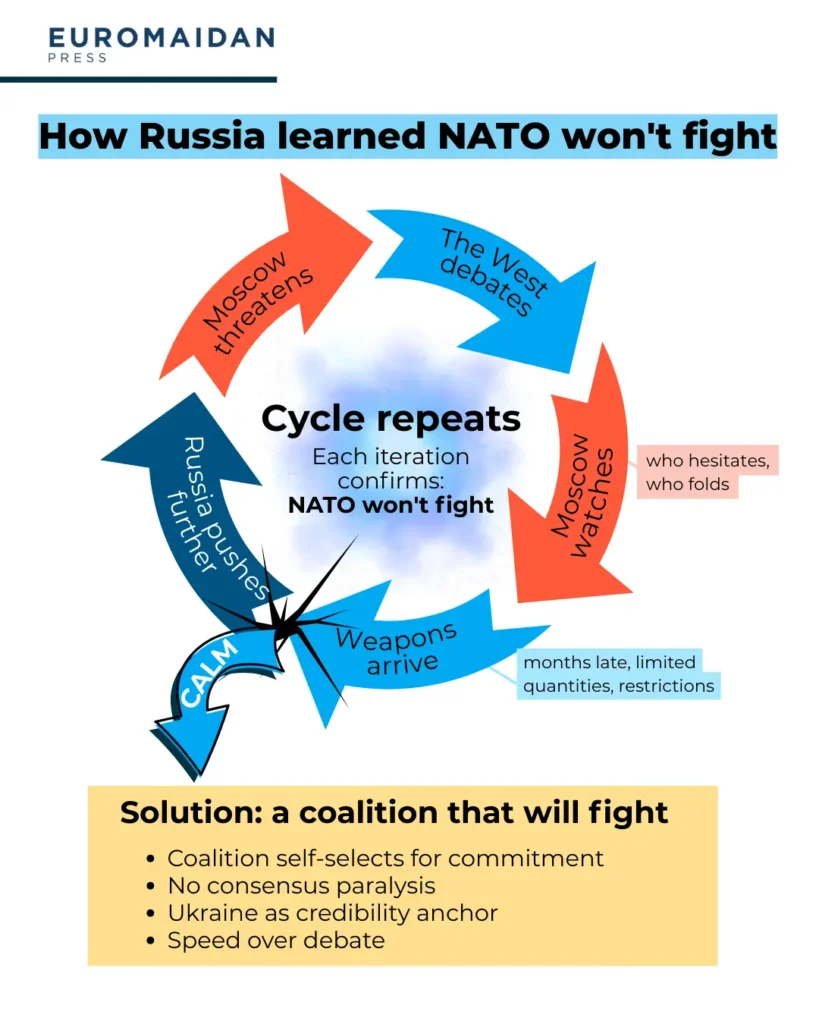
If NATO truly deterred Russia, Moscow would have never launched a full-scale war in Ukraine. Nor would it be waging a hybrid war or preparing for war with the European NATO member states.
Russia is already testing its conclusions
Russia's behavior demonstrates it no longer views NATO as a credible military alliance.
The Kremlin wages an escalating hybrid war against NATO and EU member states: sabotage operations targeting critical infrastructure, cyberattacks on government systems, disinformation campaigns designed to fracture political consensus, election interference across multiple countries, GPS jamming affecting civilian aviation, repeated airspace violations, and increasingly brazen acts of violence against Western infrastructure.
These actions would be inconceivable if Russia genuinely feared NATO retaliation. Their continuation—and escalation—and lack of NATO response proves Moscow's assessment.
Each unanswered attack validates the hypothesis. Each one teaches Russia it can push further.
According to Denmark's Defense Intelligence Service, Russia "will likely be more willing to use military force in a regional war against one or more European NATO countries if Russia perceives NATO as militarily weakened or politically divided."
Present-day NATO represents precisely this situation. Its perception of NATO as weak has been further strengthened by the transatlantic chasm and fundamental discord within the alliance. The US has shifted from ally to strategic adversary.
Why NATO can't solve this
The problem isn't capability. It's credibility.
NATO does possess weapons systems technologically superior to most of what Russia fields. But technology without demonstrated will is a hollow advantage.
In Brussels, NATO planners see an alliance with technological superiority and nuclear deterrence. In Moscow, Russian strategists see something different: hollowed-out European militaries, political divisions that paralyze collective action, and ammunition stockpiles measured in weeks.
The Kiel Institute estimates Europe needs 300,000 additional soldiers, 1,400 main battle tanks, and 2,000 infantry fighting vehicles to counter a Russian conventional attack without US participation. Europe also lacks key military enablers the US currently provides: battlefield command and control, satellite intelligence, strategic airlift, and long-range strike.

Germany's Bundeswehr is at ~50% readiness. In October 2022, it was assessed that Germany had ammunition for only 1-2 days of combat. Britain assessed in mid-2023 that continuing stockpile donations would impose "unacceptable risks" on UK readiness. France can deploy only 30,000 troops for expeditionary operations, with half its equipment non-operational.
Meanwhile, Russia is outproducing Europe.
According to NATO Secretary General Mark Rutte, Russia is "now producing three times as much ammunition in three months as the whole of NATO is doing in a year."
Calculated in purchasing power parity terms, Russia's military expenditure exceeds all European countries combined.
Russia is producing three times as much ammunition in three months as NATO is doing in a year.
NATO Secretary General Mark Rutte
In 2025, member states had a collective backlog of 442 years: each year signifying one year one member state did not meet its 2% pledge. Worse, 2% is only 57% of what Europe spent on average during the 1980s. During the Cold War, European members invested an average of 3.5% of GDP to maintain credible military power.
In November 2025, the French Institute of International Relations (IFRI) assessed that "the land domain remains Europe's weak point. Even though Europe maintains a qualitative advantage in training, command, and combined arms tactics, Russia has a decisive advantage in terms of mass, firepower, mobilization capacity, and tolerance for attrition."
As Poland's Prime Minister Donald Tusk observed, "500 million Europeans are asking 300 million Americans to defend them against 140 million Russians."
But the numbers aren't the fundamental problem. The fundamental problem is that deterrence is not decided in Washington, Brussels, Berlin, Paris, or London. It is decided in the Kremlin.
And the Kremlin has concluded—based on twelve years of evidence—that NATO will not fight.

A coalition could change that calculation
Most analysts believe Europe cannot reliably defend itself against Russia without significant US support. These arguments rest on a narrow interpretation of "Europe" as either the present-day EU or NATO's current member states.
But Europe will be capable of both deterring and defeating Russia if it takes a different form: unity instead of numbers, demonstrated commitment instead of political declarations, strategic determination instead of strategic dependency.
A Coalition of Like-Minded European Countries (CALM) inverts NATO's structural problem:
- Self-selection for commitment. NATO includes Hungary and Slovakia—nations openly aligned with Moscow. It includes nations that have consistently blocked or delayed support for Ukraine. A coalition that requires demonstrated commitment as the entry price has no weakest links.
- Speed over consensus. Thirty-two nations requiring consensus means months of debate on every decision. A more efficient decision-making process based on a three-quarters majority would enable rapid decision-making—and no telegraphing to Moscow months in advance.
- Credibility through action. NATO's credibility problem is structural: it has repeatedly demonstrated it won't act. A coalition defined by willingness to fight starts with credibility NATO cannot match. Its credibility would be established by including Ukraine and its most important European partners, its commitment to protect all member states despite one of them fighting for its right to exist, its collective diplomatic, economic and military strength, and not least, the unity of efforts through a meticulous selection process.
Ukraine must be a founding member
Not as a reward. As proof.
If Ukraine—supported by Europe—can stop and destroy Russian Armed Forces, then a coalition with Ukraine as a founding nation would be more than capable of deterring and defeating Russia.
Ukraine has demonstrated four years of will to fight against a nuclear power. That's not symbolism—it's the credibility anchor. A coalition with Ukraine at its core signals something NATO cannot: we have already proven we will fight Russia.
The country that bleeds daily for its survival brings more deterrent value than ten nations that haven't fired a shot. Ukraine's combat-hardened forces, its proven will, its twelve years of experience fighting Russian aggression—these are strategic assets no other nation can offer.
Strength is found in unity of effort, not number of member states.
The choice
Russia sees NATO as it actually is—not as the Alliance hopes to be seen. Militarily weak. Politically fragmented. Psychologically unprepared. Dependent on an increasingly uncertain American security commitment.
The choice is not between NATO and nothing. It is between an alliance that has spent twelve years teaching Russia it won't fight—and a coalition that proves it will.
The timeline is measured in months and years, not decades.
Editor's note. The opinions expressed in our Opinion section belong to their authors. Euromaidan Press' editorial team may or may not share them.
Submit an opinion to Euromaidan Press


