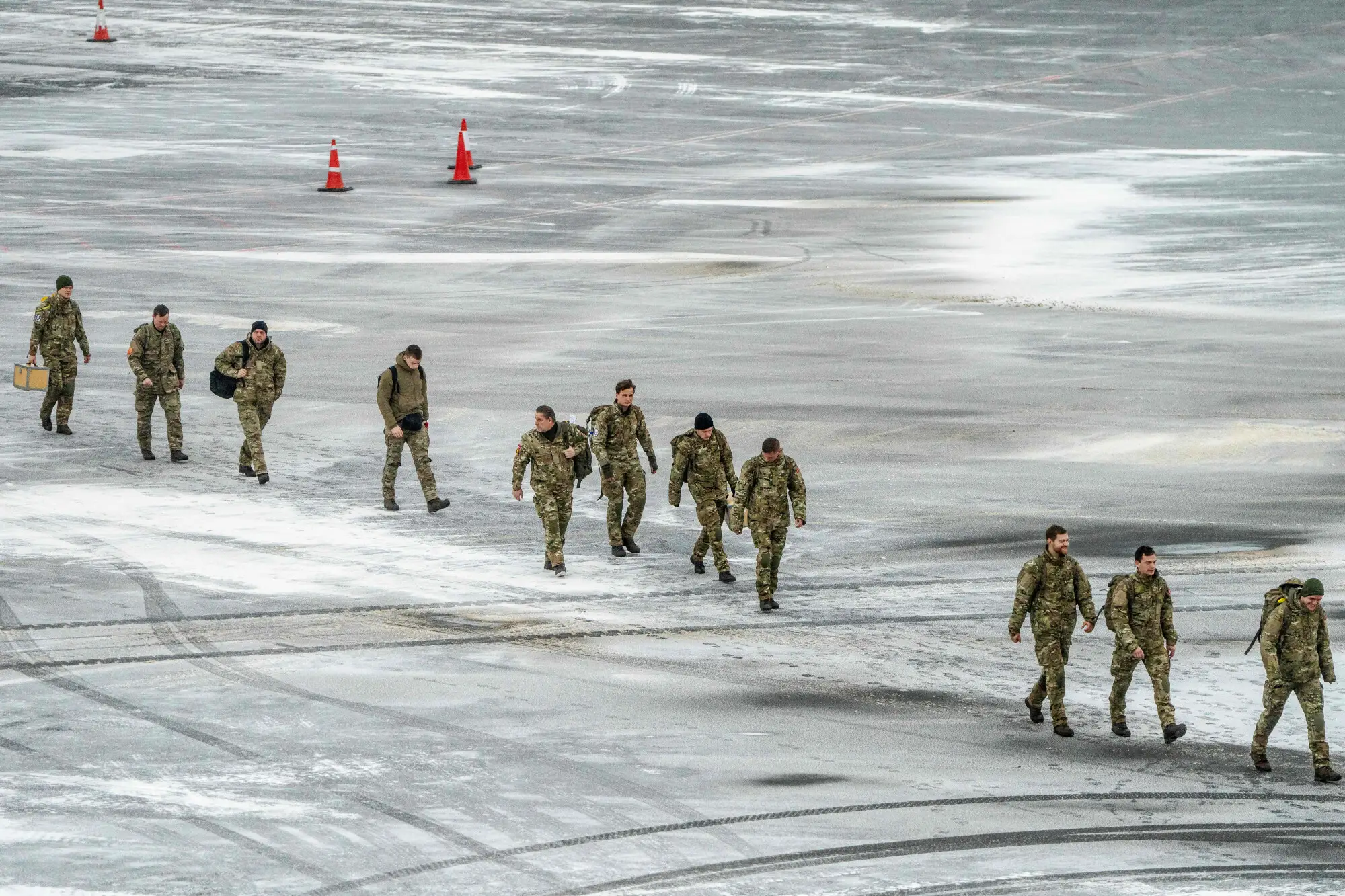
For the first time since NATO's founding, European allies are sending soldiers to Greenland in response to threats from Washington—not Moscow.
Denmark is surging troops to its Arctic territory. A handful of allies have sent small contingents or reconnaissance teams. The combined force is symbolic—but the precedent is not.
On Saturday, as thousands of Greenlanders marched through Nuuk chanting "Greenland is not for sale," President Trump announced 10% tariffs on eight NATO allies. The tariffs take effect 1 February and rise to 25% on 1 June—remaining in place, Trump wrote, "until such time as a Deal is reached for the Complete and Total purchase of Greenland."
The eight countries targeted—Denmark, Norway, Sweden, France, Germany, the United Kingdom, the Netherlands, and Finland—had just sent personnel to Greenland for Danish-led exercises called Operation Arctic Endurance.
Germany's reconnaissance team has already gone home—after just 44 hours.
Trump's Nobel letter threat
On Sunday, Trump sent a message to Norwegian Prime Minister Jonas Gahr Støre. The Norwegian government shared its contents.
"Dear Jonas: Considering your Country decided not to give me the Nobel Peace Prize for having stopped 8 Wars PLUS, I no longer feel an obligation to think purely of Peace," Trump wrote. "Although it will always be predominant, but can now think about what is good and proper for the United States of America."
The message continued: "Denmark cannot protect that land from Russia or China, and why do they have a 'right of ownership' anyway? There are no written documents, it's only that a boat landed there hundreds of years ago, but we had boats landing there, also."
Trump concluded: "The World is not secure unless we have Complete and Total Control of Greenland."
Støre noted that Norway's government does not award the Nobel Peace Prize. The prize is awarded by a five-member committee appointed by the Norwegian parliament. The most recent prize went to Venezuelan opposition leader María Corina Machado—for 2024, before Trump's second term began.
Asked by NBC News on Monday whether he would use force to seize Greenland, Trump replied: "No comment."
44 hours in Nuuk
The German reconnaissance team arrived Friday to assess conditions for future NATO exercises. By Saturday afternoon, Rear Admiral Stefan Pauli told reporters that talks with Danish forces were going well and Berlin was being briefed on possibilities for future cooperation.
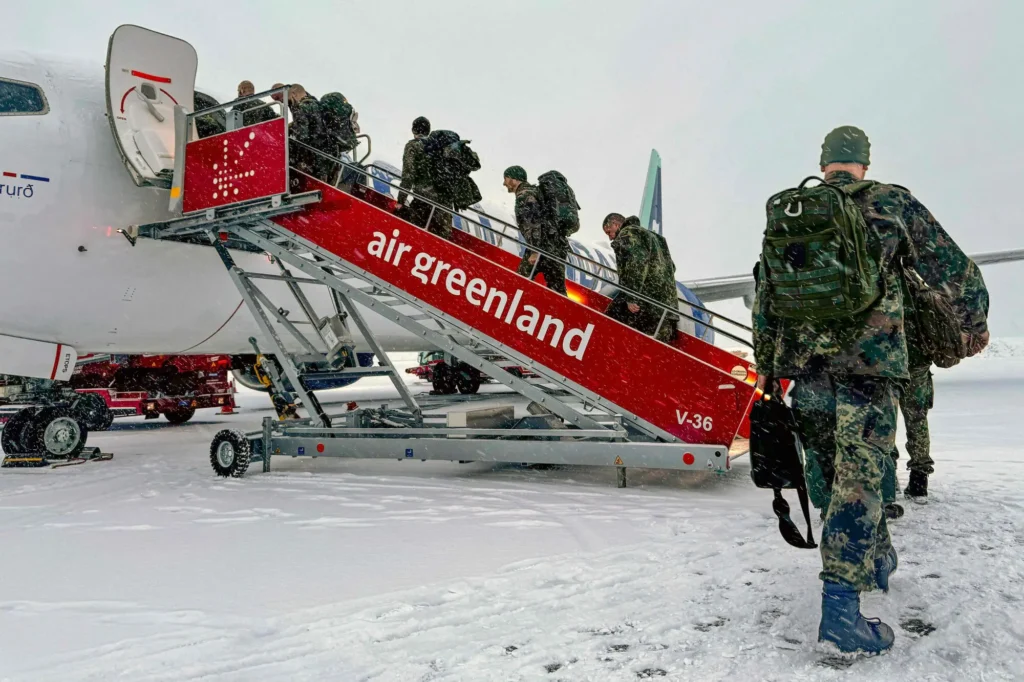
By Sunday morning, the 15 soldiers were at the airport with all their gear. Berlin had ordered them home. All planned meetings—including a visit to the Danish base at Kangilinnguit—were canceled. No explanation was given. They departed on a commercial Icelandair flight, according to Bild, which reported that the team had been expected to extend their original two-day stay.
The defense ministry later said the reconnaissance was "completed as ordered." Lieutenant Colonel Peter Milevchuk told reporters at Nuuk airport: "We have fulfilled our initial task—to study the situation as part of the initiative to conduct exercises and training."
The abrupt departure came hours after Trump announced tariffs on countries participating in the Greenland exercises.

Greenlanders in tears, Ukrainians die, Kremlin in joy: Sowing discord in West is Putin’s core idea
Denmark surges, allies send signals
France sent 15 mountain infantry specialists from the 27th Mountain Infantry Brigade. As of Saturday, French forces were operating in Kangerlussuaq. President Macron said the deployment would be "reinforced in the coming days with land, air, and maritime assets."
The rest of the European contingent consists largely of liaison and reconnaissance officers: three Swedish officers, two Norwegian personnel, two Finnish liaison officers, two Slovenian officers, one or two Dutch naval officers, one British officer, and one Belgian officer.
Italy refused Denmark's invitation. Defense Minister Guido Crosetto called the troop numbers "the beginning of a joke."
Denmark, however, has ramped up significantly.
By 17 January, Major General Søren Andersen said at least 200 troops had arrived—100 in Nuuk and 100 in Kangerlussuaq. On Monday, 58 more landed with the Royal Danish Army's chief, General Peter Boysen.
The military math is not serious. A few hundred soldiers cannot repel an amphibious brigade. The value lies elsewhere: proving Denmark is not alone, and forcing any American action to shove NATO allies physically out of the way.
"No one is thinking that any of the troops here could stop a US invasion if that happened," Al Jazeera's Rory Challands reported from Nuuk. "But it would make it more complicated, because these are now NATO allies who are coming here with their military personnel."
Trump justified the Greenland push by citing Russian and Chinese threats to the island. Danish Foreign Minister Lars Løkke Rasmussen told Fox News that according to Danish intelligence, no Chinese warship has been spotted near Greenland in a decade. Major General Andersen confirmed he has not seen any Russian or Chinese combat vessels in his two and a half years as Arctic commander.
European troops in Greenland

| Country | Personnel | Type | Status | Notes |
|---|---|---|---|---|
| Denmark | ~350+ | Combat troops | Active | 200 by 17 Jan; 58 more on 20 Jan with Army chief (Al Jazeera) |
| France | ~15 | Mountain infantry | Active | 27th Mountain Infantry Brigade; in Kangerlussuaq (France24) |
| Germany | 15 | Reconnaissance | Returned | Assessment mission; departed 18 Jan after 44 hours (Bloomberg) |
| Sweden | 3 | Liaison officers | Active | Sent at Denmark's request (France24) |
| Norway | 2 | Defense personnel | Active | (CNN) |
| Finland | 2 | Liaison officers | Active | (CNN) |
| Netherlands | 1-2 | Naval officer(s) | Active | (CNN) |
| United Kingdom | 1 | Officer | Active | (France24) |
| Belgium | 1 | Officer | Active | (Belga) |
| Slovenia | 2 | Officers | Active | (Slovenian govt) |
| Estonia | 5-10 | — | Offered | Ready if requested (ERR) |
| Italy | 0 | — | Declined | Crosetto: "the beginning of a joke" (Euro Weekly) |
| Poland | 0 | — | Declined | Tusk: no troops (Notes from Poland) |
| United States | ~150 | Existing garrison | Existing | Pituffik Space Base; invited to join exercise (CNN) |
Why tariffs became the weapon
The tariffs target the countries that sent personnel to Greenland. Trump framed their deployment as "a very dangerous situation for the Safety, Security, and Survival of our Planet."
Danish Foreign Minister Lars Løkke Rasmussen said the tariffs came "as a surprise" following what he called a "constructive meeting" with Vice President JD Vance and Secretary of State Marco Rubio just days earlier.
The eight targeted countries issued a joint statement warning the tariffs "undermine transatlantic relations and risk a dangerous downward spiral." Danish Prime Minister Mette Frederiksen was blunt: "Europe will not be blackmailed."
Trending Now
France signaled it would request the EU activate its "anti-coercion instrument"—the bloc's retaliatory trade mechanism, colloquially called the "trade bazooka"—for the first time ever. A European Commission source confirmed a package targeting €93 billion worth of US trade is on the table.
European Council President António Costa called an extraordinary summit of all 27 EU leaders for Thursday evening.

Pick US? Lose intelligence. Pick EU? Lose Patriots. Ukraine trapped by Greenland dispute, as Russia’s killings continue every day
The Ukraine shadow
Europe now faces an impossible bind. The same states defending Ukraine's territorial integrity must now defend Denmark's—while remaining dependent on Washington for weapons and intelligence.
Spain's PM Pedro Sánchez was blunter than most. A US invasion of Greenland would make Putin "the happiest man in the world," he told La Vanguardia, "because it would legitimize his attempted invasion of Ukraine."
"If the United States were to use force, it would be the death knell for NATO. Putin would be doubly happy," Sánchez said.
The tension was visible in Paris earlier this month, where 35 countries discussed security guarantees for post-war Ukraine. US special envoys Steve Witkoff and Jared Kushner attended. The gathering yielded a communiqué outlining five security guarantees—including a multinational force on Ukrainian soil led by France and the UK, and a legally binding obligation to assist Kyiv if Russia attacks again.
"President Trump's mandate is that he wants peace in Ukraine," Witkoff said.
Days later, Trump announced he no longer felt obligated to think purely of peace.
5,000 in Nuuk, thousands more across Denmark
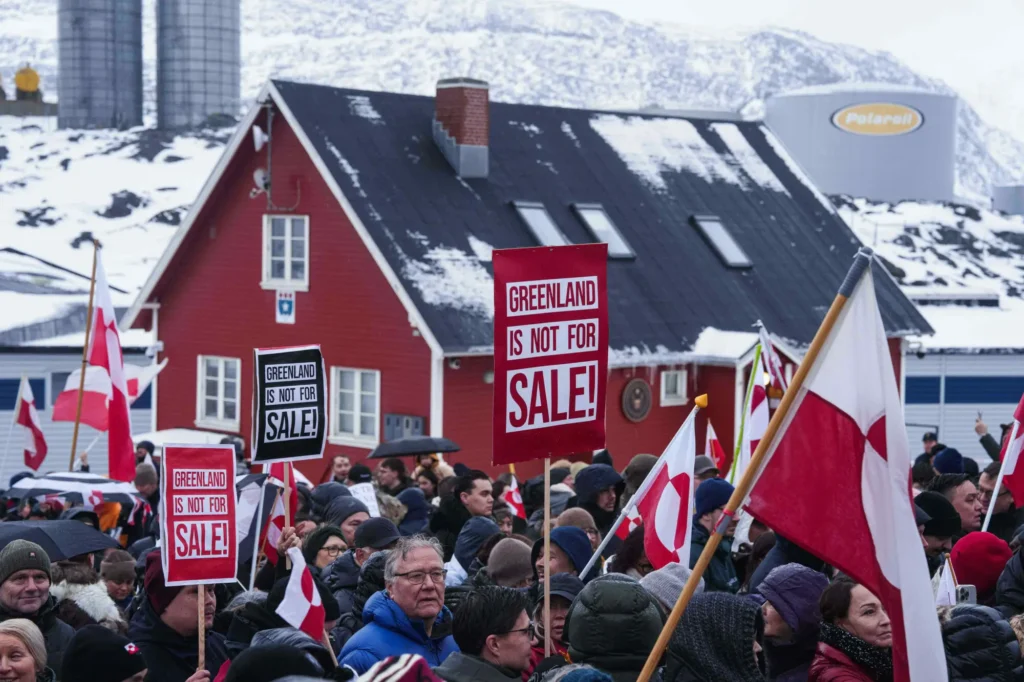
People protest against Trump's policy towards Greenland in front of US consulate in Nuuk, Greenland, Saturday, 17 January 2026. (AP Photo/Evgeniy Maloletka/Eastnews)
An estimated 5,000 people—roughly a quarter of Nuuk's population—marched to the US consulate on Saturday, making it the largest protest in Greenland's history. In Copenhagen, estimates ranged from 15,000 to 20,000. Protests spread to Aarhus, Aalborg, and Odense.
Marie Pedersen, a 47-year-old Greenlander, told PBS she brought her children to the rally "to show them that they're allowed to speak up."
"We want to keep our own country and our own culture, and our family safe," she said.
Her nine-year-old daughter, Alaska, made her own sign: "Greenland is not for sale." The girl said her teachers have been explaining NATO at school.
According to a poll from January 2025, 85% of Greenlanders oppose joining the United States. Six percent were in favor.

“US security guarantees became awkward”: Greenland dispute is eroding international law’s deterrent function for Ukraine
Moscow watches
Russia, for its part, is watching. Kremlin spokesman Dmitry Peskov called the situation "unusual, I would even say extraordinary from the standpoint of international law."
Foreign Ministry spokeswoman Maria Zakharova suggested the EU should react to US actions over Greenland as it did to Russia's 2014 annexation of Crimea. "Let them look at what they said about Crimea," she said.
Pro-Kremlin analyst Sergei Markov called it "strikingly fair" that Denmark might lose Greenland after years of warning about a Russian threat. "Now Trump wants to take Greenland from Denmark, citing the need to protect it from a Russian threat," Markov said. "Isn't that just fair?"
What comes next
Trump agreed Tuesday to meet parties in Davos, where the World Economic Forum convenes this week. NATO Secretary-General Mark Rutte confirmed he had spoken with Trump about Greenland and discussed a potential "Arctic Sentry" NATO mission.
Denmark's government will not attend Davos.
The EU emergency summit convenes Thursday evening in Brussels. Hungary, Slovakia, and the Czech Republic—whose leaders have cultivated ties with Trump—have not yet stated positions. Their votes will be needed for any collective response.
Germany's hasty departure from Greenland may signal which way the wind is blowing in Berlin. Or it may not—the defense ministry isn't saying why the reconnaissance team left early, only that its mission was "completed."
The tariffs take effect on 1 February. Whether this is negotiating posture or genuine intent, European leaders must now plan as though it is real.
Correction: a previous version of this article said that German troops "pulled out"; in fact, they completed reconnaissance early.