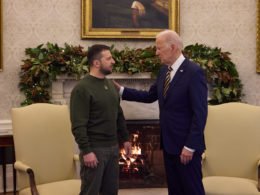


Europe, Ukraine — you are on your own.
This is the gist of Washington’s recent signals, in both words and actions. If the year 2025 was the setup, the White House’s remarks following the Venezuela operation are the exclamation mark.
Shortly after capturing Venezuelan President Nicolas Maduro, US President Donald Trump reaffirmed his country’s view of the world in terms of spheres of influence that belong to greater powers. In his mind, Europe doesn’t rate as one. Russia does.
While any words from Trump’s mouth must be generously salted on the best of days, his administration spelled out the same line of thinking in the US’s latest national security strategy in December.
In effect, the White House has turned away from ideological alliances and international law, towards transactional relations and regional dominance. This approach recalls the logic Athens used to justify crushing Melos 2,400 years ago, according to the ancient historian Thucydides: the strong do as they will, the weak suffer as they must.
For Europeans, this means having to stand closer together than they had in decades — to resist Russia’s conventional and hybrid aggression — but also political pressure from Washington. This will require the kind of political will that’s only partly in place today.
For Ukraine, this means more hard days ahead, as Russia may try to exploit the opportunity. The year 2026 will test many things, including:
- Ukraine’s ability to keep the invasion at a standstill, while degrading Russia’s economy with long-range attacks;
- European allies’ resolve to defend democracy in the region and their understanding of Ukraine's vital role in this mission;
- And whether American democracy can endure the growing authoritarianism at the top levels of government, so the broad public support of Ukraine can shine through.
Trump’s bluster or ambition?
Encouraged by the successful operation to capture Maduro, Trump and his staff have said that they’re eyeing other targets. These include Colombia, ostensibly for its role in drug trafficking; tightening US control over the Panama Canal; Cuba; Mexico; and Greenland, an autonomous territory of Denmark.
A source close to the administration, who asked not to be named, told Euromaidan Press that while Colombia is not as far-fetched as the other options, an invasion of Mexico or Greenland are firmly in the realm of absurdity.
The source said that while the administration likes to play to its domestic base while disregarding foreign leaders, military operations require cooperation from the military chain of command, which is not as impulsive as the commander-in-chief.

They added that Trump is likely to listen to Joint Chiefs of Staff Chairman John Caine and US Supreme Allied Commander Europe Alexus Grynkewich, who are likely to push back against the wildest ideas.
However, defense scholar Marc DeVore said that Trump's other foreign policy actions also seemed absurd — before they actually happened.
He gave three reasons why the Trump administration might choose to sacrifice its long-term alliances to achieve political goals.
One is "the typical problem that imperialist powers face, which is victory disease," he told Euromaidan Press. Success in Venezuela may go to the administration’s heads. "Once you've succeeded in one intervention, that emboldens you to do others."
Another reason is that the Trump administration may "rhetorically trap itself." If Greenland is brought up enough times, the White House might feel that it doesn't have an option to simply walk away without getting anything. The rhetoric has been in full effect, from tweeting the American flag over a map of Greenland, to Donald Trump Jr. showing up in Nuuk.
Finally, Trump, like many authoritarians, may find that diversionary war is politically advantageous at home, especially if the Republican Party faces headwinds in 2026.
“I could quite easily imagine Trump, say immediately before Congressional elections next October, coming to the same realization — that his economic policies have largely failed; his popularity is quite poor,” DeVore said. “By engaging in some form of military land grab, that can divide the Democrats, make him look strong, and create a rally-around-the-flag effect.”
A land grab like this would strongly resemble the way Putin's Russia operates. The Kremlin chooses to engage in nonstop aggressive expansion in part due to fears that if it stops, the state may start to implode.
Relationship already spoiled
Whether the Trump administration follows through on these threats, signs point to Washington being serious about its focus on regional hegemony, while leaving Europe and Ukraine to their own devices, experts and insiders said.
“He implies that he has, in effect, ceded Europe to Russia,” Ben Hodges, a retired US general, who commanded American forces in Europe, told Euromaidan Press.
Trump's new national security strategy explicitly narrows America’s purpose from the post-Cold War liberal order the US has created, and towards "core national interests." These are to be achieved through coercive leverage, bilateralism, and Trump's beloved art of the deal.
The US’s military command structure now emphasizes USNORTHCOM, which covers the American continent.
This is happening at the expense of USEUCOM, which covers Europe, and USCENTCOM, which covers the Middle East, Central Asia, and parts of South Asia. These two commands had in recent decades commanded a lion’s share of American military resources.
In fact, Trump’s attitude towards Europe and Ukraine goes beyond disinterest.
“One of the most shocking things in the strategy was the description of the biggest threat being the liberal democracies in Western Europe,” Hodges said. “It doesn’t even mention Russia as a threat, which is a bizarre change from decades of American foreign relations and security strategy.”
Right-wing foreign policy
This attitude seems to stem from the administration’s support for the far-right and hardline religious political agendas, which appeal to a significant proportion of Trump’s voter base.
Far from being domestic issues, Washington is interested in making these agendas a cornerstone of its foreign relations, as well.
Trending Now
In January 2025, US Vice President JD Vance attacked European countries over "free speech" concerns, claiming for example that Germany marginalizes its far-right party AfD, and blasting the UK for enforcing safe zones around its abortion clinics.
On Christmas eve, Washington sanctioned a former EU commissioner, and banned several EU and British citizens for their role in the EU's Digital Services Act, which provides a legal framework for digital accountability, platform transparency, and content moderation.

This trend is likely to continue — Trump officials are already known for prioritizing communication with right-wing and populist leaders.
"There will be a steady stream of such challenges in the weeks ahead, as the Trump administration seeks to consolidate gains and excite its base before the midterms," scholar Heather Hurlburt wrote for Chatham House.
“Washington’s focus on its view of free speech – and the associated opportunities for US tech firms – will only increase in the new year.”
The Trump team’s treatment of Kyiv and Moscow is also telling. Trump infamously asked President Volodymyr Zelenskyy to investigate Hunter Biden, the son of his political rival, in exchange for aid — and got impeached over it. Since then, Trump has nurtured hatred against the Ukrainian leader, according to the Washington source.
In contrast, Trump has repeatedly expressed his admiration for and willingness to work with Russian leader Vladimir Putin. Multiple Russian nationals were convicted in the US of interfering in the 2016 US presidential election, when Trump won his first term in office.
Putin’s own view on regional powers and spheres of influence closely matches that of Trump’s, and is the reason for Russia’s limited invasions of 2014 and full-scale invasion of 2022.
Practical upshots
The consequences are already materializing. Sanctions enforcement may loosen — officially or through quiet neglect — giving Russia's economy room to recover. Intelligence sharing, already cut in 2025, could thin further, directly degrading Ukraine's ability to intercept missiles and conduct operations.
Weapons are another pressure point. Washington still allows Europeans to buy arms for Kyiv, but DeVore warned the US could block deliveries that allies have already paid for. This has happened before: Pakistan bought American F-16s in 1989, but Washington refused to ship them.
Military attention is shifting physically, not just rhetorically. US naval vessels that patrolled the North Atlantic for Russian submarines were pulled to the Caribbean during the Venezuela buildup. Danish ships may soon spend more time watching Greenland than hunting Russian vessels in the Baltic.
If American focus stays fixed on the Western Hemisphere — or pivots to China — Russia may see an opening. A hybrid or conventional strike against a NATO member becomes thinkable, unless Russia remains tied down in Ukraine. That would force allies to decide whether to invoke Article 5, a choice no one wants to make.
And European governments may face an ugly trade-off: arm Ukraine or arm themselves. Hodges insists both are possible, but only with sufficient political will.
European unity
“This is one more sharp prod to push Europe to be more self-reliant on national security and less dependent on the US guarantee,” Peter Feaver, a US political scientist with Duke University, told Euromaidan Press.
“The narrower the US defines its own national interest, the more Europe must fend for itself.”
Everyone the Euromaidan Press has spoken to agrees with him. Indeed, multiple experts agreed that understanding is ever growing among European leaders that they can no longer rely on the US in a meaningful manner. Still, there is a difference between understanding and political will.
In some states, like Poland, the Baltics, and Scandinavia, the leadership and the populace are roughly in alignment about the threat Russia poses, and that the peace they had once enjoyed, is now fading in the rearview mirror.

In other states like Germany, France, and the UK, the leadership is aware of the threat, but the notion of sacrificing social welfare for defense spending is unpopular politically — enough to restrain greater action.
“And [then there’s] Southwestern Europe where both elites and the populace are out to lunch,” DeVore said.
For now, there is sufficient will to keep Ukraine afloat at least, as shown by the recent $90 billion loan to cover Ukraine’s pending budgetary shortfall in the coming years.
But Europeans may have to be more resolved and united, if they hope to stop Russia’s ambitions from going beyond Ukraine — especially when they can no longer rely on their wealthiest, most powerful ally.
“As soon as Europeans realize that helping Ukraine succeed is the best way to protect all of Europe, then they can shift into a higher gear production of what Ukraine needs,” Hodges said. This includes air defense, long-range strike weapons, and ground force capabilities.
He added: “Now is a time when our European friends can help the US. Hold us accountable. Don't roll over… Please stop flattering the president, treating him like royalty, or giving in.”