
For the past three years, Belarus has been hosting Russian soldiers who fought in Ukraine at its military sanatoriums, with veterans receiving massage chairs, salt rooms, electrophoresis, and other treatments—all funded by the Union State budget, according to an investigation by the Belarusian Investigative Center (BIC).
The revelation adds another dimension to Minsk's support for Moscow's war. While Belarus claims not to be directly involved in Russia's invasion, BIC's findings show the country has built post-combat rehabilitation infrastructure serving the very troops who fought against Ukraine—including a sniper who bragged about surviving the battle for Kreminna.
The sniper's testimony
Anton Kubasov, 41, told a BIC journalist posing as a Belarusian state media employee that he underwent rehabilitation at the Lepel Military Sanatorium from 20 November to 10 December 2024. He admitted serving as a sniper scout with the 488th Regiment of the 144th Guards Motorised Rifle Division, fighting in Kreminna, Luhansk Oblast—a town whose capture in April 2022 killed at least 200 civilians.
"I had a great time," Kubasov told BIC. "The food is awesome. I enjoyed all the entertainment events. Russian sanatoriums do not measure up."
He described himself as "one of the few who survived" the Kreminna fighting. Those who didn't survive on the other side—Ukrainian civilians shot while attempting to flee—remain uncounted.
A veteran who lost his leg, gained a medal
Staying at Lepel alongside Kubasov was 24-year-old Andrey Polzakhnovsky from Pskov, who lost a leg fighting in Ukraine. Unlike the sniper who complained of receiving no rewards, Polzakhnovsky received the Order of Courage and 3 million rubles ($32,000) in compensation.
The Russian Defenders of the Fatherland Foundation—headed by Anna Tsivileva, a deputy defense minister described by Russian outlet Verstka as a relative of Vladimir Putin—published photos of Polzakhnovsky inside the Belarusian facility.
Polzakhnovsky volunteered for the war in October 2022 to earn money. He told journalists he doesn't regret his decision and would have returned to fight were it not for his mother's protests.
Institutional support hidden in plain sight
When BIC contacted the Lepel Military Recreation Center's marketing department posing as Russian state journalists, staff confirmed the program's existence.
"This category of citizens from the Russian Federation undergoes rehabilitation and treatment at our facility every year," a staff member said.
The veterans pay nothing. Their treatment is funded through the Union State budget—the supranational entity binding Russia and Belarus—with $312,000 allocated in 2024 for 389 vouchers, with 180 designated for Belarusian resorts. The legal framework: a 2011 resolution updated in 2022 to expand coverage to "veterans of military operations, including those in another country."
Three Belarusian sanatoriums participate: Lepel Military Sanatorium, Chabarok, and Sasnovy Bor.
Expansion on the horizon
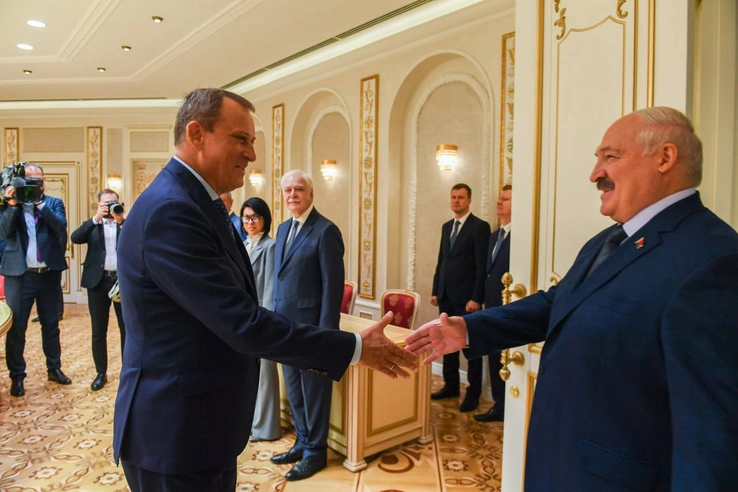
The program may soon grow significantly. The Governor of Russia's Leningrad region, Aleksandr Drozdenko, visited Belarus in September to discuss rehabilitation assistance for war veterans. His wife, Irina Drozdenko, toured recreation facilities in the Minsk region.
The result: an agreement to establish a rehabilitation program that would send at least 800 Russian veterans and their families to Belarusian resorts annually. Belarus's First Deputy Prime Minister Mikalai Snapkou approved the initiative.
Lukashenka himself expressed willingness to help when Drozdenko raised the issue personally last year—though he neglected to mention Belarus was already hosting veterans of the Ukraine war.
Belarusian state media has been silent about these developments.