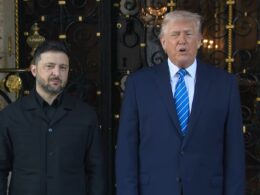


Following a landmark meeting at Mar-a-Lago on 28 December 2025, President Volodymyr Zelenskyy revealed that a 20-point peace framework with the United States is 90% complete—with only the territory question remaining unresolved.
But here's the catch: 87% of Ukrainians want peace, while 85% refuse to withdraw from eastern Ukraine. Any deal Zelenskyy signs must survive a national referendum, and those numbers suggest the hardest part isn't negotiating with Trump or Putin—it's squaring an impossible circle at home.
The 90% solution
In a Fox News interview with Bret Baier, Zelenskyy described the Mar-a-Lago talks as "very productive," crediting intensive work between Ukrainian and American teams over the past month.
Zelenskyy told Baier that 90% of the 20-point plan has been agreed upon. "There are questions with only two points. That's why I said 90%."
The sticking point? Territory. Specifically, the four oblasts Russia claims to have annexed: Donetsk, Luhansk, Zaporizhzhia, and Kherson.
Zelenskyy made clear that Ukraine cannot simply "withdraw" from these areas—not legally, not politically, not practically.
"It's not only the law. People live there; 300,000 people live there," he said. "We can't lose just people. We can't go out because hundreds of thousands been wounded, dozens of thousands been killed there."
The free economic zone proposal
As a compromise, Zelenskyy floated a "free economic zone" concept requiring both sides to pull back. If Ukraine moves some kilometers back, Russia must make mirror steps. The zone would operate under specific rules, with any final arrangement requiring referendum approval.
The proposal represents Ukraine's attempt to find middle ground between total capitulation and continued war—though whether Russia would accept mutual withdrawal remains an open question.
Security guarantees: 15 years and counting
On security, the news was more concrete. The Trump administration proposed 15-year bilateral security guarantees—described by Zelenskyy as "NATO-like" but explicitly not NATO membership.
"It's bilateral security guarantees Ukraine-America document, but it's NATO mirror," Zelenskyy explained.
He pushed back on the 15-year timeframe during the meeting.
"Mr. President," Zelenskyy recalled telling Trump, "we have now the war which is almost 15 years"—a reference to Russian aggression dating to 2014. Trump reportedly said he would "work on it," with Zelenskyy hoping for longer guarantees and Congressional ratification to make them legally binding beyond any single administration.
The document is reportedly close to defining exactly what constitutes an attack triggering US response—drones, cyber attacks, ground invasion—marking "the first time in our history" such clarity exists, according to Zelenskyy.
"I don't trust Putin"
When Trump told reporters that "Russia wants to see Ukraine succeed," cameras caught Zelenskyy's eyebrows rising and a thin smile crossing his face.
Asked about that reaction, he laughed.
"I don't trust Russians, and they don't want... I don't trust Putin, and he doesn't want success for Ukraine. Really, he doesn't want," Zelenskyy said. "He can say such words to President Trump. I believe in it, that he can say it, but it's not truth."
Putin's messaging, Zelenskyy suggested, is purely tactical: "He doesn't want to have from President Trump more pressure with sanctions."
As for Russia helping rebuild Ukraine? "They have to give us money," Zelenskyy said flatly. "We will rebuild everything what we need to rebuild, and we will decide what to do."
The war by the numbers
Zelenskyy pushed back against characterizations that Ukraine is "losing" the war, offering a cost-benefit analysis that complicates simple territorial metrics.
Russia has gained approximately 3,000 square kilometers over the past year—but at a price of 400,000 casualties, according to Ukrainian figures. Current Russian losses run at 31,000 killed per month, Zelenskyy claimed, citing drone video confirmations.
"If you look at the people, they are losing; if you look at the kilometers, they are winning," he said.
But he was equally blunt about Ukraine's dependency on American support, particularly for air defense against Russia's hundreds of daily drone and missile attacks.
"Can we win without American support? No," Zelenskyy acknowledged. "Without it, of course, we can't win."
The referendum trap
The central paradox emerged when Baier pressed on how Ukrainians can simultaneously want peace and refuse territorial concessions.
Zelenskyy recounted a polling exchange with Trump: the US president cited figures showing 87% of Ukrainians support peace. Zelenskyy agreed—but added that 85% oppose withdrawing from eastern Ukraine.
"It means that everybody want peace, but just peace," Zelenskyy said.
Any deal must pass a public referendum, and signing an agreement that would fail such a vote would be, in his words, "stupid."
"All the parties have to understand that the worst way is to go out from the Donbas," Zelenskyy said. "It will be big risks for Ukraine, not acceptable by Ukrainians by the way... and referendum will not be positive."
So can a deal actually be reached?
"We have to do it. We have to do it. We don't have other way," Zelenskyy said. "Other way, it will be the war, continuation."
The 90% framework is complete. The remaining 10% requires convincing either Russians to accept something less than full territorial surrender—or convincing exhausted Ukrainians to accept something they've repeatedly said they won't.