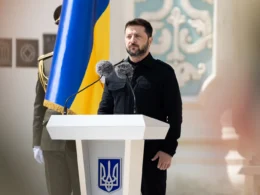
Ukrainian President Volodymyr Zelenskyy outlined an unprecedented ratification framework for any future peace agreement at an online press conference following his Mar-a-Lago summit with US President Donald Trump.
The framework demands that security guarantees be approved by both the US Congress and Ukrainian parliament, with the full 20-point plan subject to a national referendum.
Why past agreements failed
The framework marks Ukraine's clearest attempt yet to ensure any peace deal carries legal weight that past agreements lacked.
Zelenskyy explicitly cited the failure of the 1994 Budapest Memorandum — in which Ukraine surrendered its nuclear arsenal in exchange for security assurances that proved worthless when Russia invaded — and the Minsk agreements, which he said "ultimately led to a full-scale war."
"Ukraine had the Budapest Memorandum — signed by individuals — and it did not work," Zelenskyy told journalists. "None of these papers worked."
Why parliamentary ratification matters
Under the proposed framework, security guarantees would require formal votes in both the US Congress and Ukrainian parliament, transforming what could be executive agreements into binding law.
The bilateral agreements with European allies participating in the Coalition of the Willing would similarly require ratification by European parliaments.
Budapest Memorandum's fatal flaw
This structure addresses a fundamental vulnerability in past agreements.
The Budapest Memorandum was signed by heads of state but never ratified by legislatures, making it politically but not legally binding. When Russia violated the agreement by annexing Crimea in 2014 and launching its full-scale invasion in 2022, there was no enforcement mechanism.
Ukraine's Foreign Minister Andrii Sybiha marked the memorandum's 31st anniversary last month by declaring that Kyiv no longer trusts "empty pledges."
Referendum as 'strongest historical endorsement'
Zelenskyy went further on the 20-point peace plan itself, saying it "should be approved through a referendum."
He called popular ratification "the strongest historical endorsement of the force of this document."
"Everyone understands that this would be the strongest historical endorsement," Zelenskyy said. "This clearly leads to open expression of the will — not of one person, not of 450 people, but of millions of people."
Referendum complications
He acknowledged that "not everyone views this positively" — a nod to concerns that a referendum requirement could complicate negotiations or allow Russia to delay indefinitely by refusing the ceasefire conditions Ukraine says are necessary to hold a credible vote.
Zelenskyy has previously stated that Ukraine would need at least 60 days of ceasefire to organize any referendum — a timeline Russia has so far rejected.
What remains unresolved
The framework announcement comes as the 20-point peace plan has reached 90% agreement, with security guarantees at 100% readiness.
However, two critical issues remain unresolved: territorial arrangements and control of the Zaporizhzhia Nuclear Power Plant.
A final decision on the documents is expected in January.