


Russian forces are unable to build a strategic reserve and will remain locked into slow, attritional fighting in Ukraine throughout 2026, according to the Institute for the Study of War (ISW). Despite Moscow meeting its 2025 recruitment goals, the lack of fresh troops capable of launching larger offensives will keep the Kremlin’s battlefield strategy limited in scope and tempo.
Kremlin meets recruiting goals but fails to build force depth
ISW noted that Lieutenant General Kyrylo Budanov, head of Ukraine’s Main Military Intelligence Directorate (HUR), told Ukrainian broadcaster Suspilne on 27 December that Russia had already fulfilled its plan to recruit 403,000 personnel in 2025 by 3 December. He added that Russia would exceed that target by year’s end and intends to mobilize 409,000 more in 2026. However, Budanov said that Russia has not managed to build a strategic reserve and continues to “constantly” commit its operational reserve to active combat.
"ISW has previously assessed that the Kremlin is setting conditions for involuntary partial reserve call-ups to sustain its military manpower and possibly to try to establish a strategic reserve in the face of its continuing high casualty rate in Ukraine," the think tank wrote.
The Institute for the Study of War now says that although Russia maintains a steady inflow of personnel sufficient to cover its ongoing losses, it is "unable to build large enough reserves to be able to flood a sector of the front" without weakening other areas. Redeploying units to enable local offensives often leaves flanks exposed — vulnerabilities Ukrainian forces have exploited in multiple areas along the front.
Ukrainian forces reclaim ground as Russia stretches its lines
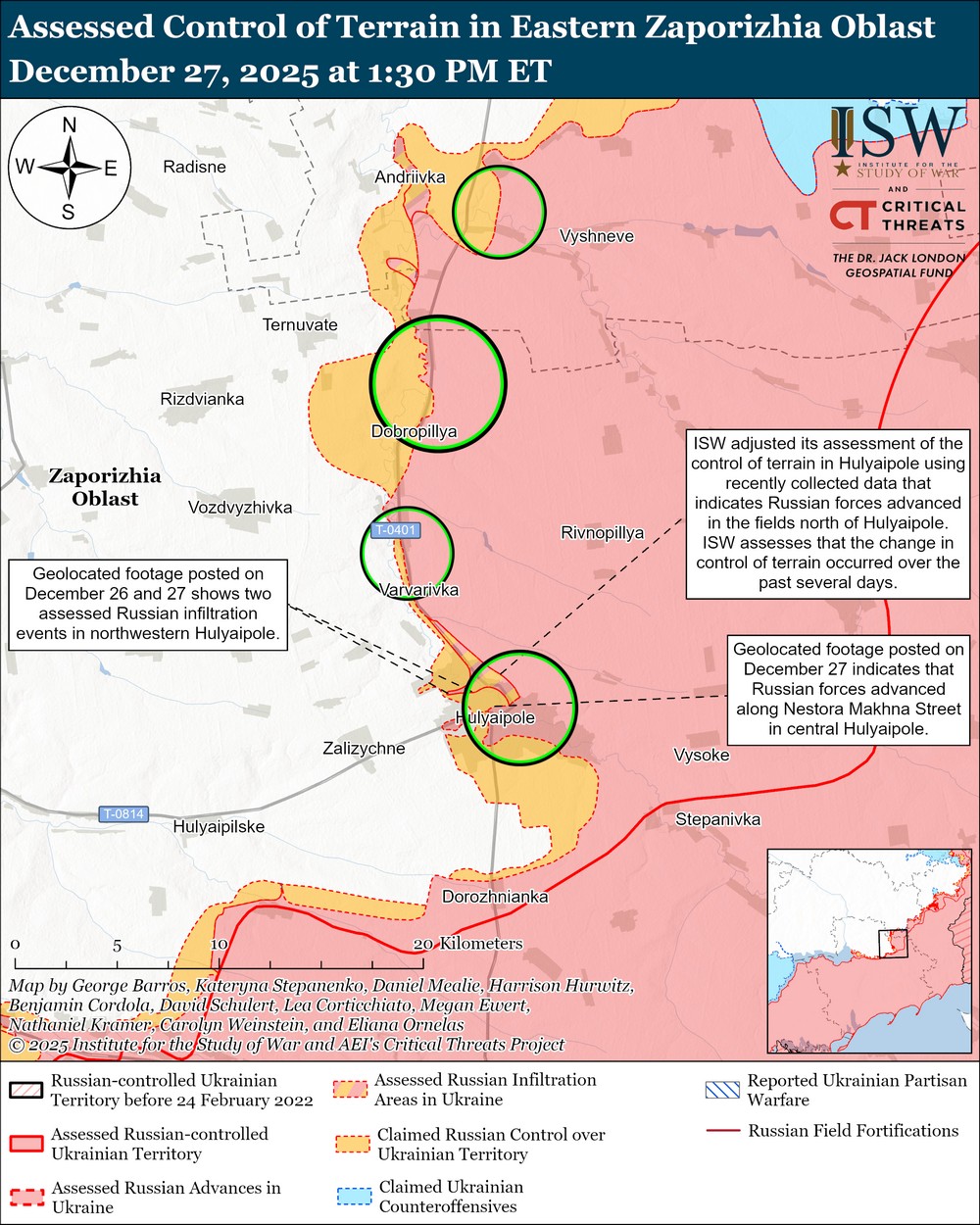
ISW highlighted that Ukraine recently retook territory north of Huliaipole while Russian troops were focused on central Huliaipole. In early November, Ukrainian forces also liberated much of the Russian breakthrough in the Dobropillia direction northwest of Pokrovsk. The successful defense and counterattack in Kupiansk likewise stemmed from the Russian military’s inability to form a reserve, as troops had been diverted elsewhere.

According to ISW, these examples show how Russia’s limitations in reserve manpower directly shape battlefield outcomes. When forces are shifted from one front to another, Ukrainian troops often move to exploit the resulting gaps.
Trending Now
"Ukrainian forces recently advanced near Kupiansk. Russian forces recently advanced near Hulyaipole," ISW noted regarding the latest movements.
Limited capacity to open new fronts or increase pace
Russian forces are currently unable to open new fronts or expand their limited cross-border operations in Sumy and Kharkiv oblasts. ISW emphasized that this constraint will likely persist into the coming year unless the Kremlin resolves its ongoing manpower shortfalls.
Although Russia’s large population and financial resources enable continued recruitment, ISW noted the Kremlin appears to be preparing for future involuntary partial reserve call-ups due to the high casualty rate. Still, Russian recruiters face difficulties attracting voluntary enlistment at costs the state is willing to pay — a point Budanov did not address.
Positional warfare dominates as maneuver options vanish
ISW concluded that Russian forces will continue fighting at their current scale and rate of advance throughout 2026, barring changes in external factors such as Western support for Ukraine. Despite Russian President Vladimir Putin’s claims that Russian forces are advancing along the entire front, ISW assessed this as false. Moscow lacks the capability to significantly escalate or accelerate its operations.
"Russian forces cannot currently conduct maneuver warfare at the scale necessary for rapid, operational-level advances. Russian forces are currently unable to address any of the factors complicating its ability to conduct rapid advances or significantly increase its current rate of advance," ISW concluded.
(The illustrative image shows Russia's recent failed horse charge in Donetsk Oblast)


