

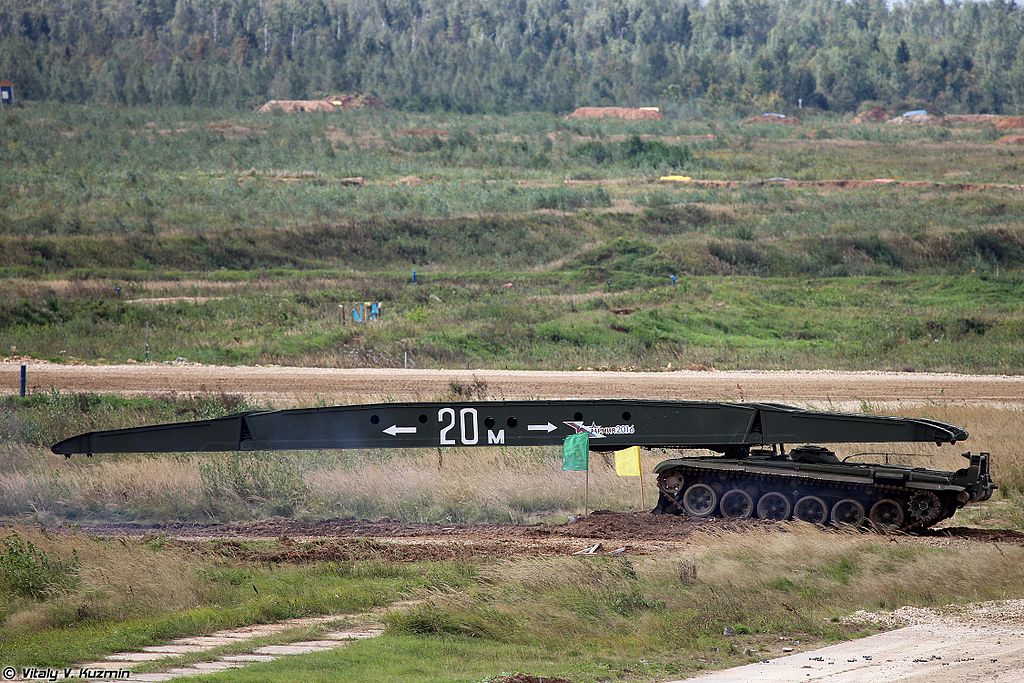
Struggling to cross a small river north of Myrnohrad, Russian forces may be deploying a new kind of bridgelayer: an up-armored Russian turtle tank with a short metal span attached to its front. The kind of span that, hastily dropped over the narrowest stretch of a small river, could help trailing vehicles and infantry quickly cross that river and continue their attack.
The apparent new improvised bridgelayer, first identified by open-source analyst Moklasen, is crude and probably unwieldy. And it may have failed in one of its earliest deployments.
But many of Russia's improvised assault vehicles—welded together in front-line workshops in response to changing battlefield conditions—don't work until they abruptly do work ... and help Russian troops advance deeper into Ukraine.
The improvised bridgelayer signals a tactical shift as the Center Group pivots from urban fighting to open terrain. If the Russians solve their river-crossing problem, the 50-km path to Kramatorsk—the last major Ukrainian-held city in Donetsk—opens for a full-scale advance.
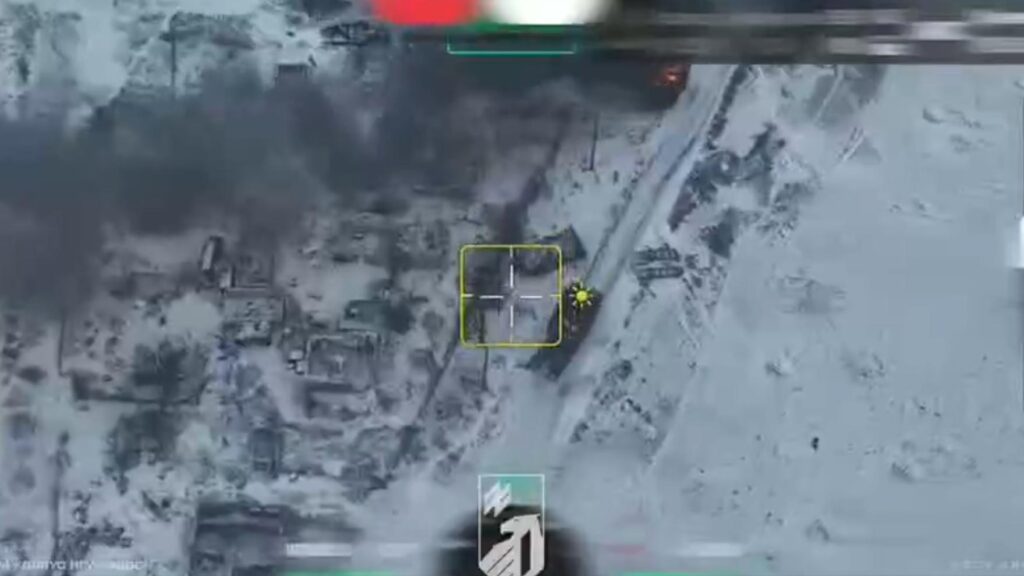
Moklasen first noted the bridge-equipped turtle tank in the aftermath of a Friday clash between the Center Group of Forces and the Ukrainian 1st Azov Corps around the village of Novotoretske, 7 km north of the ruins of the town of Myrnohrad in Donetsk Oblast.
Why Russia is shifting from infantry to armor north of Myrnohrad
Having mostly captured Myrnohrad and the neighboring town of Pokrovsk in recent weeks, the Russian group of forces—150,000 strong—is reorienting its two-year offensive to the last major free settlements in Donetsk: the twin cities of Kramatorsk and Sloviansk, 50 km north of Myrnohrad.
The problem for the Russians is that the infantry-led assaults that helped them capture Pokrovsk and Myrnohrad, one rubble-filled block at a time, might not work on the largely open terrain between Myrnohrad and Kramatorsk.
Infantry work best on the offense in towns and cities, where buildings and rubble help to hide them from drones. Fields and widely scattered villages don't offer the same kind of continuous coverage.
The urban battles for Pokrovsk and Myrnohrad favored the Russians with their abundance of infantry. They disfavored the manpower-starved Ukrainians with their abundance of drones. North of Myrnohrad, the advantage may flip. Here, there are precious few places for Russian infantry to hide from Ukrainian drones.
It's not for no reason the Russians have shifted back to mechanized assaults in vehicles wrapped in anti-drone armor.
The Kazennyi Torets: river obstacle blocking Russia's path to Kramatorsk
There's another problem for the Russians as they strike toward Kramatorsk: the Kazennyi Torets River, which flows south to north just east of Myrnohrad. The Russians are contesting much of the terrain west of the river as far north as the village of Volodymyrivka, 15 km north of Myrnohrad.
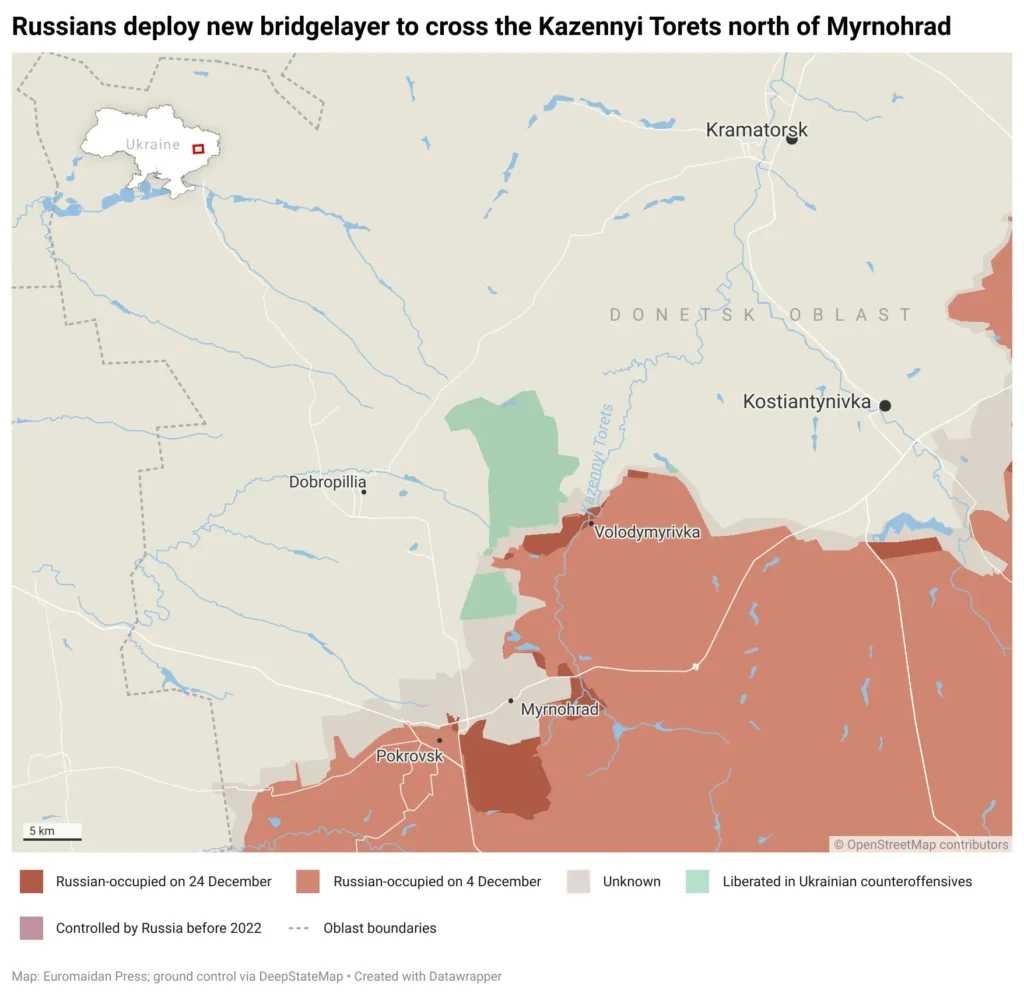
But staging bases and logistics are all on the wrong side of the river for Russian forces trying to roll from Myrnohrad toward Kramatorsk. Assault groups have to cross the Kazennyi Torets somewhere just north of Myrnohrad in order to push against Ukrainian defenses. And those crossings have become extremely difficult as the 1st Azov Corps and supporting forces bring their drones and artillery to bear.
Trending Now
It should go without saying that the permanent bridges across the Kazennyi Torets in this sector were destroyed long ago. Sometimes, Russian columns try driving right across the river along what Russian commanders believe are shallower stretches.
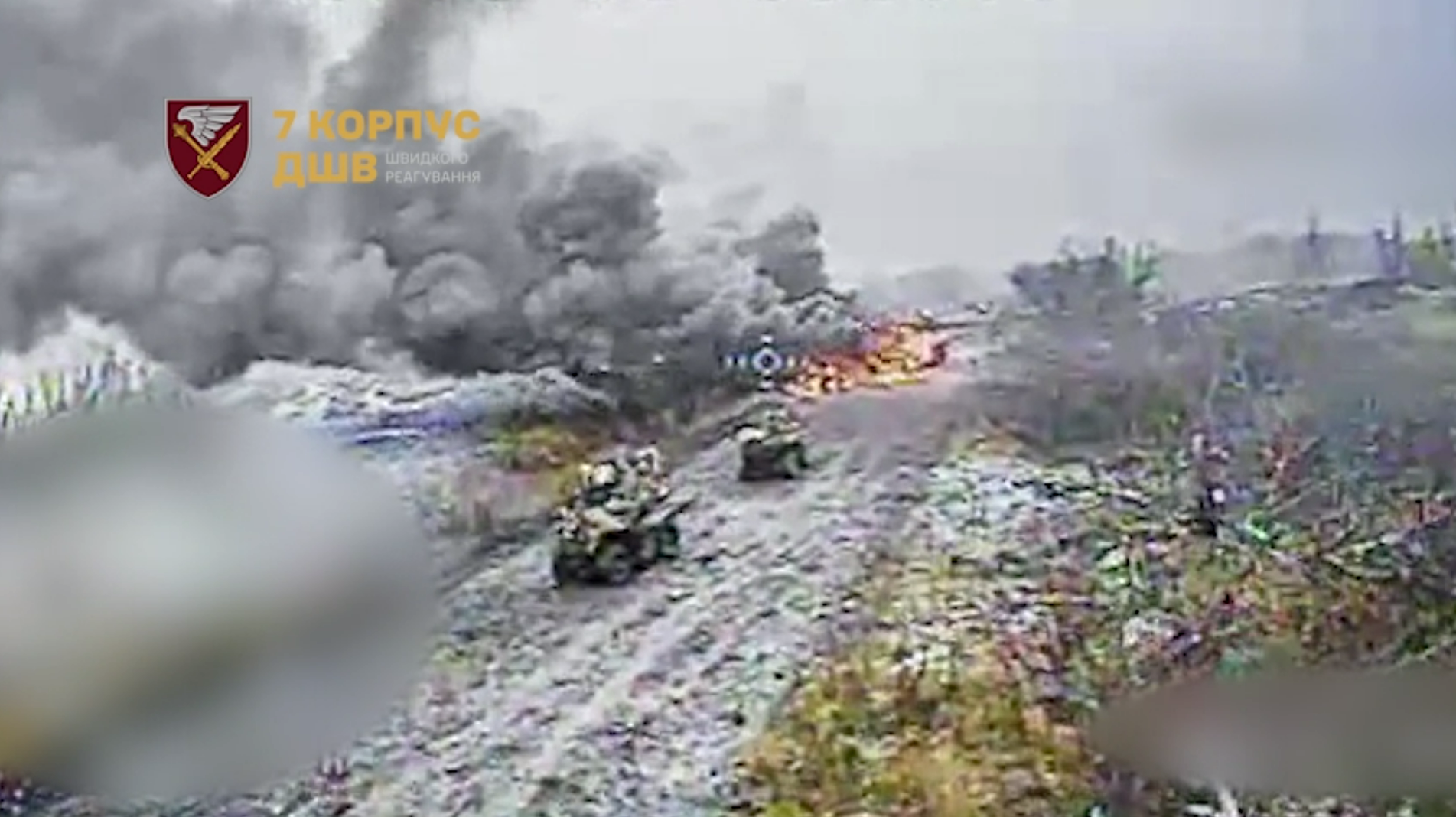
But these attempts at direct fording often fail. Ukrainian drone operator Kriegsforscher has counted 27 Russian vehicles that have recently gotten stuck mid-river—and abandoned by their crews.
Russian bridging attempts and losses
The more cautious approach is to bridge the river. Russian engineers haul in a floating pontoon bridge or drive an armored assault bridge vehicle right up to the riverbank and lever down a reinforced metal span that can support the weight of a tank or infantry fighting vehicle.
The pontoons and assault bridges are big, fat targets, however. The Russians have lost several of their 40-ton MTU-72 assault bridges north of Myrnohrad in recent weeks.
In apparently attaching a detachable metal bridge to the front of at least one up-armored turtle tank, the Russians may be trying to grow and diversify their bridging force around the Kazennyi Torets. If purpose-built MTU-72s are in short supply, a turtle tank that can drop, say, a 10-m span could fill in for assaults across narrower lengths of the river.
To be clear, the 1st Azov Corps knocked out the first known bridge-equipped turtle tank in the clash near Novotoretske on Friday. The vehicle was still a few hundred meters from the Kazennyi Torets when its crew abandoned it. In other words, it may never have gotten a chance to use its bridge.
But the next river-crossing turtle tank crew might be luckier. And the more bridge-equipped turtle tanks the Russians build, the more they'll create their own luck.
What to watch
If more bridge-equipped turtle tanks appear in drone footage over the coming weeks, it would confirm Russia is scaling this solution—and that the river obstacle may not hold indefinitely.
Key numbers:
- 27 Russian vehicles recently stuck mid-river attempting direct fording
- 50 km from Myrnohrad to Kramatorsk
- 150,000 troops in Russian Center Group of Forces
- 7 km from Novotoretske to Myrnohrad
- Several MTU-72 bridgelayers lost in recent weeks


