


Combat footage of recent failed Russian mechanized assaults continues to demonstrate that Russian forces have been unable to reestablish mechanized maneuver to the battlefield, according to the Institute for the Study of War (ISW). The think tank assesses that Russian gains will likely remain "constrained to a slow foot pace." Russian forces are unlikely to achieve any rapid operational-level breakthrough.
Russian milbloggers tear into their own commanders
In its 23 December report, ISW noted that Russian military bloggers have openly criticized their command for ordering mechanized assaults that stand no chance of success. One milblogger argued that intense Ukrainian drone and artillery fire overwhelms even well-protected armored vehicles. The milblogger added that repeated drone and artillery strikes eventually disable even well-armored vehicles.
“Experience has repeatedly shown that mechanized assaults during daylight hours and good weather conditions without fog concealment rarely lead to anything good,” the blogger wrote.
Another milblogger implied that Lieutenant General Sukrab Akhmedov commanded the failed mechanized assault in the Dobropillia direction. The Russian military command reportedly removed Akhmedov from command of the 20th Combined Arms Army in May 2024. His removal followed complaints about his role in attritional assaults near Vuhledar in winter 2022-2023 and significant casualties after a Ukrainian rear strike in summer 2023. The milblogger said Akhmedov has since "received even more power" and formed several naval infantry columns near Dobropillia.
The video shows highlights of the failed Russian attack near Dobropillia on 22 December:
Only two-person groups can survive the modern battlefield, milbloggers believe
The milblogger warned that in both the Dobropillia area and along the broader frontline, operating in groups larger than two soldiers brings “deadly consequences.” He added that Ukrainian and Russian drones keep the rear areas under what he described as “total surveillance.” Russian units are now relying on infiltration teams of just one or two troops to make forward progress. Such units move on foot toward hidden rallying positions, from which they then stage attacks.
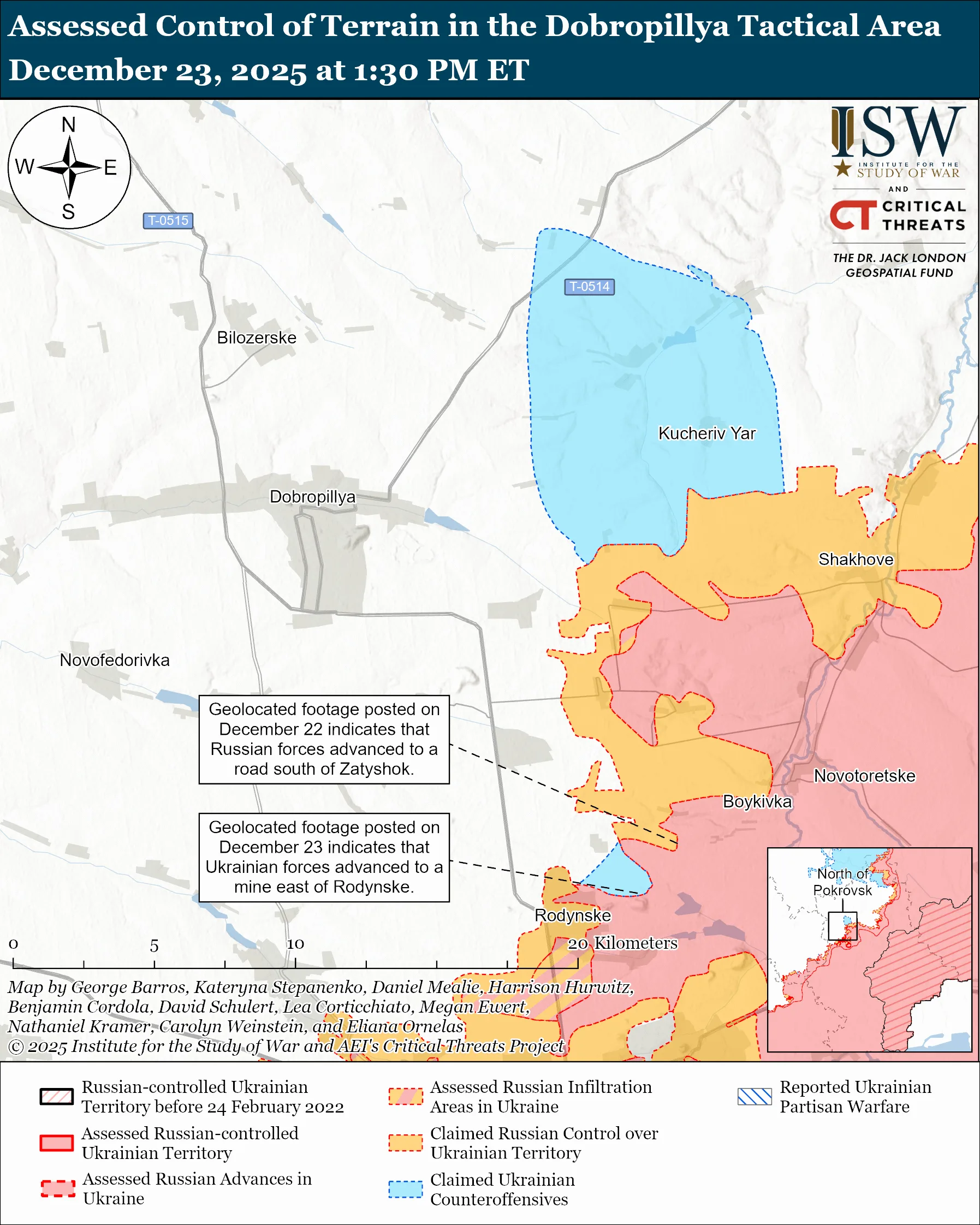
A different blogger criticized Russian forces for persisting with mechanized columns despite the recent effectiveness of infiltration tactics. The blogger stressed that for a heavy armor breakthrough to work, it must allegedly be carefully prepared and comprehensively supported, including eliminating Ukrainian drone operators, conducting deep counterbattery strikes, and synchronizing action across multiple units in a wide area. The milblogger particularly noted Ukraine's ability to strike deep into the Russian Dobropillia salient from positions north of Myrnohrad and Pokrovsk. Rivers, the lack of bridges, anti-tank ditches, and lowlands further constrain Russia's ability to maneuver.
Kremlin propaganda does not match battlefield reality
ISW continues to view Russian operations as geared primarily toward static, positional fighting.. Russian Defense Minister Andrei Belousov's 17 December statements about Russian technological and tactical adaptations in 2025 reinforced this assessment. Even in places where advances have come slightly faster, ISW said Russian gains are still confined to foot-speed progress.
"Russia’s inability to conduct mechanized assaults that result in large-scale gains confirms that Russian forces will be unable to make rapid breakthroughs and collapse Ukrainian defenses," the think tank says.
Moscow's ongoing "cognitive warfare effort" to present Ukrainian defenses as fragile and to suggest Russian battlefield success is inevitable, but argued that this messaging contradicts the actual pace and character of Russia’s advances.


