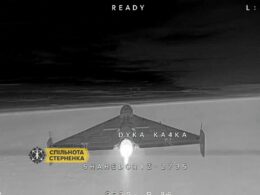
A September 2025 Ukrainian strike on the SKIF-M machine tool plant in Belgorod aimed at a facility most people have never heard of—and that's precisely why it matters.
SKIF-M makes specialized drills, bits, and cutting inserts for machining aerospace-grade titanium and aluminum. Seventy percent of its products are developed specifically for aviation materials. Its largest customer is Russia's United Aircraft Corporation, the state entity that builds Su-35 and Su-57 fighters.
The strike damaged the company's machine tooling. According to a November 2025 report from the Royal United Services Institute (RUSI), coordinating sanctions to prevent Russia from replacing that equipment could create knock-on effects across the entire aviation industry.
The reason: SKIF-M's destroyed machines weren't Russian. They were German, Swiss, and Australian.
Western machine tools power Russian fighter jet production
Trade data examined by RUSI authors Nikolay Staykov and Jack Watling shows SKIF-M imported more than $7.6 million in goods annually since 2022. Recent acquisitions include a Swiss-made Stahli flat honing machine routed through Türkiye, a German Hermle five-axis CNC machining center, and a six-axis grinding machine from Australian company ANCA.
SKIF-M remains unsanctioned by Western governments. Only Ukraine has designated it. The company's promotional materials advertise that both top Russian aviation plants and Airbus use its tools—a dual-use status that may explain Western reluctance to act.
This dependency pattern runs throughout Russia's aerospace sector. At the Karachevskiy Zavod Elektrodetal plant near Bryansk, which produces precision components for half of Russia's major military manufacturers, Japanese-made Sodick electrical discharge machines line the factory floor. Japan banned CNC machine exports to Russia in April 2023, but the equipment arrived in 2017 with a 10-year accuracy guarantee. Russia will need replacement parts within two years.
KNIRTI, the manufacturer of Khibiny electronic warfare pods mounted on Sukhoi wingtips, uses German signal generators made by Meilhaus Electronic GmbH. A 2024 corporate video shows one on an engineer's desk—a Ceyear 1465 model retailing for roughly $90,000. Trade data reveals this equipment has flowed into Russia via China and Vietnam since 2022, labeled "for non-military use."
In 2024 alone, Russian companies imported $42.4 million worth of equipment from US-based Keysight Technologies, a world leader in signal measurement that officially withdrew from Russia in 2022. An estimated $11.3 million went to entities linked to Sukhoi production. The products arrived through China, Hong Kong, Thailand, the UAE, and Türkiye.
"European countries have been remarkably incurious as to the final destination of critical machine tools labelled not for military use," the RUSI authors write.
Supply chain failures delayed Sukhoi's electronic warfare systems
The consequences of these dependencies showed up on day one of the full-scale invasion.
Khibiny pods detect and jam enemy radars, protecting Russian aircraft during combat. Ukrainian air defenders noticed during the war's opening phase that numerous Russian jets lacked their protection suites. Analysts initially attributed this to Russian overconfidence or poor planning.
The RUSI report offers a different explanation: industry simply couldn't deliver them.
KNIRTI was supposed to ship a large consignment to the Novosibirsk assembly plant by 10 November 2021. The pods arrived 115 days late—on 5 March 2022, nine days after Russian forces crossed into Ukraine. The Russian Ministry of Defense won a $2.6 million arbitration claim against the company.
But the authors conclude the delay stemmed not from company mismanagement but from KNIRTI's dependence on more than 1,300 individual suppliers, many reliant on foreign imports. No public criticism of KNIRTI leadership followed, unlike other Russian defense contractors that missed deadlines—suggesting Moscow understood the problem was systemic.
The lack of protection suites contributed to Russia losing experienced pilots in the war's opening days.
Russian fighter jet production lags behind tanks and drones
Russia has increased fighter output since the invasion began, but the gains are modest. Su-34 production rose from nine aircraft in 2022 to 13 in 2023, with a 2025 target of 17. For Su-35s, Russia ordered 12 in 2024 but delivered only 10.
Compare that to other weapons: tank, drone, and artillery shell production has increased between two and tenfold. Fighter jets require precision components with narrow tolerances—even minor disruptions cascade through the entire assembly process.
Russia has attempted import substitution with mixed results. When a German manufacturer refused to deliver critical valves and compressors for a new hot isostatic pressing installation after the 2022 invasion, Russian metallurgy group Ruspolimet had to fabricate the missing parts from scratch. The CEO later admitted to Russian media that the subsidiary handling this work is "one of the underperforming assets" of the group—despite being Russia's only manufacturer of such equipment.
Russia's aerospace brain drain accelerates
Beyond production constraints, Russia faces a demographic crisis in its design bureaus.
Professor Yuriy Yukhanov, 73, is a leading antenna design scholar at South Federal University who works closely with Sukhoi's R&D arm. His son Alexander, trained in radio engineering, left for the United States in 2007. He now works as a principal software engineer at Meta.
One in five Russian university professors is over 65. Only 6% of faculty are under 30. Average professorial salaries stood at roughly $1,300 per month in 2024. A survey of engineers with Sukhoi experience shows "a fairly extensive distribution across the world, overwhelmingly represented by young professionals."
Export customers are noticing the decline. India, historically one of Russia's closest defense partners, selected the French Rafale over Russian offerings. Egypt, operating both Rafales and Su-35s, concluded French jets are significantly more capable. Iran has been unable to obtain promised Su-35s despite deepening defense ties and is now exploring Chinese alternatives.
The RUSI authors argue that demonstrating Russia's unreliability as a supplier—through coordinated strikes and sanctions enforcement—could permanently erode Moscow's position in the global aerospace market.
The machines destroyed at SKIF-M can be replaced. But only if someone sells Russia new ones.