


"There will be no operations if you treat us with respect, respect our interests, just as we have constantly tried to respect yours. If you don't deceive us like you deceived us with NATO's eastward expansion."
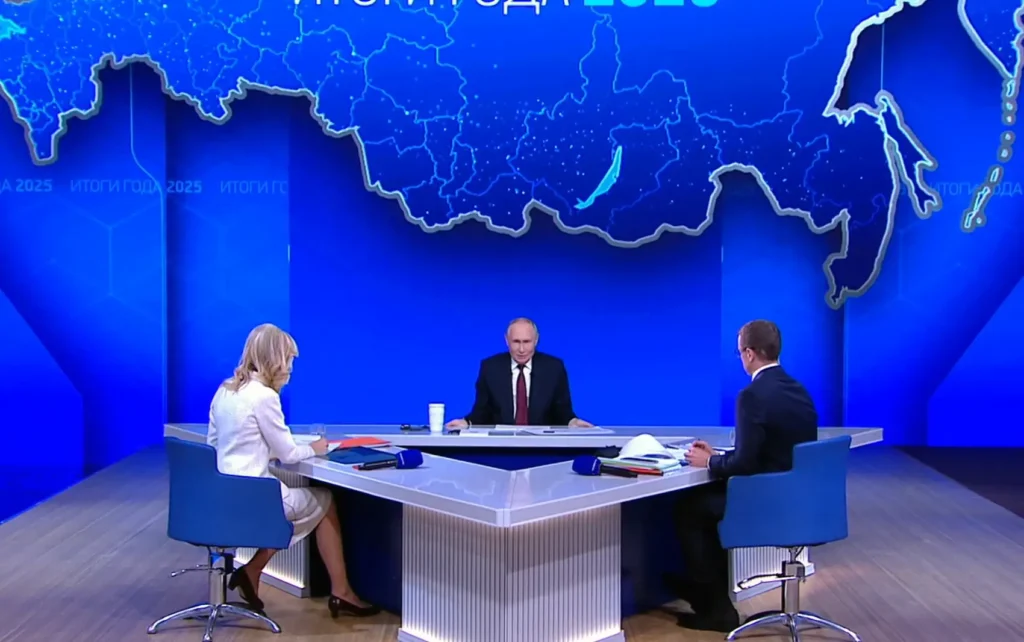
That was Vladimir Putin on 19 December 2025, responding to BBC's Steve Rosenberg during his annual Direct Line.
Rosenberg had asked what kind of future Putin envisions for Russia — whether dissent would remain criminalized, whether the hunt for enemies would intensify, whether there would be more "special military operations."
Putin's answer, preserved in the official Kremlin transcript, amounted to a conditional threat dressed as an offer of peace.
The phrasing sounded familiar. It should.
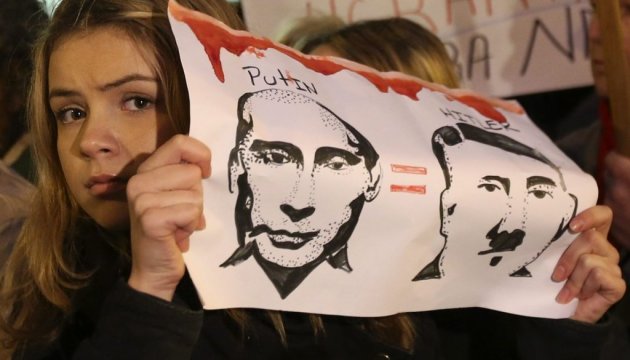
Euromaidan Press documented the same pattern in 2015, when Putin's Crimea annexation speech echoed Hitler's Danzig demands almost line for line. A decade later, the formula hasn't changed — only the audience has.
Hitler's version, 1 September 1939

Hours before German troops crossed into Poland, Hitler addressed the Reichstag:
"As always, I attempted to bring about, by the peaceful method of making proposals for revision, an alteration of this intolerable position. It is a lie when the outside world says that we only tried to carry through our revisions by pressure."
He continued: "On my own initiative, I have, not once but several times, made proposals for the revision of intolerable conditions. All these proposals, as you know, have been rejected."
Then the key line — the one that made invasion someone else's fault: "The Polish State has refused the peaceful settlement of relations which I desired, and has appealed to arms… In order to put an end to this lunacy, I have no other choice than to meet force with force."
Putin's version, 19 December 2025
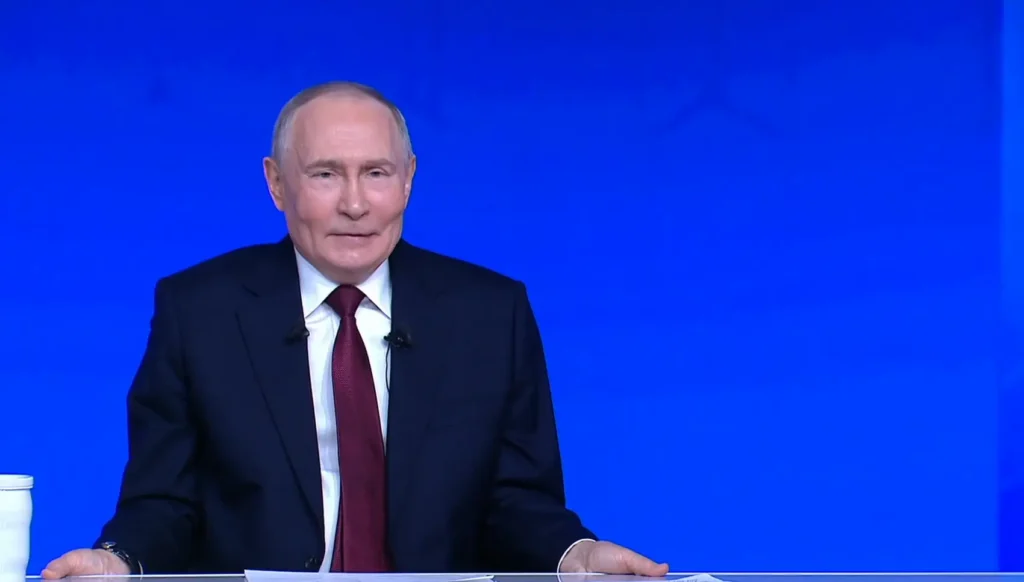
At his annual Direct Line, Putin laid out the same sequence.
First, the peaceful intentions: "We are ready and want to end this conflict by peaceful means, based on the principles I outlined in June [2024] at the Ministry of Foreign Affairs."
Then the rejected proposals: "As a result of negotiations in Istanbul, they first agreed, practically initialed [the agreement], and then refused, threw all these agreements in the trash."
Then the persecution of his people: the claim of "genocide" against Russian-speakers in Donbas, which he has repeated since 2022.
And finally, the key line — the one that made invasion someone else's fault: "After we were deceived and the Minsk agreements weren't implemented, we were forced to use our armed forces to end the war that the Kyiv regime started."
Forced. The aggressor reframed as the reluctant responder.
Hitler blamed the Treaty of Versailles — calling it a "Diktat" forced on Germany "with a pistol at our head."
Putin blames NATO expansion—citing an alleged promise Gorbachev himself said was never made. The claim that collapses under its own logic, anyway. When Finland joined NATO in 2023, extending the alliance's border with Russia by over 1,300 kilometers seeing Russia's aggression, Moscow didn't reinforce its northwestern frontier. It did the opposite: withdrew 80% of its border troops to continue destroying a non-NATO country—Ukraine.
The grievance isn't the cause. It's the cover. The parallels run through every element of the argument:
| The formula | Hitler, 1 September 1939 | Putin, 19 December 2025 |
|---|---|---|
| "I wanted peace" | "I attempted to bring about, by peaceful method, an alteration of this intolerable position" | "We are ready and willing to end this conflict peacefully" |
| "My proposals were reasonable" | "There is nothing more modest or loyal than these proposals" | "We demand nothing unusual" (Kremlin's maximalist demands for destruction of Ukraine's statehood) |
| "They rejected everything" | "All these proposals have been rejected" | "We reached an agreement in Istanbul... Suddenly they wanted out" |
| "They deceived us" | Versailles signed "with a pistol at our head" | "You deceived us with NATO's eastward expansion" |
| "Our people were persecuted" | "Germans in Poland are persecuted with bloody terror" | "The Kyiv regime unleashed war" on Russian-speakers in southeastern Ukraine |
| "I was forced to act" | "I have no choice but to meet force with force" | "We were forced to use our armed forces" |
| "No more wars if respected" | Implied: accept our terms and there is peace | "No new special military operations if you treat us with respect" |
So why do they sound identical?
The dictator's problem
Aggressors face a universal challenge: most people — including their own citizens — believe wars of conquest are wrong. You can't just announce "We're invading the neighbors because we want their land." You need to reframe aggression as defense.
Criminologists Gresham Sykes and David Matza figured this out in 1957. Studying juvenile delinquents, they noticed that offenders don't reject society's moral rules. They temporarily neutralize them using specific rhetorical techniques — ways of telling themselves (and others) that this particular violation is justified.
Trending Now
They called it "techniques of neutralization." Dictators use all of them:
- Denial of responsibility: "I was forced to act." Putin: "We had no choice."
- Denial of injury: "We're not really hurting anyone." Putin: "We're liberating, not occupying."
- Denial of victim: "They had it coming." Hitler and Putin: "They persecuted our people."
- Condemnation of the condemners: "Those judging me are hypocrites." Putin: "NATO deceived us."
- Appeal to higher loyalties: "I serve something greater."
Hitler invoked Providence — divine selection of Germany to defend civilization against "Jewish Bolshevism."
Putin's regime uses the katechon: a term from 2 Thessalonians 2:6-7 meaning "the Restrainer" who holds back the Antichrist. In March 2024, the World Russian People's Council — chaired by Patriarch Kirill — declared Russia fulfills the mission of the katechon, "protecting the world from the onslaught of globalism and the victory of the West that has fallen into Satanism." Kirill has told Russian soldiers that dying in Ukraine washes away all their sins.
The banality of reasonable-sounding evil
Hannah Arendt watched Adolf Eichmann's 1961 trial in Jerusalem expecting to see a monster. Instead, she found a bureaucrat.
Eichmann spoke in the language of duty, orders, legal procedures. He wasn't driven by hatred; no, he was "just following orders," "doing his job," serving "higher authorities." The paperwork was in order. The trains ran on schedule.
Arendt called it "the banality of evil." The most horrific crimes don't require demonic perpetrators. They require ordinary people equipped with the right rhetoric — language that makes atrocity feel like administration.
That's what Putin's "treat us with respect" formula provides. Not a call to hatred, but a framework of reasonableness. We tried peace. They rejected it. We were deceived. Our people suffered. We had no choice.
Historian Christopher Browning studied how ordinary Germans became Holocaust perpetrators in his 1992 book Ordinary Men. Reserve Police Battalion 101 — middle-aged family men from Hamburg — shot tens of thousands of Jews in Poland. Most weren't fanatics -- they were given the language of duty, victimhood, and necessity. This language was the gateway to the atrocities that followed.
But Putin's press conference was not only aimed at Russia's true believers. It was also aimed at everyone who needs a reason to look away, a formula for "both sides have a point," a script for pressuring Ukraine to concede.
The "final demand" is never final
Here's the part Western leaders learned too late in 1938.
September: Hitler demanded the Sudetenland, calling it his "last territorial demand in Europe." Neville Chamberlain agreed at Munich, flew home, proclaimed "peace for our time."
March 1939: Hitler took the rest of Czechoslovakia.
September 1939: Poland.
Each concession generated a new grievance requiring a new "reasonable proposal."
Putin's trajectory looks familiar. Crimea in 2014: righting a historical wrong. Donbas: protecting Russian speakers. The 2022 invasion: "denazification." The September 2022 annexation of four oblasts — territories Russia still doesn't fully control — became the new baseline.
Now, with Donald Trump signaling eagerness for a deal, Putin's "no more wars if you respect us" positions Russian demands as the natural endpoint. The message to Western publics: pressure Ukraine to concede, and the war ends.
Churchill's verdict on Munich: "You were given the choice between war and dishonour. You chose dishonour, and you will have war."
The script hasn't changed in 86 years. Neither has its purpose. And neither has the trap it sets.
Article was updated to elaborate on Putin's claims


