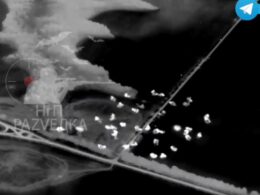

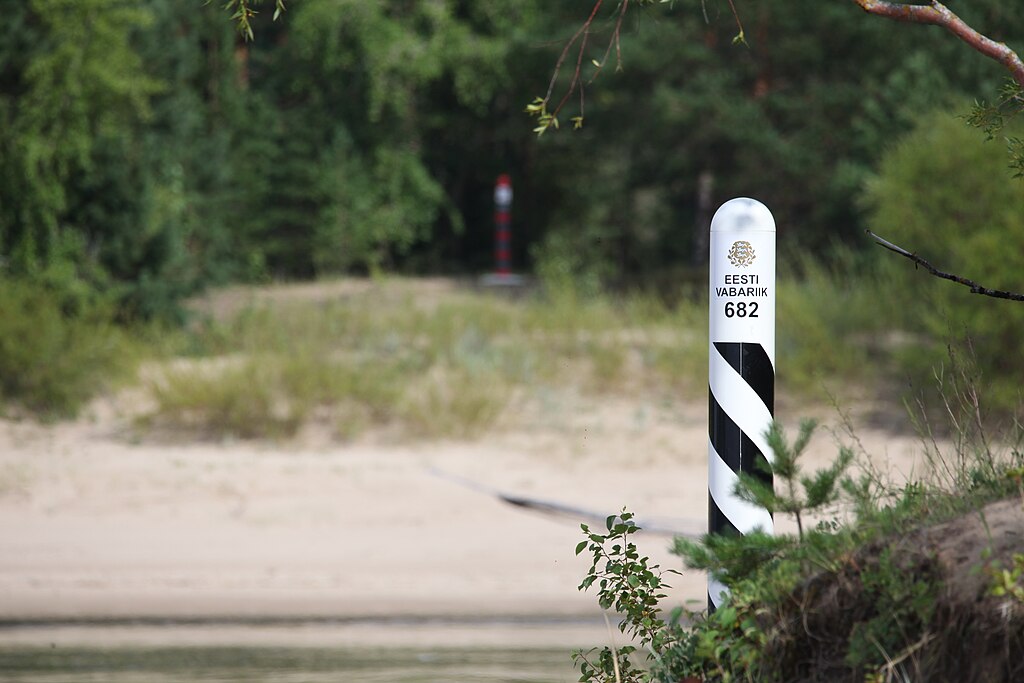
Three Russian border guards crossed into Estonian territory at the Vasknarva breakwater on the Narva River on 17 December, remaining for approximately 20 minutes before returning to Russia. The intrusion, captured on Estonian surveillance equipment, prompted Tallinn to summon Russia's chargé d'affaires and issue a formal protest note.
The incident marks the latest in a pattern of Russian boundary provocations against the Baltic state — and could push Estonia to take its most drastic step yet: closing its 294-kilometer border with Russia entirely.
Key developments:
- Three Russian border guards crossed into Estonia on 17 December, remaining for approximately 20 minutes
- Russia denied the violation despite video evidence from Estonian surveillance
- Estonia summoned Russia's chargé d'affaires and issued a formal protest note
- Estonian government meets Friday to discuss threat assessment revision and possible border closure
- Interior Minister Igor Taro said closure options range from local and temporary to permanent
Russia denies Estonia border violation despite video evidence
Estonian and Russian border representatives met for over two hours on 18 December at the site of the incident. The Russian side flatly denied any illegal crossing had occurred.
Interior Minister Igor Taro called the denial "utterly ridiculous," telling Estonian public broadcaster ERR that the control line has been in place for over 30 years.
"If they cannot read a map, if topographical ignorance prevails there, then how are we supposed to help? Should we send them a map, teach them how to read it?" Taro said.
Estonia considers closing border with Russia
Estonia's government will discuss revising its threat assessment on Friday, with a border closure among the options being considered.
Taro said any response must be proportional, but did not rule out drastic measures. "There are many different options for closing border traffic — it can be closed locally, generally, temporarily, for a longer period, or permanently," he told reporters.
Forces have already been reinforced in the Vasknarva area, and Estonia has proposed elevating border discussions to a higher diplomatic level after the Russian representative at Thursday's meeting claimed he lacked authorization to provide substantive explanations.
Russian provocations against Estonia and NATO's eastern flank
Foreign Minister Margus Tsahkna framed the incident as part of Russia's ongoing effort to test boundaries along NATO's eastern flank.
Recent incidents, ERR reports, include:
- Armed Russians appearing on the Saatse Boot road in October 2025 — a stretch of Russian territory that Estonians previously traversed under longstanding agreement
- Russia's removal of over a dozen navigation buoys from the Narva River in May 2024
- Three Russian fighter jets violating Estonian airspace for 12 minutes in September 2025
Estonia and Russia have an unratified border treaty that Moscow has refused to sign. Tsahkna said he sees no realistic prospect of resolving this.
"Russia will certainly take advantage of such opportunities. Our job is simply to be very clear about what is our territory, what is Russian territory, to keep the situation under control, and not to give in to provocations," he said.