- A Ukrainian drone submarine hit, or hit near, a Russian navy submarine in southern Russia on Monday
- Even a near miss can badly damage a submarine, especially its internal components
- Even if the sub's hull is intact following the Monday raid, internal damage could keep it out of action for months or even years
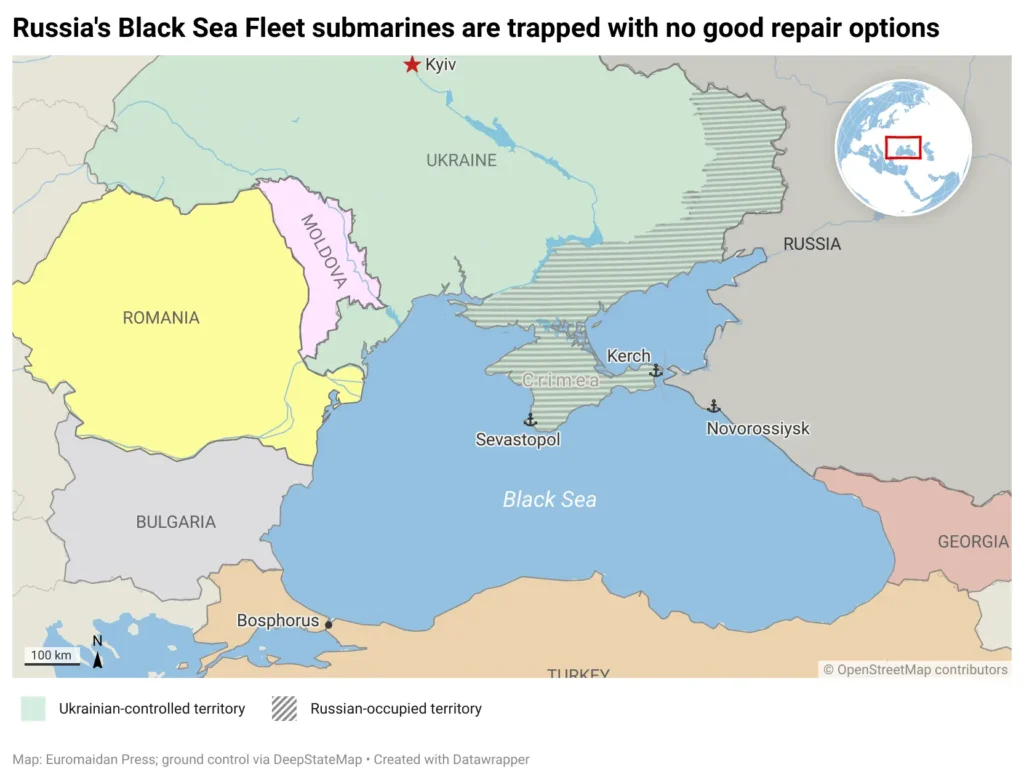
- With Türkiye's Bosphorus closure trapping damaged boats in the Black Sea, Russia has no safe port left to repair its submarines
The Ukrainian state security service, the vaunted SBU, maneuvered an explosive drone submarine past underwater defenses in the port of Novorossiysk on the Black Sea in southern Russia on Monday and struck, or nearly struck, a Russian navy Project 636.3 Varshavyanka-class attack submarine moored pierside.
But getting hit may be almost as bad as getting sunk. Türkiye closed the Bosphorus to Russian warships in 2022. The fleet's only real submarine repair yard, in Sevastopol, has been under Ukrainian missile attack for two years. Novorossiysk has docks, but not the equipment for major submarine work. A Varshavyanka that can't dive, can't sail, and can't be fixed isn't coming back.
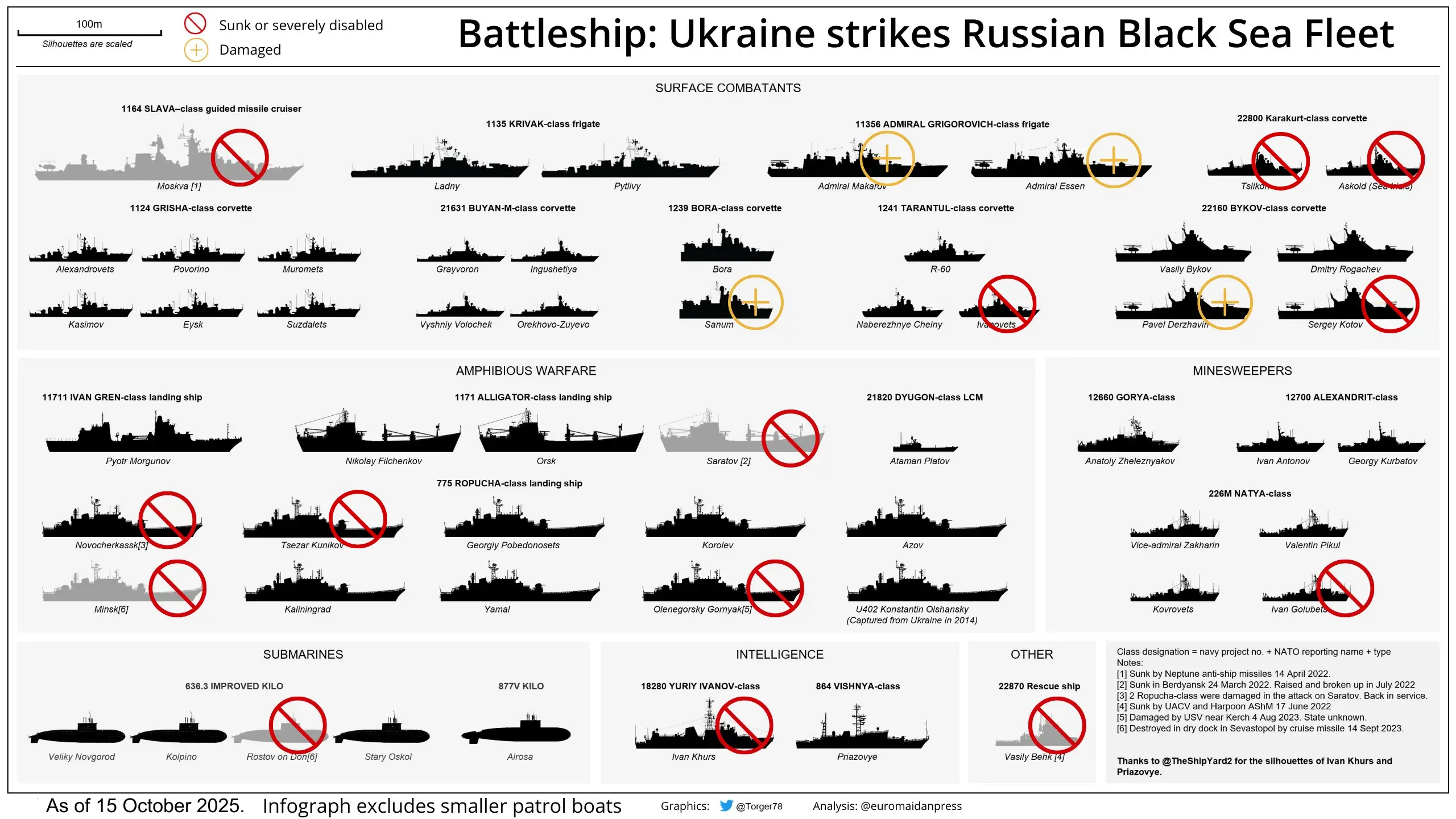
It's unclear whether the Sub Sea Baby drone directly hit the steel hull of the 242-foot Varshavyanka (NATO designation: Improved Kilo), one of three left in the Black Sea Fleet after Ukrainian missiles blew up a fourth boat, the Rostov-na-Donu, in occupied Crimea — first in September 2023, then again in June 2024, before it finally sank in August 2024.
A video from Novorossiysk confirms the drone at the very least exploded right next to the Varshavyanka. Perhaps just a few meters aft of the diesel-electric boat's stern.
That's probably close enough to cause significant damage ... and keep the Varshavyanka out of action for months if not years.
The Black Sea Fleet deploys its Varshavyankas for Kalibr missile strikes on Ukrainian cities. Every Varshavyanka the Ukrainians destroy or badly damage is one fewer Varshavyanka that can terrorize Ukrainian civilians. There are just eight or nine ships in the Black Sea Fleet that can launch Kalibrs.

The physics of a near miss
Submarines are built tough out of high-quality steel. They have to be to survive the enormous pressure that seawater exerts at depths of potentially hundreds of meters. But that doesn't mean a nearby explosion—from a drone, torpedo, or mine—won't badly damage a sub's hull or internal systems.
"The most probable threat does not involve direct contact of a ship with a mine, but has the mine exploding in the vicinity of the ship, launching a high-pressure wave into the liquid," the Massachusetts-based Mitre Corporation explained in a 2007 study.
"During World War II, it was discovered that although such 'near miss' explosions do not cause serious hull or superstructure damage, the vibrations associated with the blast nonetheless incapacitated the ship, by knocking out critical components," Mitre continued.
Scant data
It's been 80 years since a submarine has been destroyed in combat while submerged or partially submerged, so hard data on submarine survivability is hard to come by.
But after surveying the available literature, Tom Stefanick from The Brookings Institution in Washington, D.C. concluded that mines—and presumably other subsurface munitions—"can have potent tactical effects" even when they explode many meters from their targets.
"Mines can damage interior systems and people well before they sink a submarine, and can be effective at ranges of several tens of meters, depending on the size of the explosive charge and the water depth."
Ukraine's underwater arsenal
We don't know exactly how big the Sub Sea Baby is and how heavy its warhead is. But there are clues.
Two years ago, Ukrainian firm Ammo Ukraine launched Marichka, a 6-m unmanned undersea vehicle that could haul potentially 100 kg of explosives over a distance of up to 1,000 km under satellite and inertial guidance. Around the same time, another Ukrainian firm—Brave1—announced it was developing the Toloka class of UUV. The biggest, around 10 m long, may range an impressive 2,000 km with a massive 450-kg warhead.
Trending Now
Either type, or a similar new UUV, should pack more than enough explosive power to seriously damage a submarine with a close miss. And that should mean that the Varshavyanka the SBU attacked in Novorossiysk is messed up inside, even if its hull is technically intact.
Trapped in the Black Sea
Maybe the Varshavyanka didn't sink at its pier: the damage may only be internal. But internal damage might still take years to fix.
It took the US Navy four years to repair a submarine that suffered internal and external damage after colliding with a sea mount. It's taken 14 years for the Americans to repair another submarine that wasn't damaged at all, but only needed an overhaul.
Russia used to send its Black Sea submarines to the Kronstadt shipyard in the Baltic for major overhauls. The Bosphorus closure ended that option. The Rostov-na-Donu's fate — nine months of repairs in Sevastopol, then sunk anyway when Ukrainian missiles found it again — showed what happens when there's no safe alternative.
Novorossiysk has berths and floating docks, but no specialized submarine repair infrastructure. Kerch's Zaliv shipyard handles surface ships. For anything beyond basic maintenance, the Black Sea Fleet has nowhere to go.
The 15 December strike didn't need to sink its target. Crippling it may have been enough.
Half the Kalibr submarine fleet gone
When Russia launched its full-scale invasion in February 2022, the Black Sea Fleet had four Kalibr-capable Varshavyanka-class submarines. Now Rostov-na-Donu sits at the bottom of Sevastopol harbor. If Monday's attack disabled a second boat, Ukraine has eliminated half the missile submarine force.
| Submarine | Class | Status | Notes |
|---|---|---|---|
| Rostov-na-Donu (B-237) | Varshavyanka (Kalibr) | Destroyed | Storm Shadow Sep 2023; struck again Jun 2024; sunk Aug 2024 |
| Krasnodar (B-265) | Varshavyanka (Kalibr) | Operational* | Relocated to Novorossiysk |
| Veliky Novgorod (B-268) | Varshavyanka (Kalibr) | Operational* | Relocated to Novorossiysk |
| Kolpino (B-271) | Varshavyanka (Kalibr) | Operational* | Relocated to Novorossiysk |
| Alrosa (B-871) | Older 877V Kilo | Operational | Torpedo boat; no Kalibr capability |
All that is to say, the SBU's Sub Sea Baby strike, for all practical purposes, probably eliminated around 10% of the Black Sea Fleet's Kalibr launch capacity.

Better than Moskva: four things to know about Ukraine’s drone attack on Russian Fleet in Sevastopol