

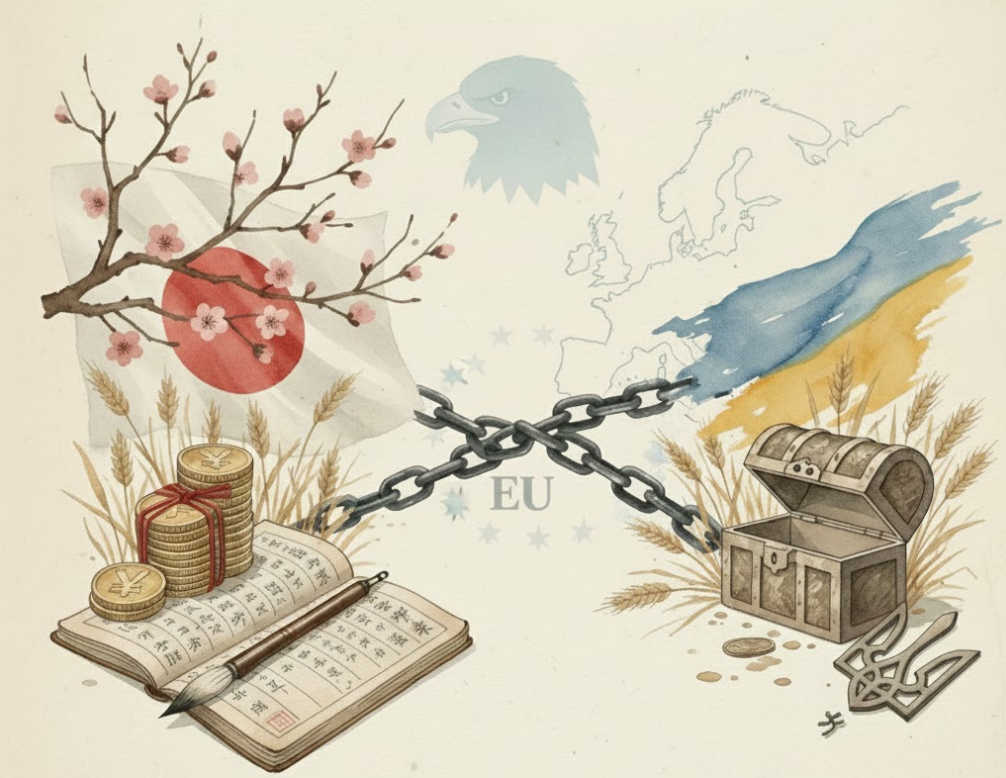
Japan has refused to join the EU’s plan to convert frozen Russian sovereign assets into loans for Ukraine, Japanese Finance Minister Satsuki Katayama told G7 counterparts on Monday, citing legal concerns. But EU diplomats briefed on the discussions told Politico that Tokyo’s real calculation is simpler: don’t cross Washington.
The refusal exposes a deepening rift within the G7 over how to end Russia’s war, with Europe increasingly alone in its approach.
Two theories now compete. Europe wants to make the war progressively more expensive for Moscow. “The longer Putin wages his war, spills blood, takes lives, and destroys Ukrainian infrastructure, the higher the costs for Russia will be,” European Commission President Ursula von der Leyen said Monday after meeting Ukrainian President Volodymyr Zelenskyy.
The Trump administration sees things differently. Washington views the frozen assets not as war financing but as negotiating chips — leverage to bring Vladimir Putin to the table. US officials have suggested handing part of the money back to Russia and using the rest for American investments in Ukraine.
Japan chose Washington.
A supporter, within limits
Tokyo’s refusal isn’t a betrayal. Japan has been one of Ukraine’s most consistent backers — approximately $15 billion in assistance since 2022, with another $3.5 billion announced, plus asset freezes on more than 1,000 Russian individuals and entities. Just two months ago, Ukraine aligned a new sanctions package with Japan, targeting Russian military suppliers across China, Türkiye, and Kazakhstan.
But Japan considers Ukraine’s war as a test case for US credibility in Asia—and that’s precisely why it won’t risk the relationship over frozen assets.
As the Polish Centre for Eastern Studies noted, mitigating the negative consequences of US policy is Tokyo’s primary challenge, “particularly as the United States remains Japan’s key ally.”
Japan holds roughly $40 billion in frozen Russian assets—the second-largest amount after Belgium. They will stay frozen and won’t become loans.
Europe isn’t entirely alone
The UK and Canada have signaled openness to transferring Russian state assets held on their soil to Ukraine—provided the EU’s plan moves forward first. British Prime Minister Keir Starmer is set to meet Belgian Prime Minister Bart De Wever on Friday to discuss the issue.
Yet, the US and Japan, together holding significant portions of the more than $300 billion in globally frozen Russian assets, have drawn a line.
Trending Now
At Monday’s G7 meeting, Washington confirmed it will cut support to Ukraine after disbursing the final installments of a loan negotiated under the Biden administration in 2024.
Brussels is running out of options
The split lands ten days before a critical EU summit on 18-19 December. Belgium, where €210 billion sits frozen at clearinghouse Euroclear, remains the key holdout. De Wever has demanded that G7 partners share the burden, and Japan’s refusal means one path to satisfying that demand just closed.

Hungary’s veto of an alternative €90 billion eurobond scheme last week eliminated another option. Seven EU countries—Finland, Estonia, Ireland, Latvia, Lithuania, Poland, and Sweden—demanded the bloc move forward with full asset seizure instead.
Ukraine faces a €71.7 billion budget shortfall next year. Without fresh funding, Kyiv will have to start cutting public spending from April.
Europe’s options are narrowing. The December summit just got harder.