


For decades, NATO's Article 3 has required member states to maintain the capacity to resist armed attack. The alliance lists seven baseline requirements for national resilience: energy, communications, transport, food, water, government continuity, and population movement.
Healthcare—the system that sustains all the others—barely appears.
The war in Ukraine proves this is a dangerous oversight. Hospitals aren't secondary assets during conflict—they're strategic infrastructure. When healthcare collapses, armies cannot fight, economies cannot function, and civilians flee.
Europe is entering a decisive twelve-month window. NATO's 2026 Summit will formalize member-state commitments to Article 3 resilience, and European governments are rewriting civil-defense budgets right now—without including medical infrastructure. Meanwhile, Russia has shifted its strike pattern toward power infrastructure and critical services, the exact systems hospitals depend on.
What Kharkiv is demonstrating today could become Europe's operational reality within a single escalation cycle.
How hospitals 40 km from Russia stay operational

40 kilometers from the Russian border, Kharkiv's hospitals have operated under sustained attack for three years. What they've built reveals what NATO Article 3 should require.
When Professor Rostyslav Smachylo, Chief Surgeon at the Zaitsev Institute, showed me their old elevator via video, he pressed the call button.
The sound that came back was sharp and metallic—a strained groan that only machines past their lifespan make. Years of cannibalizing three Soviet-era lifts into one had left their mark.
Then he turned the camera toward the neighboring shaft: a hollow concrete throat disappearing into darkness. Motionless. Silent.

The €30,000 replacement elevator we provided through 1 for Ukraine carries 175 patient movements daily—more than one million transfers over its 20-year service life, each one determining whether a patient reaches surgery in time.
This is medical resilience in practice:
- Basement operating rooms with full surgical suites, moving between above-ground and underground based on strike patterns.
- Hospitals run on generators as primary power because grid electricity is unreliable.
- Decentralized oxygen networks function because centralized storage is vulnerable—drivers unload cylinders during air-raid warnings, no headlights, no delay.
Air-raid sirens in Kharkiv often begin around 2 AM. Medical teams face the same calculation: Moving ICU patients down several floors can destabilize them. Interrupting surgery mid-procedure carries its own risks. The missile threat must be weighed against the medical threat of delay.
A hospital administrator told me simply: "We've stopped assuming the grid exists. We plan as if it doesn't."
Kharkiv is now constructing Europe's first purpose-built underground hospital: approximately six meters below ground, reinforced concrete significantly thicker than civilian standards, triple-redundant power, compartmentalized oxygen and water networks, designed to function during sustained bombardment.
Why a €30,000 elevator outperforms a Patriot missile
Since 2022, 1 for Ukraine has delivered equipment enabling 3,000+ life-changing cases. A €28,000 surgical generator enables 14,000 procedures over its lifetime—less than the cost of a single Patriot missile. Over a ten-year lifecycle, the cost per life saved falls below €10.
But this isn't only about cost-effectiveness. Every time a hospital closes, thousands flee.
Each family that remains in Kharkiv because operating rooms still function saves European governments tens of thousands in refugee costs. Healthcare must be counted as security expenditure, not aid.
Every time a hospital closes, thousands flee, increasing the refugee count.
Working with Ukraine's National Academy of Medical Sciences, equipment deliveries follow verified need assessments with full documentation from procurement to installation. This model demonstrates that medical resilience can be built with transparent accountability—a template for how NATO members could structure similar programs.
When equipment deliveries eliminate impossible choices
Every day, Ukrainian doctors face choices no one should face—who gets the last dose of anesthesia, who gets the only working ventilator. When new equipment arrives, those choices disappear. The relief isn't only medical—it's moral.
To heal under fire proves that civilization still functions. If deterrence is Europe's shield, resilience is its skeleton—and right now the skeleton is missing a vital bone.
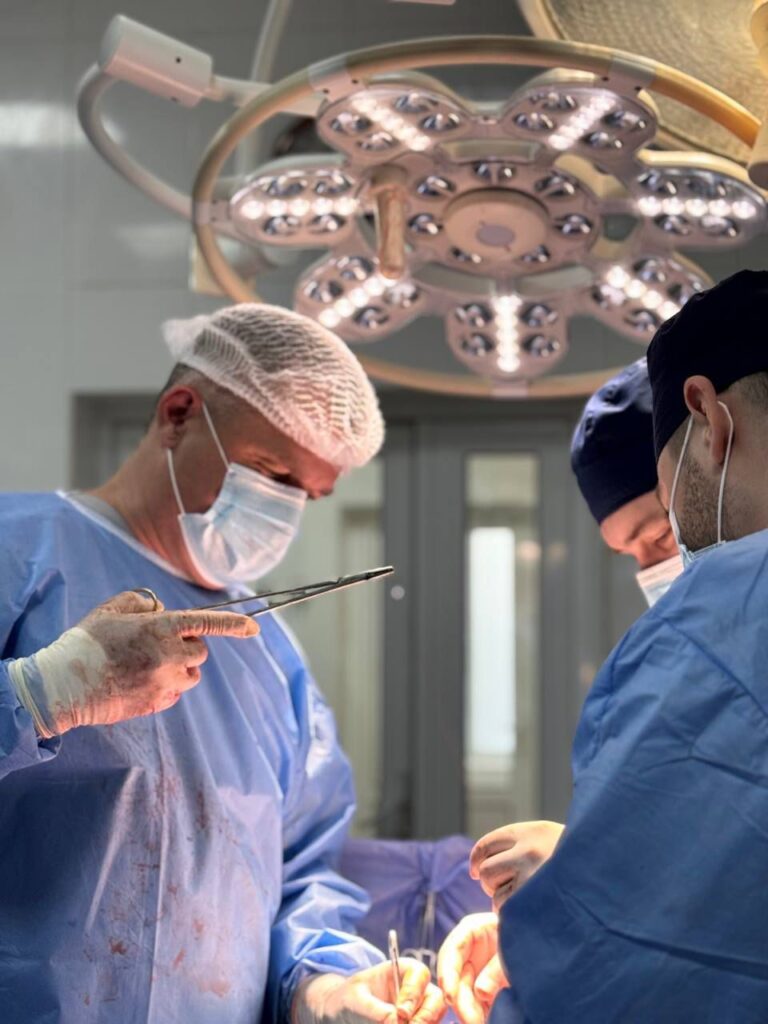
What happens when Vilnius loses power for 48 hours
Most hospitals in the Baltic States and Eastern Europe—even in major cities like Vilnius, Riga, and Tallinn—are built to peacetime standards. A single well-timed strike on a key transformer could collapse a city's medical system within hours.
The cascade is predictable: ICU ventilators fail first, then surgical capacity, then trauma services. Within 48 hours, hospitals that can't operate begin evacuating patients. Within a week, families follow.
A single strike on a key transformer could collapse an Eastern European city's medical system within hours.
Kharkiv shows that functioning hospitals are the primary factor preventing mass civilian flight. Europe risks displacement waves comparable to 2015's refugee crisis—not from war zones, but from cities where hospitals failed and populations had nowhere else to go.
Three policy changes NATO can make by 2026
NATO should add an eighth pillar to Article 3: medical resilience.
- First: NATO should establish a Medical Resilience Working Group by Q2 2026, with mandate to define minimum operational standards for hospitals under attack—including underground surgical capacity, decentralized oxygen networks, triple-redundant power, and protected reserves of ventilators, anaesthesia systems, electrosurgical devices, and trauma diagnostics. First framework delivered at NATO's July 2026 Summit.
- Second: European governments should earmark 2-4% of civil-defense budgets for medical infrastructure continuity starting in FY2027, covering generators, oxygen systems, underground capacity, and the critical equipment that keeps surgical and intensive care functional during power disruptions.
- Third: The Baltic States and Poland should launch pilot "Kharkiv Model" hospitals beginning in early 2026. Realistic milestones: pilot hospital designation by March 2026, funding secured by year-end, construction launched in 2027, with operational capacity and progress assessment by the 2028 NATO Summit. These pilots create Europe's proof-of-concept for resilient medical infrastructure.
How to demand hospital resilience from your government
Ask your local hospital how long it can operate without grid power. Request transparency from your health ministry about resilience planning. Support organizations strengthening frontline medical capacity—like 1 for Ukraine. Raise the question in NATO-member parliaments: "Does our healthcare system meet Article 3?"
Kharkiv shows that resilience is built through decisions—and those decisions begin with people who refuse to ignore what this war is teaching.
Europe's next security doctrine won't be written solely in Brussels or Washington. It's already being drafted in hospital basements in Kharkiv, Dnipro, and Zaporizhzhia.
The underground hospital in Kharkiv opens in 2027. That gives NATO exactly one budget cycle, one summit, and one chance to learn these lessons before they're tested under fire in a NATO member state. The knowledge exists. The timeline is clear. What's missing is the political will to treat hospitals as what they actually are: the infrastructure that determines whether societies endure or collapse when attacked.
Kharkiv is showing Europe how to build that resilience. The question is whether Europe acts on it before being forced to.

Editor's note. The opinions expressed in our Opinion section belong to their authors. Euromaidan Press' editorial team may or may not share them.
Submit an opinion to Euromaidan Press


