

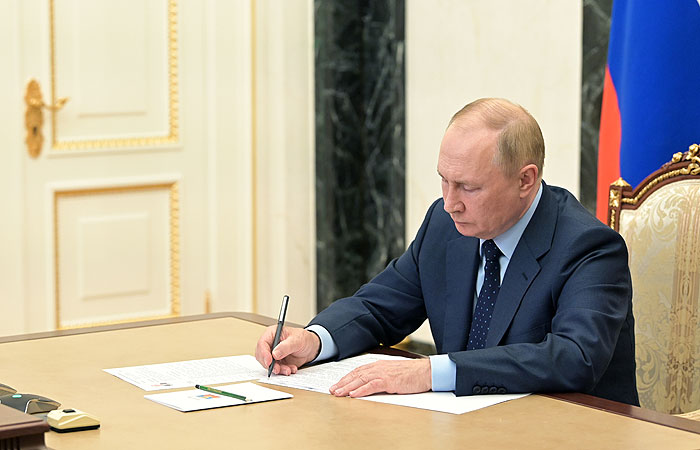
Vladimir Putin signed Presidential Decree No. 858 on 25 November 2025, establishing Russia's "State National Policy Strategy" through 2036—a document that explicitly incorporates four occupied Ukrainian oblasts into Moscow's long-term ethnic assimilation framework and sets target metrics for erasing Ukrainian identity.
The decree comes as Russia faces mounting pressure on multiple fronts: a war economy showing structural strain, Western allies debating whether to seize $300 billion in frozen Russian assets, and Ukrainian forces continuing drone strikes deep inside Russian territory. For Ukrainians under occupation, the document formalizes what human rights groups have documented as systematic identity erasure—"In fact, it is now illegal to be Ukrainian in the occupied territories," Zmina Human Rights Center advocacy director Alyona Luneva told Euromaidan Press earlier this year.
Occupied territories embedded in Russian ethnic policy
The decree repeatedly references Crimea and the Donetsk, Luhansk, Zaporizhzhia, and Kherson oblasts as subjects of Russian "national policy" requiring special integration measures. Section 26 describes the 2022 annexation as "reunification with Russia of historical territories" that "created conditions for restoring the unity of the Russian state's historical territories."
The document frames Russia's invasion as liberating Russian-speakers from "years of discrimination and violence on ethnic and religious grounds from Ukraine's neo-Nazi leadership" (Section 27).
Specific provisions mandate:
- Formation of executive bodies for "national policy implementation" in all four occupied oblasts (Section 28)
- Integration into Russia's "legal, social, economic, educational, cultural, and information space" (Section 29)
- "Counteracting manifestations of neo-Nazism and attempts to falsify history" (Section 46)
- Participation targets: at least 2.56 million residents of occupied territories in "all-Russian events" by 2036 (Section 59c)
Systematic Russian language imposition
The decree establishes Russian language dominance as central to what it calls "strengthening all-Russian civic identity." Section 38a mandates "protection, support, and development of the Russian language" as the state language and "language of the state-forming people."
This codifies policies already underway. British intelligence reported in July 2025 that Russia's Education Ministry drafted orders to eliminate Ukrainian from school curricula in occupied territories starting September 2025, citing an allegedly "changed geopolitical situation."
The strategy also targets youth indoctrination, requiring "involvement of children and youth from Donetsk People's Republic, Luhansk People's Republic, Zaporizhzhia Oblast and Kherson Oblast in implementing projects, participating in competitions and events at the all-Russian level" (Section 38b).
International law violations formalized
The decree's provisions contradict multiple international legal frameworks Russia has ratified:
UN Charter Article 2(4) prohibits "the threat or use of force against the territorial integrity or political independence of any state." The UN General Assembly Resolution ES-11/4 of October 2022 declared Russia's annexation of Donetsk, Luhansk, Zaporizhzhia, and Kherson oblasts illegal.
Fourth Geneva Convention Article 49 prohibits forcible transfers and deportations of protected persons from occupied territory, as well as transfer of the occupying power's civilian population into occupied territory. UN reports have documented over 140,000 Russians relocating to occupied Crimea between 2014-2018 alone.
Fourth Geneva Convention Article 51 prohibits compelling protected persons to serve in the occupying power's armed forces. Russia has forcibly mobilized tens of thousands of Ukrainian men from occupied territories since 2022.
The decree's provisions on "adapting foreign citizens" to Russian society and requiring them to learn Russian language, adopt Russian "legal consciousness and legal culture," and embrace "traditional Russian spiritual-moral values" (Section 40b) effectively mandate cultural assimilation of occupied populations.
Target metrics reveal assimilation goals
Section 59 establishes measurable targets for 2036:
- "All-Russian civic identity" level: minimum 95%
- Citizens positively assessing interethnic relations: minimum 85%
- Citizens reporting no discrimination based on national or linguistic belonging: minimum 90%
- Events promoting Russian culture as share of all ethnocultural events: minimum 50%
- "Foreign citizens" covered by adaptation measures: minimum 70%
The document defines success as occupied Ukrainians adopting Russian identity and reporting satisfaction with that transformation.
"Civilization-state" ideology codified
The decree frames Russia as a "distinctive civilization-state" (Section 61) whose unity depends on the "consolidating role of the Russian people as the state-forming people" (Section 39b). This ideology—previously articulated in Putin's essays denying Ukrainian statehood—now carries the force of strategic planning law.
Section 7 states Russian society is "united by a common cultural (civilizational) code" based on "preservation and development of Russian culture and language, historical and cultural heritage of all peoples of the Russian Federation."
The strategy explicitly identifies as threats: "Russophobia growing in the international space," "discrediting of the Russian language and culture," and "attempts to falsify historical truth" about World War II (Section 31).
Passport ultimatum preceded decree
The formalization follows Putin's March 2025 decree requiring Ukrainians in occupied territories to "settle their legal status" by 10 September 2025 or leave. UK intelligence assessed this was "almost certainly intended to force the departure" of Ukrainians refusing Russian citizenship, "further forcibly changing the ethnic composition of the occupied areas."
The new strategy decree takes effect 1 January 2026 and requires the Russian government to develop three-year implementation plans.
Never miss a story.Follow Euromaidan Press on Google News! Value this reporting? Support our work.
BECOME OUR PATRON!


