

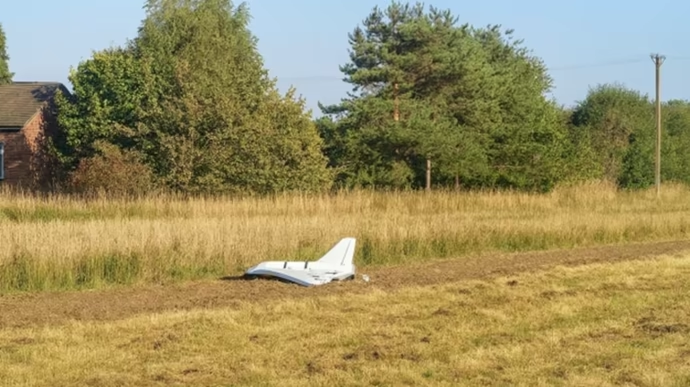
Polish Lieutenant General Maciej Klisz has revealed that the Russian drone incursion into Poland on the night of 9-10 September posed a greater danger than initially assessed, according to RMF24 and Rzeczpospolita.
"The narrative that these were objects made of cardboard and cardboard is not entirely true," Klisz told Rzeczpospolita. He said that even drones used as decoys to overload air defense systems were equipped with explosives, meaning the threat to Poland in September was real.
The scale of the incident was substantial. Klisz informed Rzeczpospolita that several hundred Russian unmanned aerial vehicles were flying from Ukraine toward Poland that night. The Operational Command treats every object heading west as a potential threat to Polish airspace. Some drones passed Kyiv and reached western Ukraine.
Twenty-three Russian drones crossed into Polish airspace, according to the general. Some were destroyed on Polish territory, while others broke apart, which may have led to inaccurate counts of the number of objects that violated the border.
Individual drones penetrated nearly 300 kilometers from the eastern border. This marked the first mass incursion of Russian drones into Poland, with approximately two dozen unmanned vehicles entering the country.
The incident prompted diplomatic action. On 18 September, Ukraine and Poland agreed to establish a joint operational group on unmanned aerial systems, which will include representatives from both countries' armed forces.
Earlier statements by Polish Prime Minister Donald Tusk indicated that no drones with warheads were found among those that fell on Polish territory. General Klisz's recent comments appear to contradict this assessment, emphasizing that the drones carried explosive materials.


