Karl Schlögel has admired Russian culture since his youth. He first traveled to the Soviet Union in 1966 as a teenager, witnessed the Prague Spring in 1968, and dedicated his career to studying Russian cities and Soviet history. He wrote books that placed Kyiv, Odesa, and Kharkiv on German mental maps decades before most compatriots could locate them.
Yet at the acceptance ceremony for the Peace Prize of the German Book Trade, the country's equivalent of the Nobel, on 19 October 2025, the 77-year-old scholar delivered a withering verdict: "We were no match for this figure of evil."
He told Germany's cultural elite to stop looking to Russia for understanding—and learn from Ukraine instead.
"As unlikely as it may sound, we Europeans would do well to learn from Ukraine: this would mean learning how to be fearless and brave, and perhaps even learning how to triumph."
The speech, delivered at Frankfurt's Church of St. Paul—site of Germany's first democratic parliament in 1848—marks a remarkable intellectual journey from Russia scholar to Ukraine's most articulate German champion.
When the old books stop working
The Peace Prize was established in 1950 in a Europe still rebuilding from the ashes of Nazism, awarded in a church that had been reconstructed as a symbol of German democracy. It represented Germany's post-war commitment to peace and cultural renewal.
That Europe is crumbling before our eyes, Schlögel warned. "Europe is now confronted not only with the phenomenon of Putinism, but also with a US president who is overturning all notions of the silent functioning of checks and balances."

Schlögel acknowledged his generation faces something entirely new. He described returning to the classic texts on totalitarianism—Ernst Fraenkel's The Dual State, Franz Neumann's Behemoth, Hannah Arendt's The Origins of Totalitarianism—written by minds trying to capture the forces that consumed Central Europe in the 1930s.
"However prescient and accurate these analyses were, we must now, at this turning point in history, set out on our own journey to capture the novelty and danger of today's situation in our own words. Heeding the lessons of Ukraine in this pursuit is helpful, indeed indispensable."
Even America has become uncertain: "I could not imagine an America, which I had come to know as a student, harbouring fears of an authoritarian regime taking hold one day soon."
"We are at a loss for words to accurately convey what is happening. This is more than just a lack of concepts or writing skills; it is the loss of the horizon of experience that has formed us till now, a reality where everything we have accumulated over the course of a lifetime seems in question, devalued, even in ruins."
Europe finds itself "alone and fully on its own in a situation where everything is in flux."
The Russlandversteher problem
Schlögel aimed his sharpest criticism at Germany's Russlandversteher—those who claim deep understanding of Russia's perspective.
"There have been many Russlandversteher, but too few who actually understood anything about Russia itself. If they had been clear-eyed, they would have explained what was in store for us."
There have been many Russlandversteher, but too few who actually understood anything about Russia itself.
Karl Schlögel
"It is astonishing how long it has taken Germany to realize the true nature of Putin's Russia." Recent German-Russian relations "are ripe for historical clarification and a reappraisal from which no one emerges clean."
The categories Germany used to make sense of Putin's empire "were in large part the product of wishful thinking and credulity, instead of ultimately having to admit that we were no match for this figure of evil."
"I could not imagine that Russia would regress into times that in many respects resembled the practices of Stalinism," Schlögel laments Russia's fall under Putin.

Not only Merkel and Schroeder: Germany’s Russia problem runs deep despite war in Ukraine
Fear as weapon, urbicide as strategy
Putin operates through "escalation dominance," Schlögel explained—"the calculated escalation of conflicts, including his calculated breach of the nuclear taboo. Fear is his most important weapon, and his true talent lies in his exploitation of fear. To this day, he considers himself the undisputed master of the proceedings."
Diplomacy serves only to "buy time, which he believes works in his favor. Those in his circle of advisors say it openly: We will break the backs of you Europeans."
When conquest fails, destruction becomes the goal: "If the country cannot be conquered, it must at least be destroyed, made unliveable. A new term is circulating: urbicide."

"Cities that were on the rise—new airports, transport routes, hotels—are being flattened by bombs. Cities have become zones where drones hunt people. The direct hit of a missile is followed by a direct hit on the rescue team."
"What was once the Ukrainian equivalent of Germany's productive Ruhr area no longer exists."
From terra incognita to Europe's teacher
Trending Now
Schlögel described Ukraine's journey from blank spot on Western mental maps to vivid presence.
"It took the Maidan Revolution and a war to finally shake Ukraine loose from the limitations of a narrow west-centred perception. It ceased to be 'terra incognita,' a blank spot on the map."
"It became present to us via our screens, through reporting; the refugees who came to us, a large and beautiful country, a Europe in miniature, connected to the world by thousands upon thousands of threads: the thousand-year-old Kyiv, Kharkiv, a metropolis of European modernity, Odesa, whose grand staircase descending to the harbour offers a look back on the entire 20th century, Lviv, Leopolis, Lvów, Lvov, Lviv, more than just a 'Little Vienna', a cultural headwater for the entire continent."
Schlögel described Kyiv, Kharkiv, Odesa, and Lviv as cities embodying "all European experiences in the 'century of extremes': The venue of revolutions, civil war, world wars, the Holodomor and the Holocaust, and finally the stage for independence and freedom after decades of struggle."

Nazi dreams of an enslaved Ukraine: the blind spot of Germany’s historical memory – Timothy Snyder
What Europe must learn from Ukraine
Schlögel reversed the typical Western narrative. Ukrainians aren't victims requiring rescue—they're instructors showing Europe how to defend democratic values in circumstances the continent hasn't faced in generations.
"No one is more interested in peace than the Ukrainians. They know that an aggressor with limitless determination cannot be stopped with words. They are realists who can afford no illusions. Their refusal to be victims drives them to fight back. They are heroes in a post-heroic world, without making a fuss about it."

"They are ahead of us in terms of military technology, as they were forced to fight at a time when we could still allow ourselves to ponder questions of eternal peace. They took it on themselves to develop weapons that were withheld from them out of hesitation or fear."
"They are the mirror into which we peer, reminding us what Europe once stood for and why it is still worth defending."
Ukrainians are the mirror into which we peer, reminding us what Europe once stood for and why it is still worth defending.
Karl Schlögel
"The citizens of Ukraine are teaching us that what is happening is not the 'Ukraine conflict', but war. They are showing us that accommodating the aggressor only increases its appetite for more, and that appeasement does not lead to peace—it paves the way to war."
The most striking lesson concerns fear: "They are calling out to us: do not be afraid—not because they are not afraid, but because they have overcome their fear."
The price of peace
Schlögel ended with what amounts to a love letter to Ukrainian resilience:
"They are prepared for anything. They fight for their children, for their families, for their state—they are prepared even to die for their country. What amounts to television footage for others is firsthand experience for them."
"To endure, to persevere, despite unspeakable exhaustion—this is the revolution of dignity in permanence."
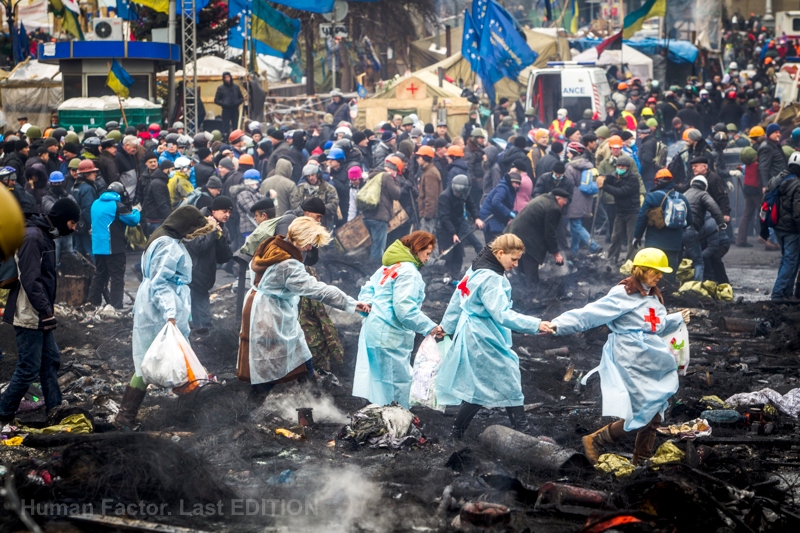
"They are the ones to whom we owe our peace, while they pay a price both incalculable and unfathomable."
His final words addressed them directly: "It is a greeting to the defenders of a free Ukraine, to the men and women who continue their work despite everything, who take their children to school despite swarms of drones, to the inhabitants of Kyiv who hole up in metro stations, to the engine drivers who navigate their trains on time from Ivano-Frankivsk to Kharkiv."
"Without a free Ukraine, there can be no peace in Europe."

Karl Schlögel, born in 1948, is one of Germany's most influential historians of Eastern Europe. His major works include "Terror and Dream" (2008) and "The Soviet Century: Archaeology of a Lost World" (2023).
The Peace Prize of the German Book Trade, one of Germany's most prestigious cultural honors awarded annually since 1950, recognizes figures who promote peace through intellectual and cultural work. Past recipients include Václav Havel, Jürgen Habermas, and Svetlana Alexievich.
Read the full speech here.