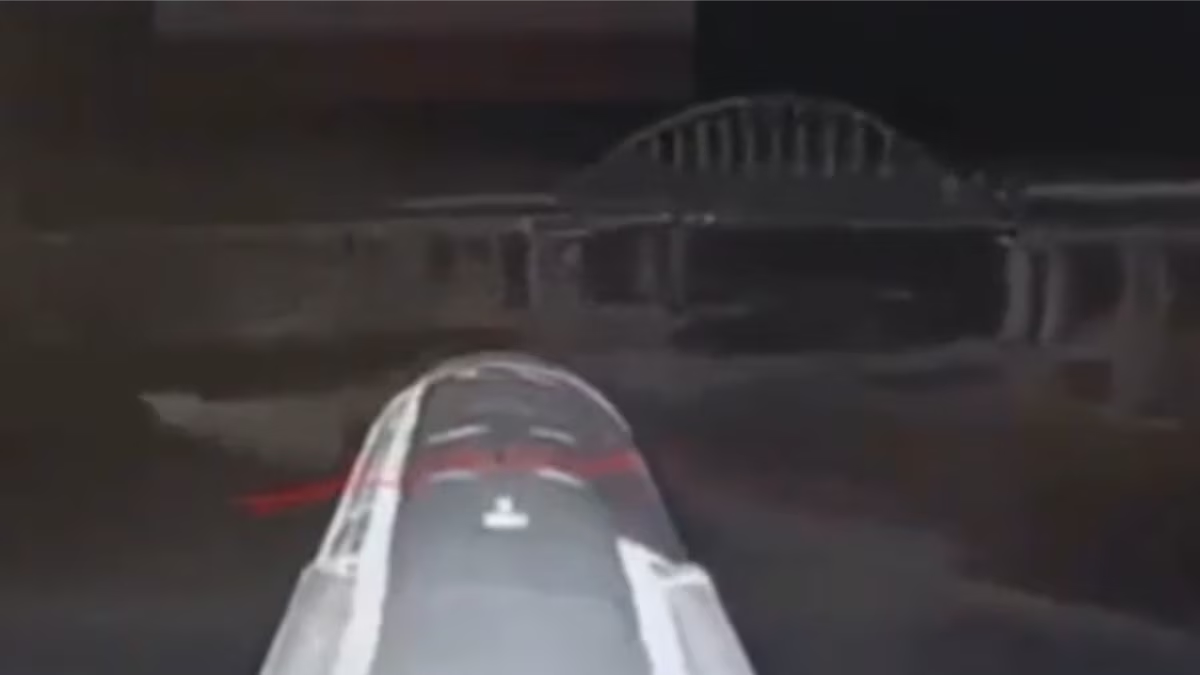
Ukrainian operators steered at least one Flamingo cruise missile into the Kerch Bridge on 17 November through a live camera feed, much as pilots fly FPV drones, the Institute for the Study of War and Ukrainian aviation expert Kostiantyn Kryvolap assess based on footage shared by Ukraine's President.
Until now, the Flamingo flew to a preset point on its own, and most known launches missed: Dnipro Osint counted 12 hits in 53 launches that left a public trace. A human watching through the missile's own camera greatly increases the accuracy of the strike, which allowed the FP-5's 1,150-kg warhead to strike the bridge with surgical precision, Kryvolap told Euromaidan Press.
This could herald a new era of higher-precision strikes for the powerful missile—even if its range will likely be limited by the reach of the mesh network, below the declared 3,000 km.

Kyiv is reportedly weighing cuts to the Flamingo missile. But now steered like an FPV drone, it does a job the Neptune can’t
Drones carried the signal instead of Starlink
According to the Institute for the Study of War, Ukrainian forces kept "a live camera feed and operator control over the Flamingo missile" until just before impact. A mesh network of drones with signal repeaters carried the signal more than 250 km from the front line. President Volodymyr Zelenskyy said the missile's "communications uplink worked flawlessly until the very last seconds."
A Ukrainian officer involved in planning the operation told The Times that "we used all these drones to pass video signals to missiles so they could hit precise points on the bridge," and that the strike showed Ukraine "can conduct such operations without Starlink," Meduza reported. ISW said the relays let Ukraine hit "structurally vulnerable points of the bridge with high precision."
Why the bridge needed a human at the controls
The bridge's 207-meter rail arch rests on four bearings, two at each end, and is held on them only by its own weight, Ukrainian aviation expert Kostiantyn Kryvolap told Euromaidan Press. The bearings let the steel arch shift as it heats, cools, and carries loads, so nothing clamps it down. The concrete piers beneath are almost impossible to destroy, he said, so the aim was to hit the gap inside a bearing and throw the arch off. That needed "absolute accuracy… neurosurgery."
Trending Now
A missile flying to coordinates lands somewhere within a circle around the aim point, and that would not have been enough, he said.
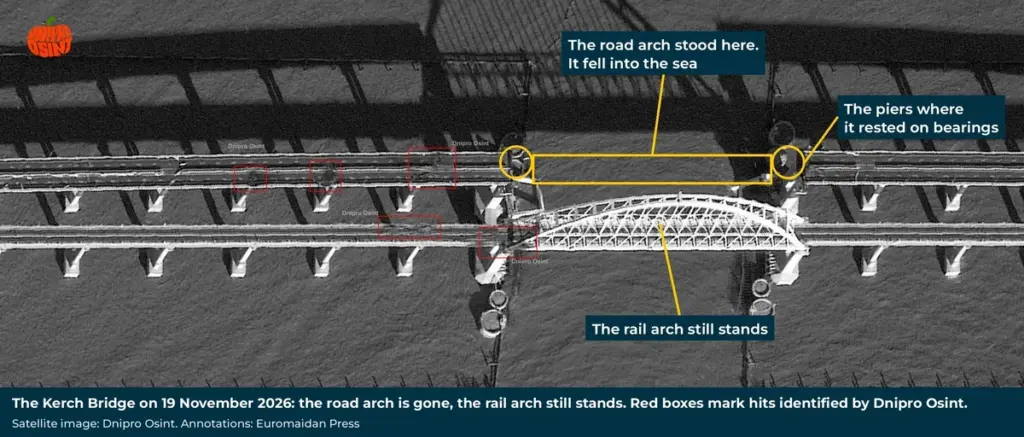
Earlier attempts on the bridge, a truck bomb, sea drones, and an underwater blast, could not deliver that precision, Kryvolap said. The Flamingo could: on top of its 1,150-kg warhead, the roughly five tons of missile left at impact carried enormous kinetic energy of their own.
Kryvolap believes the Flamingo was flown in FPV mode to the end. If the missile's video is already reaching an operator, adding a second channel to steer it is simple, he said, and with Russia's jammers around the bridge destroyed beforehand, "to the last moment they flew in as they wanted," as far as he knows.
The open question is whether a human can steer a missile that fast. Fire Point gives the Flamingo a top speed of 950 km/h. Kryvolap said he had heard of estimates from video that it was going around 400 to 500 km/h on the final approach, and compared that with fighter pilots landing at 300 to 320 km/h. He did not rule out another reading: that the missile homed in on its own and the operator only corrected it, like a driver nudging a car on autopilot.
Neither Kyiv nor Fire Point, the Flamingo's maker, has described the system in detail, and steering only works as far as the relay chain reaches, well short of the missile's claimed 3,000-km range. The upgrade lands amid rumors that Kyiv will move money from the Flamingo to the Neptune missile, which the President's Office denied. David Axe argues the two missiles can complement each other, as they do different jobs.
/