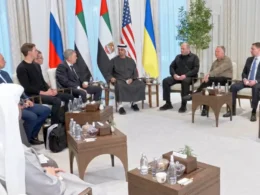
US President Donald Trump predicted a “big agreement” on Russia’s war against Ukraine that “might involve all of Europe” on 5 November, after meeting Kremlin envoy Kirill Dmitriev at the White House, Bloomberg reported. Earlier that day, Dmitriev and a Ukrainian delegation marked the truce in the Russian-occupied Ukrainian town of Oleshky there, at an event hosted by First Lady Melania Trump.
Russia’s war on Ukraine grinds on while Washington pushes for a deal. On 3 November, Russia hit Ukraine’s power grid with 59 missiles and 289 drones. The Abu Dhabi round will be the first three-way talks on ending the war since the delegations last met in winter, and Moscow has floated a Trump–Putin–Xi summit to settle the war on terms that would favor it. A deal reaching beyond Ukraine would reshape Europe’s security, yet Europe has no seat at the table.
Next week, the US will hold “the first trilateral peace discussions with Ukraine and Russia since February” in Abu Dhabi, Trump’s envoy Jared Kushner wrote on X. Washington will consult European partners “on the sidelines,” he said, and “if progress is made,” it aims for a broader format with their direct participation. Until then, Europeans are consulted on a deal Trump says may reach their continent, but they are not seated in the talks. Italian Prime Minister Giorgia Meloni wrote to European Council President António Costa on 5 November, asking EU leaders to decide “once and for all” who represents the bloc at the negotiating table, and with what mandate. Scattered national initiatives condemn the EU “to irrelevance,” she wrote, Italian daily Il Foglio reported.
A deal for “more than Ukraine”
Trump told reporters in the Oval Office he could not share what he and Dmitriev discussed. “It’s going to involve more than Ukraine, and I could even say it might involve all of Europe,” he said, AFP reported. He had not met the Ukrainian delegation.
Kushner wrote that Trump had advanced talks with several European leaders on “the need for a broader European security architecture.” He listed five goals, among them permanent security consultations and “an enduring framework for long-term European security and stability.” The US will also engage Russia as part of the peace negotiations, he added. NATO will remain central to European collective defense, Kushner wrote, and no country would have a veto over another’s sovereign choices. Consultations with Ukraine, NATO, the EU, and European partners continue in what he called the Shell Bay format.
Kyiv asks for more missions
Melania Trump brokered the 27 October–1 November truce that let civilians leave Russian-occupied Oleshky. At her event, Ukrainian lawmaker Davyd Arakhamia urged her to keep going, find new missions, and de-escalate as much as possible, but Dmitriev called the full-scale war the “Ukrainian crisis.”
Dmitriev gave the First Lady a child’s drawing and claimed the girl’s family had chosen to go to Russia. He also said humanitarian assistance to the town must continue. The same day, the Institute for the Study of War (ISW) assessed that the Kremlin is “weaponizing humanitarian crises Russia itself has created” to court the Trump administration.
On 2 November, three days before the event, Kremlin spokesperson Dmitry Peskov said that Moscow had no similar plans or initiatives for now.
Tetiana Hasanenko, head of Oleshky’s Ukrainian administration, said this week that residents who stayed report the aid is not reaching them. Her administration cannot verify this, she added. Also on 2 November, Russia’s ombudswoman Yana Lantratova said that aid deliveries to Oleshky would take place monthly, with Melania Trump mediating, Reuters reported.
Read also
-
The Oleshky truce saved hundreds, but Russia used it to bring fresh troops, armor, and fuel within nine kilometers of Kherson, marines say
-
WSJ: US pitches Russian gas through Ukraine’s pipelines as Moscow’s incentive for an energy truce
-
“Now it’s your turn”: US envoys planned to show Moscow a refinery pause and a diesel deal, then ask for something back, a source tells Reuters