


- Ukraine and the Netherlands are working together on a new missile defense project
- "Bliksem" may be an effort to develop a ballistic missile interceptor that can hit incoming missiles above the atmosphere
- It's a rare and valuable capability, and one Ukraine needs—but it won't come quickly or cheaply
Ukraine and the Netherlands will collaborate on an air-defense project called "Bliksem," Ukrainian President Volodymyr Zelenskyy announced during his visit to the Netherlands on Wednesday, 28 October.
Zelenskyy didn't offer a lot of details. But if the Bliksem initiative he referenced on Wednesday is the same Bliksem initiative that a consortium of European companies launched this summer, then Ukraine could be in line to acquire one of the world's most powerful missile interceptors.
But not quickly. Nor cheaply.

Ukraine fired its first FP-7 ballistic missile in combat. Its maker says next version will do what Ukraine needed since 2022
The pan-European Bliksem project aims to develop a so-called "exo-atmospheric" interceptor. That is, a missile that can fly higher than 100 km—above Earth's atmosphere—in order to hit the most dangerous ballistic missiles during their mid-course phase of flight, before they tip back into the atmosphere and streak down toward their targets.
On Wednesday, Zelenskyy and Dutch Prime Minister Rob Jetten met with the heads of Dutch and Ukrainian companies in the defense, energy, and software sectors, Zelenskyy said. "We defined key priorities and decisions that can strengthen our practical economic cooperation: defense production, joint technology and energy projects, industrial development, and, very importantly, satellite technologies and air defense," Zelenskyy said.
"Our teams have been tasked with working out a specific air defense project, Bliksem," Zelenskyy continued. "We have already started this work."
If the Dutch-Ukrainian Bliksem is the same as the wider European Bliksem, then it's an effort to develop a missile in the class of the American Terminal High Altitude Area Defense (THAAD) and Standard Missile-3 (SM-3), as well as the US-Israeli Arrow 3. All three are exo-atmospheric.
Cued by radars and satellites and boosted 100 km into the sky, they punch right through the hazy Kármán line that delineates the border between the atmosphere and space.
Cold of space
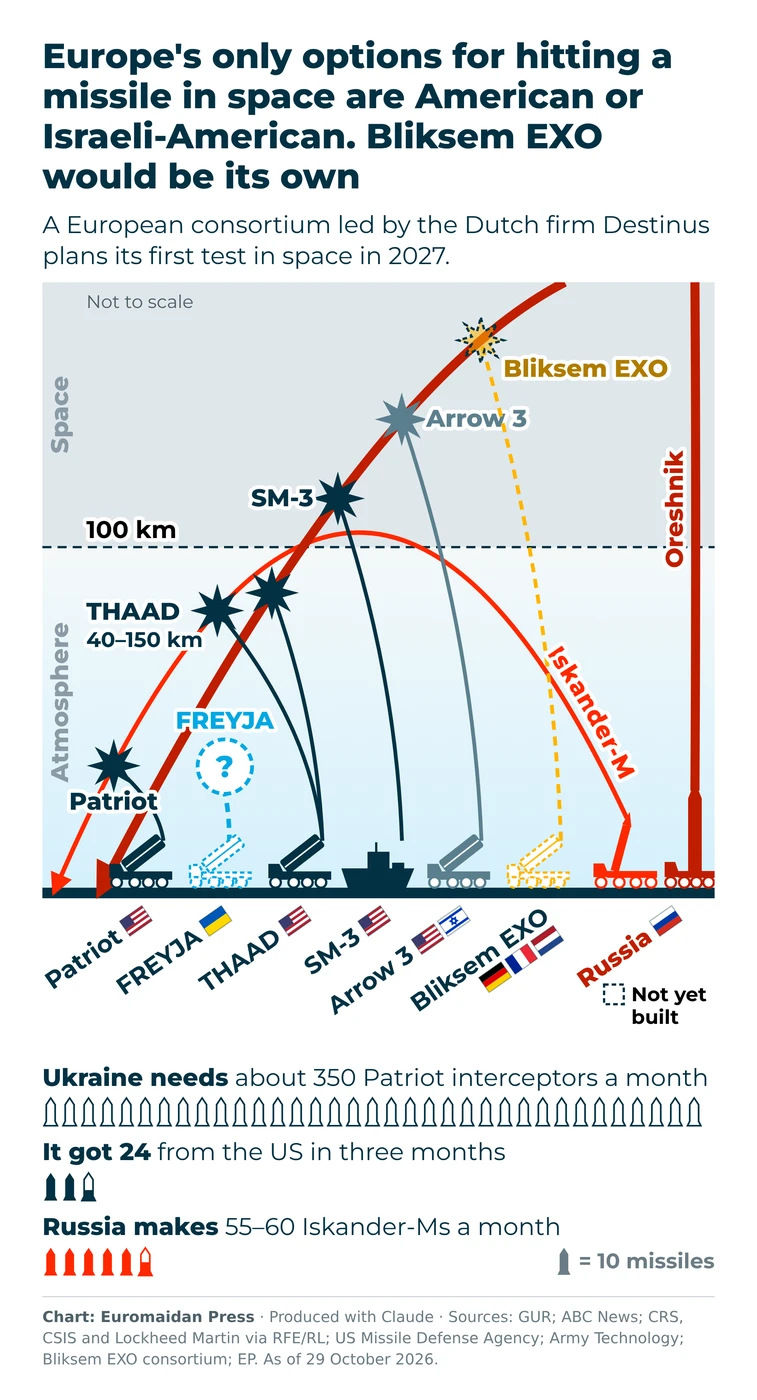
Up there in the cold vacuum, the interceptors can see clearly with sensitive infrared seekers—and distinguish incoming ballistic missiles from any decoys the missiles may deploy. Thrusters maneuver the interceptors to directly impact incoming missiles, destroying them with kinetic energy rather than explosive warheads.
While Germany has a few Arrow 3s, most European powers lack exo-atmospheric interceptors. Their only option for shooting down the heaviest incoming ballistic missiles (such as Russia's intermediate-range Oreshnik) is to hit them in the final seconds of flight, when even a destroyed ballistic missile can cause damage by scattering supersonic debris.
To plug that air defense gap, this summer five European companies—Destinus, MBDA, Safran, Airbus, and Thales—signed a letter of intent to form the Bliksem EXO consortium. The goal: to test the interceptor's kill vehicle in space in 2027.
The companies signed in Paris at the first meeting of an anti-ballistic coalition that Ukraine launched with nine European countries, including the Netherlands, with Dutch Prime Minister Rob Jetten present. They said the design would draw on Ukraine's experience against Russian missiles. The lead firm, Destinus, is Dutch. Given Zelenskyy's statement, it's possible Ukrainian firms will join the consortium itself.

Ukraine’s answer to Russia’s jet Shaheds: a jet drone named Bars, built to strike Russia and now turned around to hunt them
If the timeline holds and any technology Bliksem EXO develops actually works, the result could be a new interceptor rivaling the THAAD, SM-3, and Arrow 3—and one unbound by American export restrictions. Europe could arm itself for mid-course missile defense. Ukraine could, too, significantly stiffen its missile defenses that are in a state of collapse owing to a deepening shortage of American-made Patriot missile interceptors.
Don't expect Bliksem to bear fruit quickly or cheaply. The THAAD, SM-3, and Arrow 3 interceptors each needed a decade or more to move through development to deployment. And leaving aside their multi-billion-dollar development costs, the missiles are expensive. A single THAAD interceptor costs $12 million. Even the Americans can't afford to stockpile more than a few hundred THAADs at a time.
Trending Now
A Bliksem interceptor could eventually—and at great cost—lend Ukrainian forces a capability they currently lack: an active defense against a big ballistic missile like the Russian Oreshnik.
Ukraine is also building its own anti-ballistic system, FREYJA, with European partners. Zelenskyy wrote on 21 October that officials had found ways to speed it up so it reaches testing by the end of this year.
But neither project will solve a much more urgent problem: how to shoot down the dozens of smaller ballistic missiles Russia has been launching at Ukrainian cities every month. Ukraine got only 24 Patriot interceptors from the US in three months and needs about 350 a month, Zelenskyy told ABC News on 23 October. Meanwhile, Russia produces 55–60 Iskanders a month, according to Ukrainian military intelligence.
To stop the ballistic barrage, Ukraine simply needs more Patriots—and soon.
Read Also
-
This is the fancy new F-16 Ukraine could get. It’s not what its pilots need most.
-
One year of Ukrainian arms exports, and industry has questions: how much army gained, where Berlin office is, who joins joint ventures
-
Ukraine’s answer to Russia’s jet Shaheds: a jet drone named Bars, built to strike Russia and now turned around to hunt them


