


- The Ukrainian navy says one of its Neptune anti-ship missiles hit the Russian frigate Admiral Essen at Novorossiysk overnight on 8–9 September
- Ukraine's general staff confirms hits on three ships in the raid; open-source analysts read the satellite imagery as showing a second Kalibr carrier, a Buyan-M corvette, knocked out
- It'll take many more strikes to reduce the Russians to zero Kalibr capacity
A Ukrainian Neptune anti-ship cruise missile struck the Russian missile frigate Admiral Essen in the port of Novorossiysk in southern Russia overnight on 8–9 September, the Ukrainian navy claimed. Satellite imagery published by the Ukrainian open-source group Exilenova+ shows fires and apparent damage consistent with the claim. How badly the ship is hurt is unclear.
But if the navy is correct and one of its truck-launched Neptunes hit Admiral Essen, it would be a major victory for Ukraine—and a major loss for Russia. Pummeled by Ukrainian missiles and drones, the Russian Black Sea Fleet has lost or had damaged around a third of its combat strength, by Ukraine's own reckoning. No more than eight of the surviving vessels carry launchers for launching the fleet's best missile: the Kalibr cruise missile.
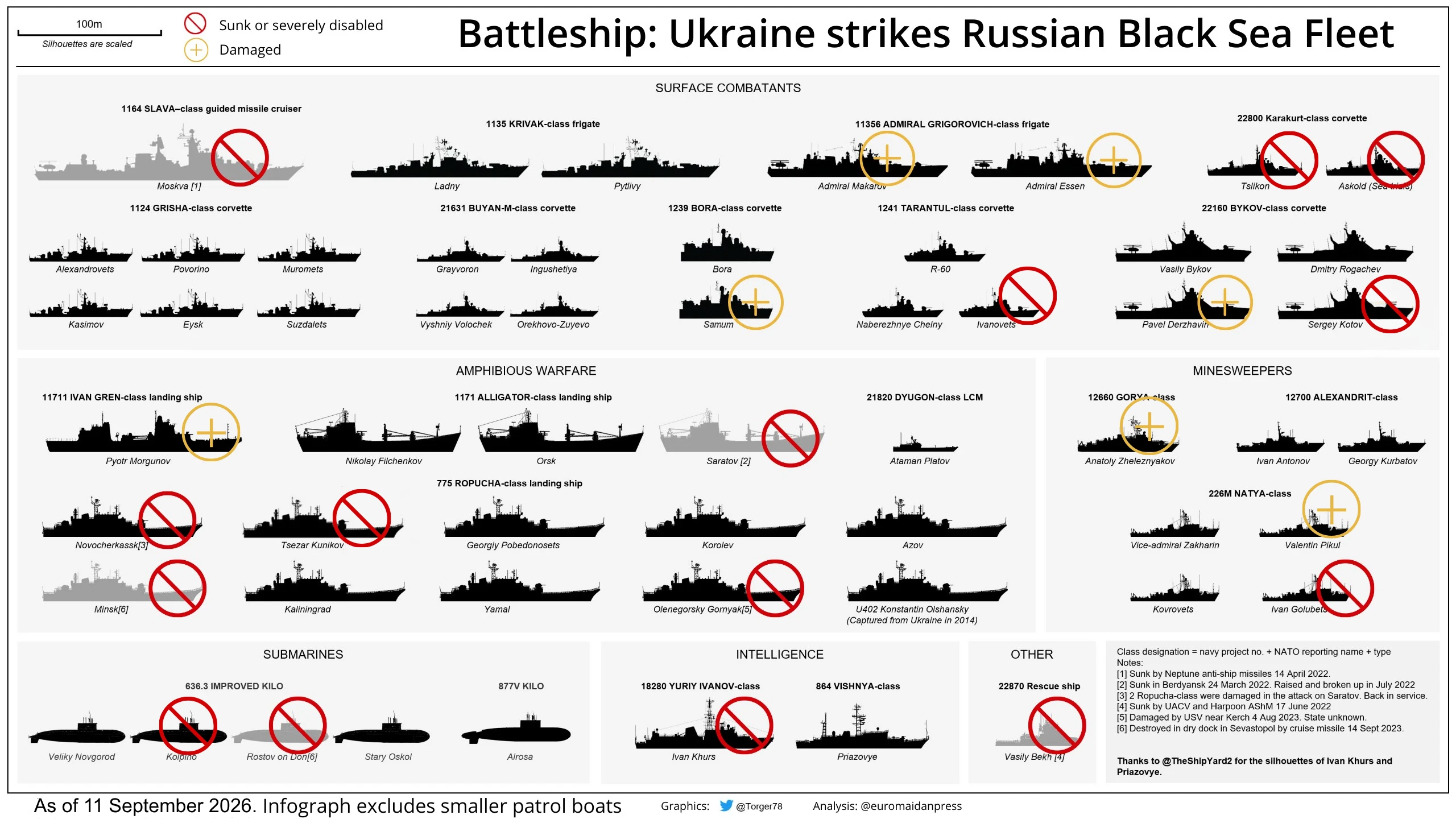
Taking out those eight Kalibr shooters—two frigates, three corvettes, and as many as three submarines—is a top priority for Ukraine. Preserving the Kalibr ships is one of Russia's top priorities as it escalates its bombardment of Ukrainian cities, factories, warehouses, and power plants.
And the frigate wasn't the only ship in the target set. Ukraine's general staff confirmed hits on three vessels—Admiral Essen, the minesweeper Zheleznyakov, and the landing ship Pyotr Morgunov—along with fuel-oil storage at the port. Exilenova+ reads the imagery as showing two more Kalibr carriers hit: a Kalibr-armed Buyan-M corvette knocked out of action, and fresh damage to sister frigate Admiral Makarov.

Ukraine reported hitting warships and an oil terminal in a Russian port city whose mayor claimed only falling debris
To be clear, it's evident the Ukrainians have already hit Admiral Essen and Admiral Makarov. A Ukrainian drone raid targeting Novorossiysk on 12 August resulted in what appeared to be direct hits to the forward missile cells on both ships.
Admiral Essen and Admiral Makarov can launch as many as eight of the 2,500-km Kalibrs at a time from these 3S14 cells. Damage the cells, and the frigates can no longer threaten Ukraine. At least until the Russians can effect repairs. Ukraine's military intelligence directorate described this week's damage as a fire on Admiral Essen's deck superstructure—not its missile cells.
Hitting one of the frigates with a 900-km/h Neptune's 260-kg warhead, as opposed to the much lighter warhead on a much slower drone, could do more than temporarily sideline the ship. It may cause irreparable damage, effectively removing the vessel from the Black Sea Fleet's dwindling order of battle.
Recall that a pair of Neptunes from a much earlier batch of the increasingly powerful missile sank the Russian missile cruiser Moskva in April 2022, initiating the ongoing battle over the Black Sea that has seen the Russians gradually lose irreplaceable ships—and gradually pull back surviving vessels into Novorossiysk's protected basin.
Unsafe haven
Novorossiysk, 350 km from the southern front line, is safer for Russian ships than are, say, the ports of occupied Crimea. But it's not actually safe. Ukrainian drones and missiles routinely target the port and the dozens of ships moored inside.

Trending Now
Most of the Ukrainian munitions miss or get shot down. Undeterred, Ukrainian deep strike forces have only intensified their strikes. Launching more Neptunes would represent another escalation. Drones damage. Neptunes destroy.
Even if one or more Neptunes finally took Admiral Essen out of action this week, there's more work left to do. The Russians normally fire fewer than 10 Kalibrs as part of the mix of missiles and drones they hurl at Ukrainian cities once a week or so.
A single frigate can fire eight Kalibrs at a time. So can a single corvette. A submarine might fire four Kalibrs. Even with Admiral Essen off the board, the carriers that may still be combat-capable can put 16 to 20 Kalibrs into the air at once, per Defence Express. Before 2022 the theoretical figure was 76.
Ukraine's navy puts the number in the same range. On 21 August, spokesman Dmytro Pletenchuk counted three surface ships and two submarines able to fire Kalibrs, with both frigates excluded as damaged. He also noted the fleet used its missile carriers once in August, down from three times in July, and now fires from inside protected harbors rather than putting to sea.

But more and better Neptunes may be coming to Novorossiysk. More Kalibr shooters may burn. Ukrainian missile-maker Luch Design Bureau has steadily improved the Neptune with greater range and payload while also increasing production. An open-source tally published by Ukrainska Pravda counted 26 verified Neptune hits on Russian land targets between 2023 and mid-2026.
Ukraine seems determined to eventually reduce the Black Sea Fleet's Kalibr capacity to zero. It will take time and many more strikes, of course. How soon the Ukrainians can send more Neptunes to Novorossiysk may determine how many more Kalibrs blast Ukrainian cities.


