

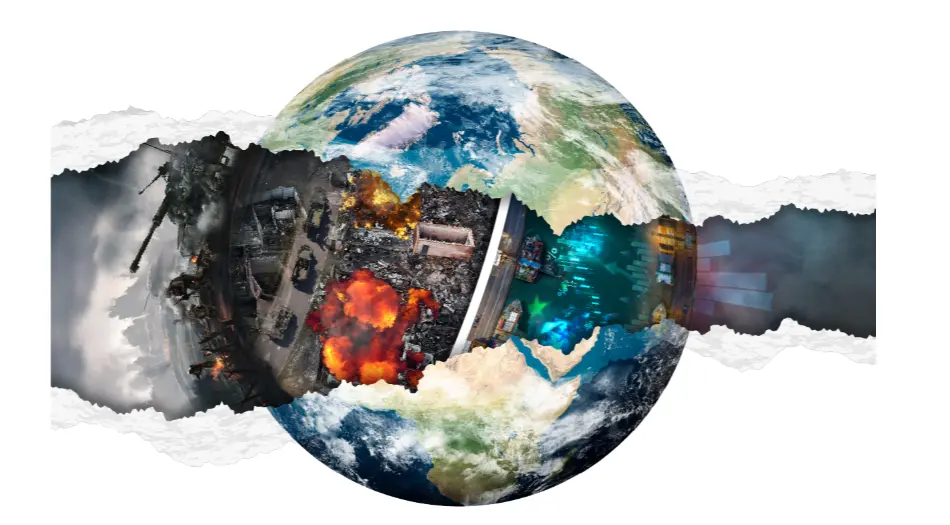
For most of the past three decades, geopolitics was considered a concern for governments, diplomats, and academics. Business leaders operated in a world where the rules were relatively stable, supply chains were optimised for efficiency rather than resilience, and the assumption underlying most corporate strategy was that the international system would more or less hold together. That assumption no longer holds. The events of the past several years have made geopolitical risk a board-level concern in ways that would have been difficult to imagine at the turn of the millennium. The COVID-19 pandemic exposed the fragility of globalised supply chains.
Russia's invasion of Ukraine demonstrated that large-scale conventional warfare in Europe was not a relic of the past. The accelerating rivalry between the United States and China has turned semiconductor chips, rare earth minerals, and artificial intelligence into instruments of statecraft. And the 2026 Iran war — with its weaponisation of the Strait of Hormuz and its cascading effects on global energy and shipping markets — has confirmed what many risk analysts had long argued: that geopolitical disruption is not an occasional shock to be absorbed, but a structural feature of the environment in which business now operates.
The cost of geopolitical ignorance
The financial cost of being caught off guard by geopolitical events has never been higher. Companies that had optimised their manufacturing around single-source suppliers in politically unstable regions found themselves unable to fulfill orders when those regions became conflict zones or sanctions targets. Businesses that had ignored the trajectory of US-China relations suddenly faced export controls that made their products unsellable in key markets. Firms that had dismissed energy price volatility as a temporary inconvenience found their cost structures upended by a geopolitical crisis they had not modelled for.
The pattern is consistent: companies that treat geopolitical risk as someone else's problem tend to discover, at significant cost, that it is very much their own. What distinguishes the companies that navigate geopolitical disruption successfully is not luck or size. It is the quality and timeliness of their intelligence. The businesses that weathered the Hormuz crisis most effectively were those that had already mapped their exposure to Gulf energy routes, had alternative supply arrangements in place, and understood — before the crisis peaked — what the political dynamics of the region made probable.
From risk management to strategic advantage
There is a more ambitious way to think about geopolitical intelligence than simply as a risk management tool. For companies willing to invest in genuine analytical capacity, geopolitical insight is a source of competitive advantage. Understanding where a conflict is heading before your competitors do allows you to reposition supply chains, lock in contracts, and enter or exit markets at the right moment. Understanding the trajectory of regulatory change — which sanctions regimes are likely to tighten, which trade relationships are likely to fracture, which governments are likely to fall — allows businesses to make capital allocation decisions that others are not yet in a position to make.
This is the logic behind the growing demand for what analysts call geopolitical intelligence — analysis that goes beyond surface-level news coverage to provide structured, expert-driven assessments of political risk and its commercial implications. Platforms like Eagle Intelligence Reports have emerged precisely to meet this demand, bringing together military analysts, former diplomats, academic specialists, and regional experts to produce the kind of rigorous, evidence-based analysis that business decision-makers require but that conventional media rarely provides.
What good geopolitical intelligence looks like
Not all geopolitical analysis is created equal. The market for political risk commentary has expanded rapidly, and with it the volume of superficial, agenda-driven, or simply inaccurate analysis available to business audiences. Good geopolitical intelligence has several distinguishing characteristics. It is grounded in deep regional and institutional knowledge — written by people who understand not just what is happening but why, and who have the professional background to assess the significance of events that may not yet be visible in mainstream reporting.
It is analytical rather than merely descriptive — it does not simply report what happened yesterday but provides a structured assessment of what it means and what is likely to follow. And it is honest about uncertainty — acknowledging what is not known rather than projecting false confidence about inherently unpredictable political dynamics. For business audiences, this kind of analysis needs to be accessible without being dumbed down. The decision-maker reading a geopolitical brief does not need a doctorate in international relations. They need a clear, well-structured assessment of the risk landscape relevant to their sector, their markets, and their strategic decisions — delivered by people who do have that expertise.
The sectors most exposed
While geopolitical risk now touches virtually every industry, some sectors face particularly acute exposure. Energy companies and utilities are directly affected by conflict in producing regions and by the weaponisation of energy as a tool of statecraft. Financial institutions face exposure through sanctions regimes, currency volatility, and the shifting architecture of international payments.
Technology companies operate at the intersection of great power competition, where export controls, data localisation requirements, and industrial policy are reshaping the competitive landscape. Defence and aerospace contractors are experiencing demand shifts that are directly driven by the rearmament decisions of governments responding to a more dangerous world. For all of these sectors, the quality of geopolitical intelligence available to senior leadership is not a peripheral concern. It is a direct input into decisions about where to invest, where to divest, what risks to hedge, and what opportunities to pursue.
Conclusion
The era in which business could treat geopolitics as background noise is over. The companies that will navigate the next decade most successfully will be those that invest in the analytical capacity to understand the political environment they are operating in — not as a one-time exercise in scenario planning, but as an ongoing discipline embedded in how they make decisions. The good news is that the tools to do this are more accessible than they have ever been. The question is whether business leaders are willing to treat geopolitical intelligence as the strategic necessity it has become, rather than the optional extra it was once considered to be.


