


Ihor Bezkaravainyi was driving a vehicle in an infantry battalion of the 9th Brigade in 2015 when a Russian TM-62 anti-tank mine blew it up. He lost his leg. After rehabilitation, he entered the public sector, and now, as Deputy Minister of Economy, Environment and Agriculture, he is responsible for coordinating Ukraine’s response to the same weapon that almost killed him.
Bezkaravainyi expects parts of Ukraine to remain unusable for generations, comparable to the radiation zones of Chornobyl or the unexploded-shell zone the First World War left in France.
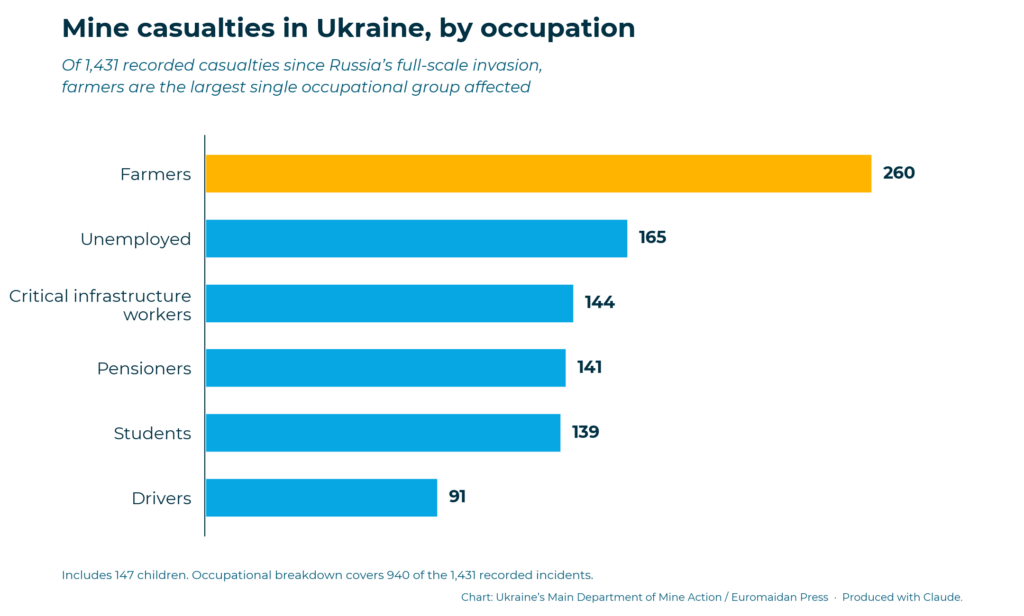
Since the full-scale invasion, Ukraine has recorded 1,431 casualties from mines and unexploded ordnance, 147 of them children, as of 1 April 2026.
Russia’s war has affected roughly 133,300 km² of Ukrainian territory, including 57,900 km² of agricultural land—an area larger than Croatia. The economy loses an estimated $11 billion every year as a result.
Since the full-scale invasion, explosive remnants of war have killed 429 people in Ukraine and injured 1,077 more—1,506 casualties in total, including children, according to data from the Information Management System for Mine Action (IMSMA) shared by Ukraine’s Ministry of Economy in May 2026.
Bezkaravainyi spoke to Euromaidan Press about cleaning up after one of the most heavily mined wars in modern history, why the international playbook keeps failing on contact with Ukraine, and why innovation has been better at killing in this war than at cleaning up after it.
Peeter Helme: This work is personal for you.
Ihor Bezkaravainyi: Yes. Everything we are doing now to rehabilitate and restore the country is the result of war, and this war started 12 years ago. In 2014, I signed a contract with the 9th Brigade and served as a vehicle driver in an infantry battalion. In 2015, my vehicle was blown up by a TM-62 anti-tank mine.
For a mine, it makes no difference whether you are a civilian, a serviceman, or an animal.
I was injured and lost my leg. I underwent rehabilitation in Ukraine and, in 2017, began my career in the public sector. Now I am responsible for several issues at the ministry, including humanitarian demining and coordinating Ukrainian and international stakeholders working on this topic.
But I should add that for a mine, it makes no difference whether you are a civilian, a serviceman, or an animal. That is the nature of the problem.
Peeter: How serious is the scale of contamination today, and what does it mean in practice for farmers and rural communities?
Bezkaravainyi: The annual economic losses from contaminated land are around $11 billion. Around $9 billion of that is lost exports, and roughly $1.1 billion is lost local tax revenue. About 57,900 km² of agricultural land has been affected, which is approximately 40% of the 133,300 km² of national territory affected by the war.
Kharkiv Oblast alone accounts for roughly 475 km² of confirmed or suspected hazardous agricultural land. That is about 59% of all such areas in Ukraine. Mykolaiv has around 205 km², and Kherson around 111 km².
Demining is not really about metal detectors. It connects to every part of governance.
But the scale is only part of the story. When people hear “demining,” they imagine sappers in protective suits with metal detectors. Demining is not really about metal detectors. It connects to every part of governance—security, economy, agriculture, environment, social impact, healthcare, and digitalization.
We started by focusing on agricultural land because returning a field to productive use generates revenue for the farmer this season and next season. That revenue circulates through the economy and helps fund general restoration.
Peeter: Tell me about the compensation program for farmers. How does it actually function?
Bezkaravainyi: It started from a number we refused to accept. A few years ago, a widely cited report, I believe Time picked it up, suggested Ukraine would need 700 years to be demined. We were not satisfied with that, so we started thinking about what we could change.
The bottleneck was simple. We had farmers who needed clearance, and Ukrainian companies ready to provide it. The missing piece was payment, because farmers do not have those resources. So we built a state program that pays for the service when a farmer applies.
We filter for farmers who are officially registered in the area, pay taxes, and have no record of cooperation with the Russian Federation.
A farmer applies through the state agrarian register. We filter for farmers who are officially registered in the area, pay taxes, and have no record of cooperation with the Russian Federation. Then we assess what the clearance will require—what kind of ordnance is likely on the site, how active the area was during combat. Operators bid for the contract, and competition drives prices down.
More than 15,500 hectares have already been cleared and returned to farmers under the program. The average cost is around UAH 60,000 per hectare ($1,360). The state has allocated UAH 2 billion ($45 million) this year within the Ukraine Facility framework.
The costs have risen. Prices are about 30% higher now than two years ago, partly because of broader economic shifts and partly because the tasks themselves have become harder.
When we started, we worked on the easiest cases first—fields with a few craters and a destroyed tank or two. As we move to fields with trenches, combined minefields, and cluster munitions contamination, the work becomes much more demanding. War is not cheap. The result of war is not cheap either.
Two weeks before this interview, an operator clearing a field in Kharkiv Oblast uncovered a large Second World War air bomb.
We have changed the rules of the program six times so far. We are preparing the next round of changes now, and I expect we will need to change it once or twice more after that. We started with too many restrictions because nobody knew how it should work. We refine it as we go.
One thing the program keeps surfacing is older history. In the past year, companies clearing agricultural land have found Second World War ordnance on three different sites. Two weeks before this interview, an operator clearing a field in Kharkiv Oblast uncovered a large Second World War air bomb two meters underground. We came to clear after a modern war, and we kept finding the previous one.
Peeter: You said earlier that you initially deprioritized forests. What changed?
Bezkaravainyi: When we built our prioritization two years ago, we followed the international mine action standards: first infrastructure, then socially important sites like schools and hospitals, then economic activities, then everything else, including natural parks and forests. It looked like common sense.
On one side, we were following international best practice. On the other side, we faced a problem the standards had not anticipated.
Then last summer, the wildfires started. It was impossible to manage them. The roads were mined, so firefighting trucks could not get through. We lost firefighters, and we lost a lot of forest.
In Kharkiv Oblast, we could not even deploy helicopters, because the front line was too close. Ordinary trucks and machinery could not move on mined roads. On one side, we were following international best practice. On the other side, we faced a problem the standards had not anticipated.
We lost two years on the forests. Now we are starting again from scratch, building a forest program with our partners and applying what we learned from agriculture.
Peeter: You also use a more systematic prioritization tool to decide what gets cleared first. How does it work?
Bezkaravainyi: Yes, we are using a tool called Ground Rehabilitation Through Innovative Technology, or GRIT, to cross-reference information. The idea is to use high-performance computing to analyze data from hundreds of sources and identify which areas the government should clear first.
We assess four pillars. Security is the foundation: what is the probability that hostilities will return to this area? If it is close to the front line, it is deprioritized. Then we balance three pillars that often pull against each other—economic, social, and environmental impact. If you optimize only for economy, you lose the environment and society. If you optimize only for the environment, you lose the economy and society. We use AI and modeling tools to balance these.
Trending Now
A small piece of land may not look important, but if it is a school playground contaminated with mines, the social impact makes it a priority.
This year, we prioritized 5,000 hectares using this method, ranked from first to last, with clear reasoning attached to each entry.
GRIT also helps with cases where economic logic alone would point in the wrong direction. A small piece of land may not look important in economic terms, but if it is a school playground contaminated with PFM-1 butterfly mines, the social impact makes it a priority. Children are involved, a community is affected, and that field must be cleared first, regardless of its economic value.
Humans make the decisions in government. But they should be based on evidence, not on feeling.
The opposite case also exists. Sometimes, a few people live in a small, destroyed village, and returning safety to that area would be enormously expensive. In those situations, the more realistic answer may be to help those families relocate rather than try to restore the village.
The supercomputer does not make these decisions. It prepares the evidence. Humans make the decisions in government. But they should be based on evidence, not on feeling, which is exactly how we ended up with the forest mistake.
Peeter: You have suggested some territories may never be safely cleared.
Bezkaravainyi: Right now, we are trying to apply known skills to a problem that exceeds them. When I imagine what comes after we win, it gets harder, not easier. What is happening in the 20-kilometer zone along the front line is not described in any international standard. Drones, fiber optics, and new equipment—this is not a future problem. It is the reality now.
We can compare it to Chornobyl. To Fukushima. It is our assessment that something similar will happen in Ukraine on a large scale: areas where we will never operate safely.
There is a comparable historical case. The First World War left France with the Zone Rouge, territory deemed too dangerous to ever return to productive use. We can compare it to Chornobyl. To Fukushima. It is our assessment that something similar will happen in Ukraine on a large scale: areas where we will never operate safely. We do not have full evidence yet, but the trajectory points that way.

Peeter: Another area where international standards have not kept up involves civilians near the front line. How did that come up?
Bezkaravainyi: It came up because we ran into a category of demining that international standards do not cover. We talk about humanitarian demining as a structured, methodical process, but we also have what we call operational demining—the fast government response that follows immediately after a strike. If a Shahed lands in a cultivated field, no chapter in the International Mine Action Standards (IMAS) tells you what to do next. It does not exist.
In practice, a child takes a bicycle, rides into a field, and starts working on a Shahed with a screwdriver.
In areas where Shahed drones regularly come down, children began disassembling them with screwdrivers to harvest microchips and components. When our mine awareness teams went into schools, the children started asking us to teach them how to do this safely.
The first reaction from international specialists was that this must be strictly prohibited. In theory, yes. In practice, a child takes a bicycle, rides into a field, and starts working on a Shahed with a screwdriver. Prohibition does not work. We have to engage with reality.
Where innovation helps us is in data analysis: knowing where not to look so we do not waste resources.
This is the broader point about innovation. There is no existing technology that can speed up demining the way people imagine. Small plastic mines under vegetation cannot be identified by drones or satellites. Machines cannot excavate anti-vehicle mines like the TM-62; human labor is required afterward.
Demining machines do not actually demine—they identify, and humans clear. Where innovation helps us is in data analysis: knowing where not to look so we do not waste resources on land that was never mined. Innovation works very well for killing in this war. Unfortunately, it works less well for cleaning up after it.

Peeter: So, how long will Ukraine actually need?
Bezkaravainyi: It depends on when the war ends and on what terms. For the existing problem at our current capacity, I estimate around 10 years to make a meaningful difference. That is a different number from 700.
That is the modern war. And the modern war is not yet described in any mine action standard.
But the 20-kilometer zone along the front line, and whatever lies behind it on the Russian-controlled side, is a different problem entirely. That is the modern war. And the modern war is not yet described in any mine action standard. We are writing the standards as we go.


