Tens of thousands of foreign nationals have been funneled into Russia’s military through a system that increasingly relies not on ideology, but on individual vulnerability.
Some sign up for money. Others are pressured, misled, or effectively forced. Many only realize they are headed to the front when it is too late to refuse.
This system provides a steady stream of manpower for high-intensity combat, shifting part of the human cost of the war from Russians themselves onto vulnerable foreign populations.
A joint report by the International Federation for Human Rights and Truth Hounds shows that at least 27,000 foreign nationals from more than 130 countries have joined the Russian Armed Forces since the start of the full-scale invasion of Ukraine in 2022. This number rises further when including state-backed deployments such as North Korean troops.
This recruitment represents a structured system designed to meet Russia’s manpower demands. The report categorizes these fighters not as a uniform group of mercenaries, but as individuals driven by a mix of motivation, coercion, and circumstance.
These include ideologically driven recruits, those seeking financial gain, individuals pressured into signing contracts, and people who may qualify as victims of human trafficking. In practice, these categories often blur, as initial consent gives way to coercion or deception once recruits enter the system.
“What is actually happening is that Russia has created a system of predatory recruitment that now covers many countries across the so-called Global South,” Truth Hounds associate researcher and advocacy expert Maria Tomak told Euromaidan Press.
“And of course this issue matters deeply, because what we are witnessing is essentially the exploitation and enslavement of vulnerable people, turning them into expendable material for a war taking place in Europe.
“What is ultimately at stake here is human dignity and freedom. The concept of enslavement is historically painful for many parts of the world, especially for Africa, and I do not think people are willing to accept any return to such practices in a new form,” Tomak said.
From ideology to opportunism
In the early stages of the war, foreign fighters on Russia’s side more closely resembled traditional ideological volunteers. Many were drawn by far-right or anti-Western views, or by narratives of civilizational conflict and pan-Slavic identity. Some had prior military experience and saw Ukraine as another front in a broader ideological struggle.
That pattern has shifted significantly. The report finds that ideologically motivated fighters now make up only a small fraction of foreign recruits. The expansion of the war, combined with heavy battlefield losses, has pushed Russia to move beyond niche ideological networks.
Recruitment has become more pragmatic and more global, targeting individuals based less on belief and more on vulnerability.
“It is not an either-or situation. We are still dealing with large numbers of mercenaries — we know they have been used by Russia since 2014, and they are still there today. At the same time, we can also see that, as a result of the recruitment system created by Russia, there are many cases in which people’s stories bear clear signs of human trafficking,” Tomak said.
“We are not claiming that all foreign recruits are victims. Obviously, that is not the case. But some of them may indeed qualify as victims of trafficking or exploitation, and this is not limited to isolated or accidental incidents,” she added.

Financial incentives and hidden realities
Financial desperation serves as a primary motivator for recruitment. Russia offers relatively high salaries (especially for those coming from lower-income countries), large signing bonuses, and fast-track citizenship for foreign nationals willing to sign military contracts.
In some regions, payments can reach tens of thousands of euros, creating a powerful pull for individuals from economically disadvantaged backgrounds.
On the surface, this resembles classic mercenary recruitment. However, the report highlights that these contracts are often opaque or misleading. Many recruits sign documents written only in Russian, without translation or proper explanation. Key conditions, such as the inability to terminate contracts during mobilization, are frequently not disclosed.
As a result, individuals who initially join for financial reasons often find themselves trapped in a system they did not fully understand. The promise of stable income or citizenship can quickly give way to frontline deployment under conditions far more dangerous than expected.
For many recruits, the decision to join was the final outcome of a "cascade of setbacks" that exhausted all conventional options.
One Nepali interviewee described a decade of struggle, including six years of labor in Malaysia spent entirely on loan interest and a subsequent truck-driving accident. Another, a former construction contractor, saw his business destroyed by the pandemic.
Supporting large households, these men viewed the Russian military salary not as a career choice, but as a desperate "breakthrough" to clear mounting debts.
The report also highlights how personal trust and legal precarity override the known risks of war. A Sri Lankan navy veteran, whose pension was rendered worthless by inflation, followed a colleague of 22 years to Russia simply because he "trusted my friend wouldn’t let me down."
Others, like a former cook in Moscow facing deportation, saw military service as the only path to legal residency. For these men, the war was a known danger, but it was assigned less weight than the certainty of economic ruin at home.
By early 2026, data indicated at least 842 Nepali nationals had joined the Russian Armed Forces, with at least 115 confirmed killed in action.
Coercion inside Russia
For many migrants already inside Russia, recruitment is not truly voluntary. The report documents a pattern of coercion targeting foreign nationals, particularly from Central Asia, who live in precarious legal and economic conditions. These individuals are vulnerable to police harassment, detention, and deportation.
Many migrants from Central Asia are driven to Russia by systemic poverty and a reliance on remittances to support families back home. This economic dependence forces them into a predatory bureaucratic system where the threat of losing their livelihood or being barred from re-entry serves as a powerful tool for state control.

Authorities have used this vulnerability as leverage. Migrants have been detained in raids on workplaces, dormitories, and even places of worship. They are then presented with a stark choice: sign a military contract or face deportation, criminal charges, or continued detention.
In more severe cases, coercion includes physical violence, confiscation of documents, and fabricated legal accusations. Under such conditions, the line between voluntary enlistment and forced recruitment becomes blurred. What appears on paper as a signed contract may in reality reflect a decision made under duress.
Deception and trafficking across borders
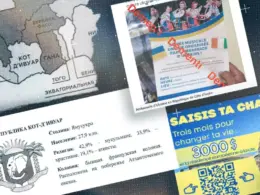
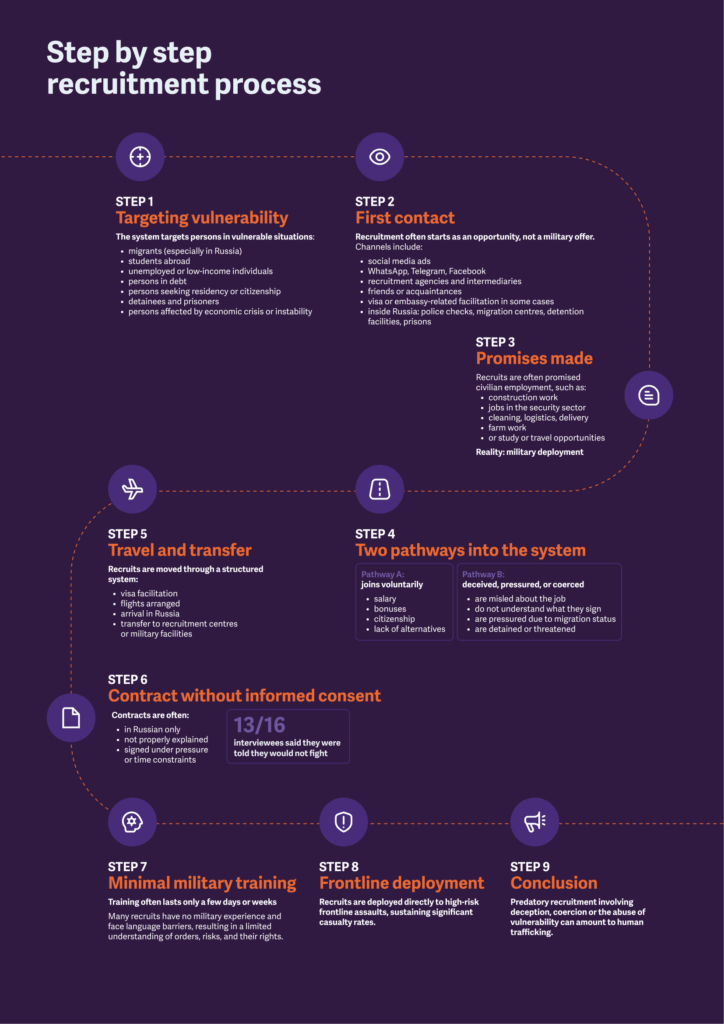
The most alarming category identified in the report involves individuals recruited through deception, many of whom may qualify as victims of human trafficking. Recruitment networks operate across Africa, South Asia, and Latin America, often using social media platforms and informal intermediaries.
Potential recruits are offered jobs in construction, security, or logistics, or promised educational opportunities and pathways to Europe. Upon arrival in Russia, they are redirected to military recruitment centers. Contracts are presented in a language they do not understand, often under pressure and without alternatives.

The report provides striking testimony: of 16 foreign prisoners of war interviewed, 13 said they had been told they would not be required to fight. Despite these assurances, most were deployed to combat positions within weeks. This pattern – recruitment through deception followed by forced deployment – matches key elements of human trafficking under international law.
In late 2023, a trafficking ring was uncovered in Cuba that lured teenagers as young as 18 with promises of construction work, only to confiscate their passports and force them into Russia’s armed forces.
Trending Now
Similar patterns were found in Sri Lanka and Nepal, where recruits were told they would serve in rear areas, only to be issued weapons and sent to the front under threat of criminal prosecution if they refused.
“This is not simply a matter of morality — it is about Russia violating existing legal obligations. Establishing a system that exploits vulnerable people for the purpose of deploying them into an armed conflict is, by its very nature, illegal,” Tomak said.
"If we were to refer to some other non-legal aspects, it would be challenging the false narrative that Russia is somehow a “friend” of Africa, Latin America, or Asia. Russia is not acting as a friend to these regions, and the system of predatory recruitment is a very clear illustration of that reality,” she added.
A system built on vulnerability
The report makes clear that this recruitment system is not random. It is structured to target individuals with limited options.
Inside Russia, this includes migrants facing discrimination and legal insecurity. Outside Russia, it focuses on regions marked by poverty, political instability, or lack of employment opportunities.
Young men seeking a way out of difficult circumstances are particularly susceptible. The promise of stable income, legal status, or migration opportunities can outweigh the perceived risks, especially when those risks are downplayed or concealed.
Recruitment networks exploit these conditions. They operate through a mix of state-linked institutions, private intermediaries, and online platforms, creating a decentralized but coordinated system.
The involvement of official structures, including diplomatic channels and state agencies, suggests a level of oversight that goes beyond informal or purely criminal networks.
Minimal training and rapid deployment into "meat assaults"
Regardless of how individuals enter the system, their trajectory tends to follow a similar path. Training is often minimal, lasting from a few days to several weeks. Many recruits have no prior military experience and receive little preparation for combat.
They are then assigned to high-risk units, frequently involved in so-called “meat assaults.” These operations involve frontal attacks designed to absorb enemy fire and expose defensive positions. The role of these units is inherently expendable, relying on volume rather than survivability.
Casualty rates reflect this reality. Ukrainian estimates suggest that 3,388 foreign fighters have been killed, with some reports indicating that up to one in five do not survive.
Many die within the first few months of deployment. Language barriers, lack of coordination, and inadequate medical screening further increase the risks they face.
A formalized state policy: lowering barriers and increasing incentives
The recruitment of foreign nationals is no longer an ad hoc effort but a formalized state policy. Since 2023, Russia has systematically lowered legal barriers to enlistment.
Key legislative changes include the removal of minimum residency requirements and the relaxation of Russian language proficiency standards, which previously acted as hurdles for non-CIS citizens.
Under a series of presidential decrees, foreign nationals who sign a one-year contract with the Armed Forces are now eligible for a simplified, fast-track path to Russian citizenship.
This formalization extends to a bounty system that incentivizes local officials and private intermediaries. Regional governments now allocate specific budgets for "referral" payments, creating a competitive recruitment market.
In the Ryazan region, for example, the fee for recruiting a person from countries outside the former Soviet Union was set at 575,000 RUB (approx. €4,000).
This institutionalized structure has driven a sharp increase in scale: identified foreign recruits grew from roughly 3,800 in 2023 to nearly 14,000 in 2025.
What comes next
While some countries have initiated domestic investigations, criminal prosecutions, and crackdowns on local trafficking rings to curb enlistment, the predatory recruitment machinery shows no signs of stopping.
Despite rising international attention and declarations from Moscow claiming it has ceased intake from certain nations, investigators find that the pipeline continues to actively circumvent these state-level restrictions.
What is unlikely to change is the underlying logic. Russia faces ongoing manpower demands and political constraints on domestic mobilization. Foreign recruits – especially those who are vulnerable – provide a way to bridge that gap.
Ukrainian intelligence estimates indicate that Russia plans to bring in an additional 18,500 foreign nationals by the end of 2026, signaling that this system is intended to be a long-term structural component of the war effort.

Recruitment through exploitation reframes the legal status of foreign recruits
The term “foreign fighter” suggests a degree of agency and choice that does not always exist. While some individuals do join voluntarily, many others are drawn in through a combination of economic pressure, misinformation, and coercion.
Understanding this distinction matters, as it shapes how these individuals are treated under international law, how responsibility is assigned, and how responses are designed. The report points toward a need to move beyond narrow definitions of mercenarism to recognize the broader patterns of exploitation at play.
Many recruits meet the international criteria for victims of human trafficking, which necessitates a shift in how home countries and the international community approach their repatriation and legal processing.
For Russia, these individuals function as a source of expendable manpower. They are part of a system that recruits globally, targets the vulnerable, and deploys them rapidly into high-risk roles to shield the Russian population from some of the costs of the war.
This institutionalized exploitation represents a growing humanitarian and legal challenge for the international community.
Read the full report here.
Read also
-
“A warning to companies that remain”: Russia takes control of Nestlé and Auchan’s assets – companies that stayed in Russia following the full-scale invasion of Ukraine
-
“I can travel back to Finland and be safe. That is a luxury”: Sanna Marin on the Russian strike that stopped her train from Kyiv
-
Ukraine put its own peace proposals on the table as two US envoys reached Kyiv for the first time