

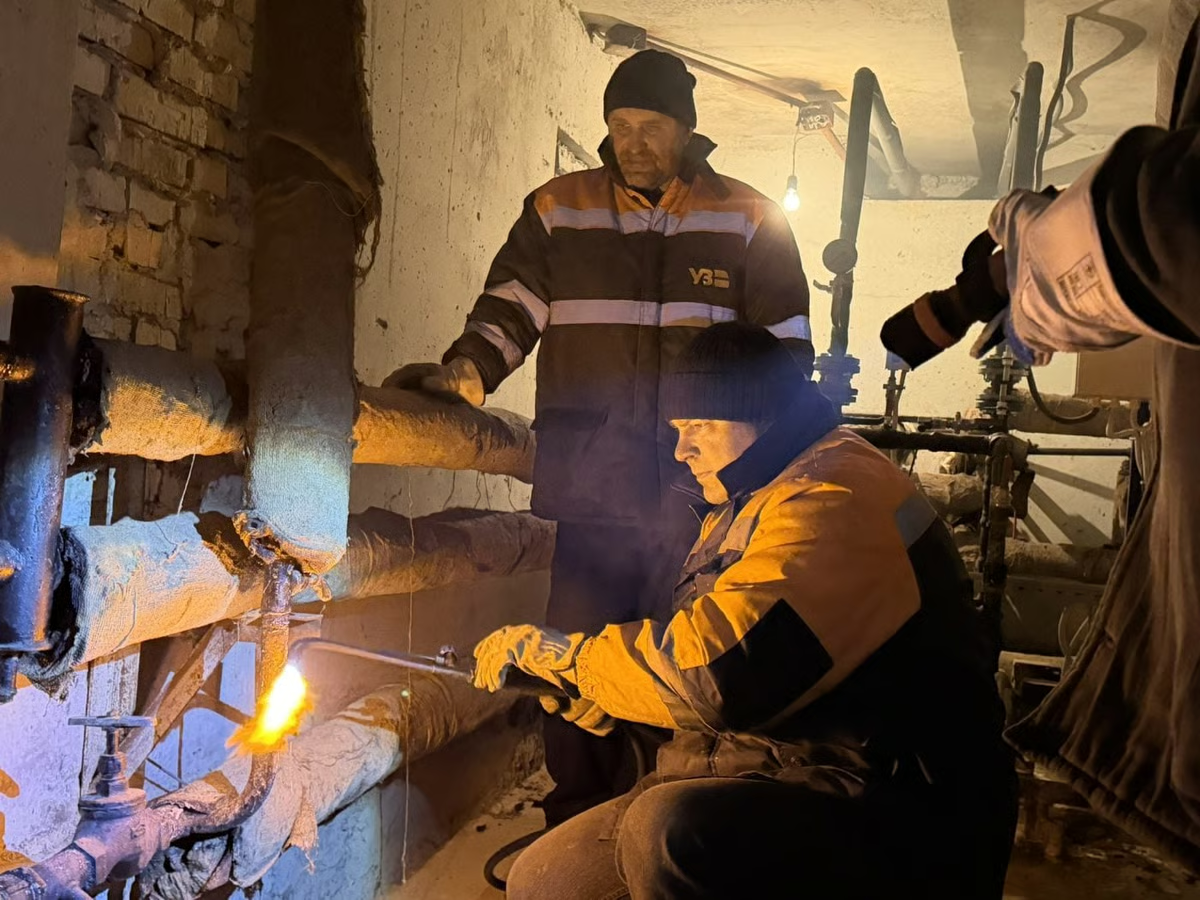
Ukrzaliznytsia railway crews from frontline cities, utility teams from Lviv, and hot meals from volunteers converge on Kyiv.
When railway workers from Zaporizhzhia, Kryvyi Rih, Odesa, and other cities arrived in Kyiv last Sunday evening, they brought more than welding equipment. They brought a centuries-old Ukrainian tradition called toloka — the gathering of neighbors to meet an urgent community need.
More than 40 emergency crews from Ukrzaliznytsia and municipal utilities teams across Ukraine have converged on the capital since Russia's 9 January strike left 6,000 apartment buildings without heat, with temperatures plunging to -15°C. The mobilization represents the largest inter-regional emergency response since the full-scale invasion began—and a modern expression of the principle that Ukrainians help each other first.

A tradition older than borders
The word toloka dates back centuries in Ukrainian village life. When a young couple needed a house built, or fire destroyed a neighbor's home, the community gathered without payment or formal obligation. The understanding was simple: we help you now, and you will help us when we need it.
"We were told to go, so we went, because there is a war in the country and we need to help," said Hennadii Tretiak, a foreman leading railway construction workers from Zaporizhzhia and Kryvyi Rih—two cities that face daily drone attacks and artillery strikes themselves.
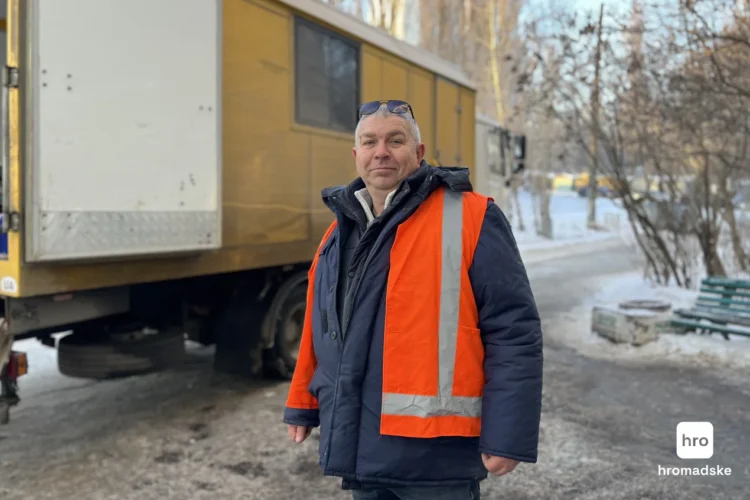
His crew includes welders, reinforced-concrete assemblers, grinder operators, and plasterers. None had done residential heating repair before. They sleep in rooms at the train station and work until each building has heat, then move to the next site. They will stay for a month.
"But is this the time to ask questions? They told us to go, so we went. In silence. It's crazy everywhere. We have to help and rescue each other. It's war. Lots of trouble. There are no people left. Many skilled workers are fighting. Well, we'll just help as much as we can," railway worker Andrii Karataiev tells Hromadske, gazing at the building with tired eyes.
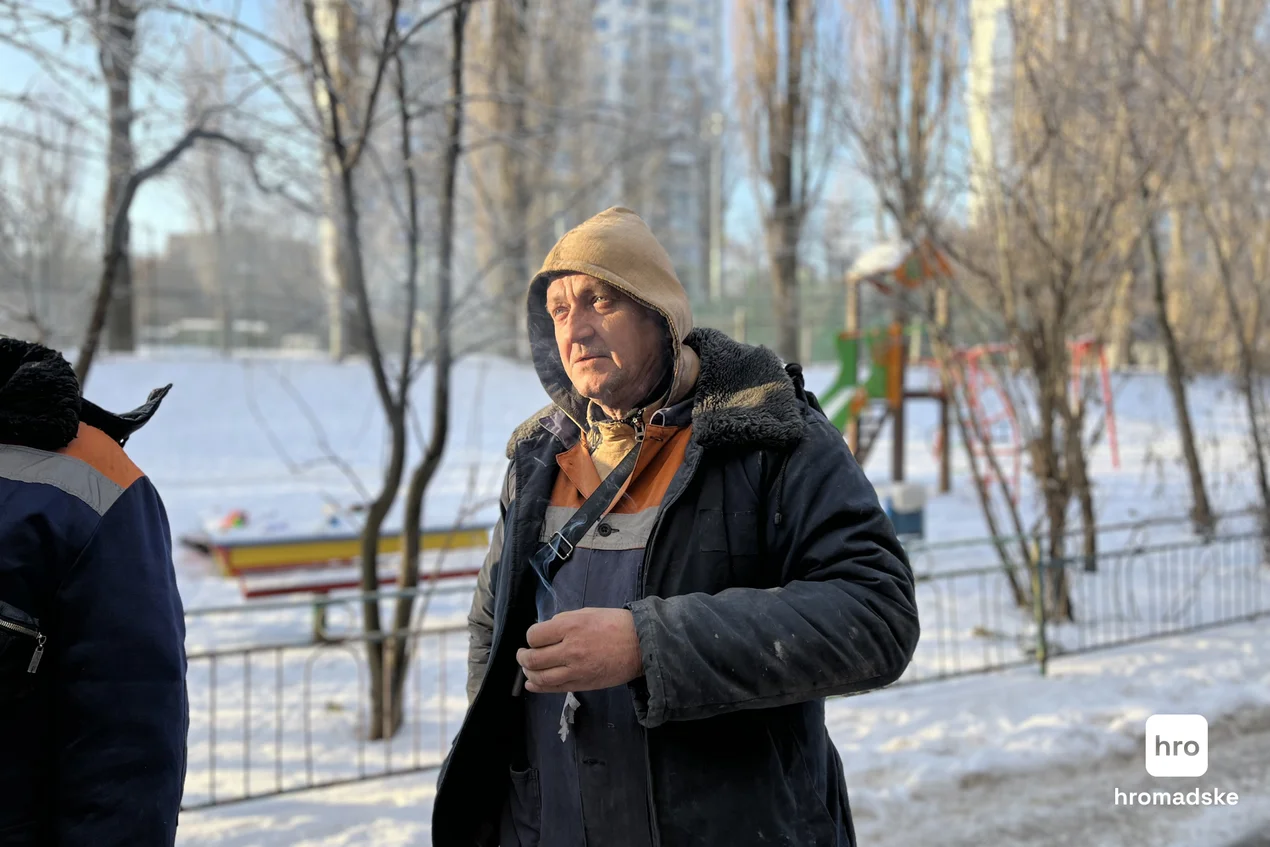
When frontline workers come to help the capital
Ivan, one of the most experienced repairmen, climbed the stairs carrying tools to defrost another frozen riser shaft. He is from Zaporizhzhia, a city less than 50 kilometers from active combat.
"We were in Dnipro, where the depot was destroyed, and we were doing repairs there, too. Well, they called us. Half of us stayed there, and half came here," he said.
His wife and elderly mother-in-law remain in Zaporizhzhia. His instructions to them were practical: "I told them: it will be bad. If there's no heating, go to the garage. There's a stove in there. Light it, and you'll be warm."
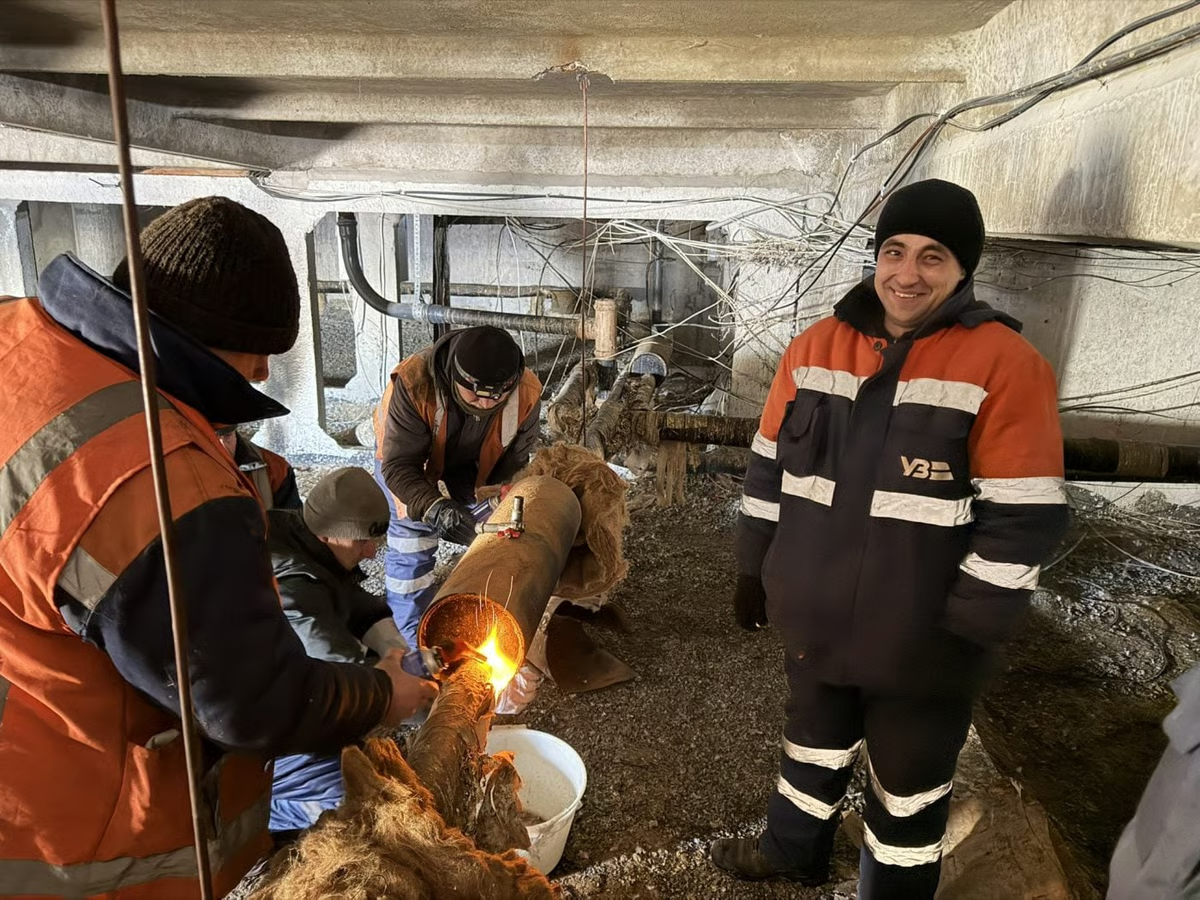
Oleksandr is hard at work in the building's basement. “I'm just a plasterer. We're all construction workers, basically. But they didn't send us here for nothing. The main thing now is to get the heat on and running for the folks up there,” says Oleksandr, as he drains water from the pipes.
Six utility teams from Lviv deployed to Kyiv with equipment for restoring electricity and internal networks. "We love Kyiv, so today we must stand together," wrote Lviv Mayor Andrii Sadovyi on social media.


Prime Minister Yulia Svyrydenko reported that more than 160 crews of energy, utility, and railway workers from other regions are working around the clock in the capital. Additional teams arrived from Rivne this week. The pattern is unmistakable: Ukraine's provinces are coming to the rescue of its capital.
"We’re slowly dying."
The human cost of the heating collapse is measured in degrees Celsius and days without warmth.
Lidia, 73, showed the utilities crew into her apartment wearing her coat and carrying a flashlight. The thermometer read 5°C. Before the railway workers arrived, it was -2°C to -4°C. She moved in with relatives in a small town, unable to stay.
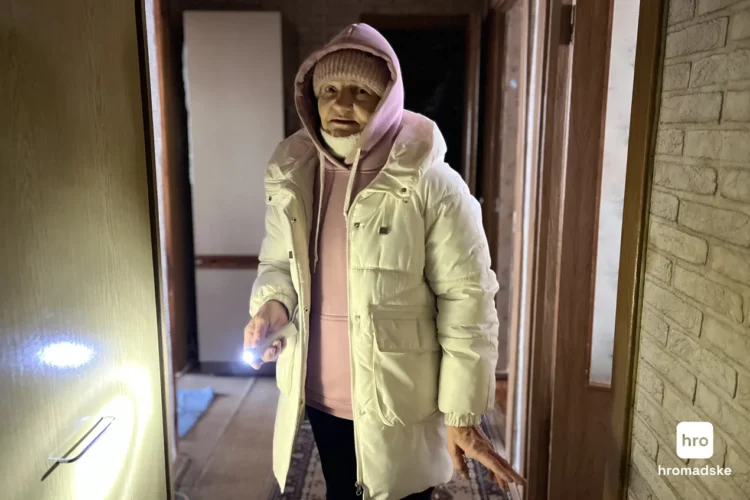
"The guys arrived yesterday. Before that, there was nothing. People just sat here. There are elderly women who can barely walk living up there. I called them and said, 'How are you doing?' And they replied, 'We’re slowly dying,'" she said.
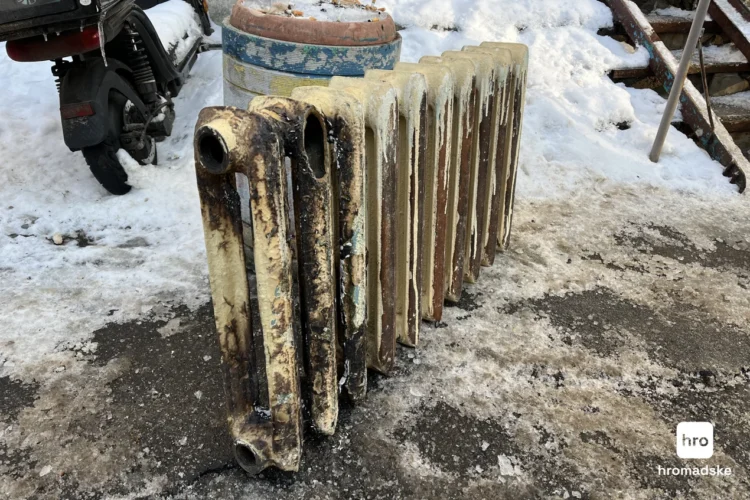
In the courtyard of her 16-story building in Solomianskyi Raion, an old cast-iron radiator lies burst open—split by water that froze inside during 12 days without heat. Most residents have fled to other towns or relatives. Those who remained watched the temperature inside their apartments drop toward freezing.
Experienced railway workers say the last time they were involved in such an operation was 20 years ago, in Alchevsk, Luhansk Oblast. In January 2006, during a -30°C frost, an underground pipe cracked, isolating the city's main boiler from the heating system. Water throughout the network froze, causing additional pipes to burst. The crisis forced the evacuation of schoolchildren and left 100,000 people without heat for weeks.
The Kyiv crisis came dangerously close to repeating that pattern.
The networks of care
Beyond the pipe repairs, a broader support system has mobilized. World Central Kitchen opened multiple hot soup stations across Kyiv, with volunteers cooking 550 meals daily despite power cuts, relying on generators to keep the operation running.
"We're providing thousands of meals across Kyiv. Every day we are trying to do more and more. The main thing is that we are trying to find the needs and deliver to locations that are the most affected," said Yuliia Vysytska of World Central Kitchen in Ukraine.

Valentyna Kiryakova, a retiree, waited in line at -14°C to bring hot food home to her 6-year-old granddaughter. "We live in a high-rise building, and there's no power. If there's no power, the stoves don't work, and there's no heating. But it's OK, we're surviving. We understand that there's a war going on: we have to endure, we have to survive," she said.
Solidarity crossing borders
The response has extended beyond Ukraine. Polish donors raised over 5.8 million zlotys ($1.6 million) through the campaign "Warmth from Poland for Kyiv," with nearly 24,000 individual contributors. Poland's government is sending 379 generators from state reserves, plus another 447 funded by the EU. Warsaw alone is donating 90 additional generators.
"For us, it is a gesture of support—for them, a real chance to survive the winter," the fundraisers said.
Ukraine's Foreign Minister Andrii Sybiha instructed all Ukrainian diplomatic missions worldwide to launch similar campaigns. "Our heroes—energy workers—are performing real miracles, saving lives under extreme conditions," he said.
Unity Day, made literal
The mobilization coincided with Ukraine's Unity Day on 22 January, which commemorates the 1919 Act of Unification, when eastern and western Ukraine joined to form a single state. In 1990, over 300,000 Ukrainians formed a human chain stretching 482 kilometers from Kyiv to Lviv to mark the anniversary—the largest public demonstration in Ukraine since the beginning of glasnost.
This year, the unity was less symbolic. It took the form of welders from Zaporizhzhia climbing frozen stairwells in Kyiv, utility workers from Lviv defrosting pipes, and volunteers from across Europe sending generators.
 "Since we recently celebrated Unity Day, I thought that this is what unity is - when thousands of workers from different regions come to patch, weld, and restore," one observer wrote on social media.
As of 23 January, 1,940 high-rise buildings in Kyiv remained without heat—down from nearly 6,000 after the 9 January strike. The work continues building by building, riser by riser, apartment by apartment.
"We'll stay here until we get everything up and running," said foreman Hennadii Tretiak.
On 24 January, Russia struck the capital and other major cities with drones and missiles. Once again, Ukraine's tireless railway, energy, and utility workers appeared on site to rescue, repair, and comfort as soon as the all-clear siren sounded. “Putin cynically ordered a brutal, massive missile strike on Ukraine just as delegations were gathering in Abu Dhabi to promote the peace process under the auspices of the United States. His missiles hit not only our people, but also the negotiating table,” said Foreign Minister Andrii Sybiha.


