

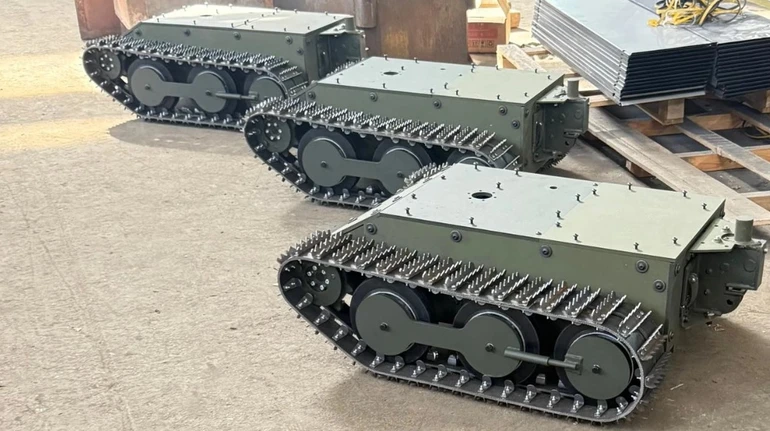
Ground-based robotic systems are increasingly being used in combat conditions. However, their effectiveness is tightly constrained by one critical factor — stable communications, says adviser to Ukraine’s Minister of Defense, Serhii “Flash” Beskrestnov, ArmyInform reports.
According to him, the technical platform itself is not particularly complex. The main problems emerge during actual battlefield deployment.
Ground robots lose control when single critical channel disappears
“The most important and most difficult issue is communication,” Flash emphasizes.
He explained that the control channel determines the system’s combat capability. Without it, the robot effectively drops out of the mission: it either stops or enters an uncontrolled state, making it vulnerable on the battlefield.
What happens when terrain and urban structures completely cut signal
Ground robotic systems operate in a much more challenging environment than aerial drones. Terrain, urban infrastructure, tree lines, and cover constantly interfere with the control signal.
In such conditions, even a brief loss of communication can render the system unable to remain in combat, regardless of its technical condition or weapon payload.
Ukraine is looking for ways to make combat robots resistant to signal loss
The key challenge today is not building the platforms themselves, but creating a resilient control system that leverages signal relays, hybrid communication channels, and autonomous operational modes.
“Flash” emphasizes that without solving this issue, the large-scale deployment of ground robotic systems will remain limited. At the same time, Ukrainian developers are already working to strengthen signal stability and improve the survivability of control systems under battlefield electronic warfare conditions.
Earlier, a Ukrainian combat robot equipped with a Browning 12.7 mm heavy machine gun held an infantry position alone for 1.5 months.
Read also
-
Two Kalibr-carrying frigates, a missile ship, a patrol vessel: Ukraine hit four Russian warships in one night at Novorossiysk
-
Russia starves most Ukrainian POWs, then “fattens” a few for exchange so they look normal, Ukrainian official says
-
Russia builds 3,000 jet drones monthly to counter Ukrainian interceptors, HUR says


