


Russia's military Antonov aircraft fleet is approaching a maintenance collapse it cannot stop, with its own officials privately acknowledging the crisis in documents obtained by a private intelligence and analytics company, Dallas. Two fatal crashes in four months — one of them covered up — and a repair monopoly left nearly bankrupt and led by a man with no aviation background illustrate how the war against Ukraine, combined with Western sanctions, has hollowed out a critical pillar of Russian military aviation.
A fleet with no future
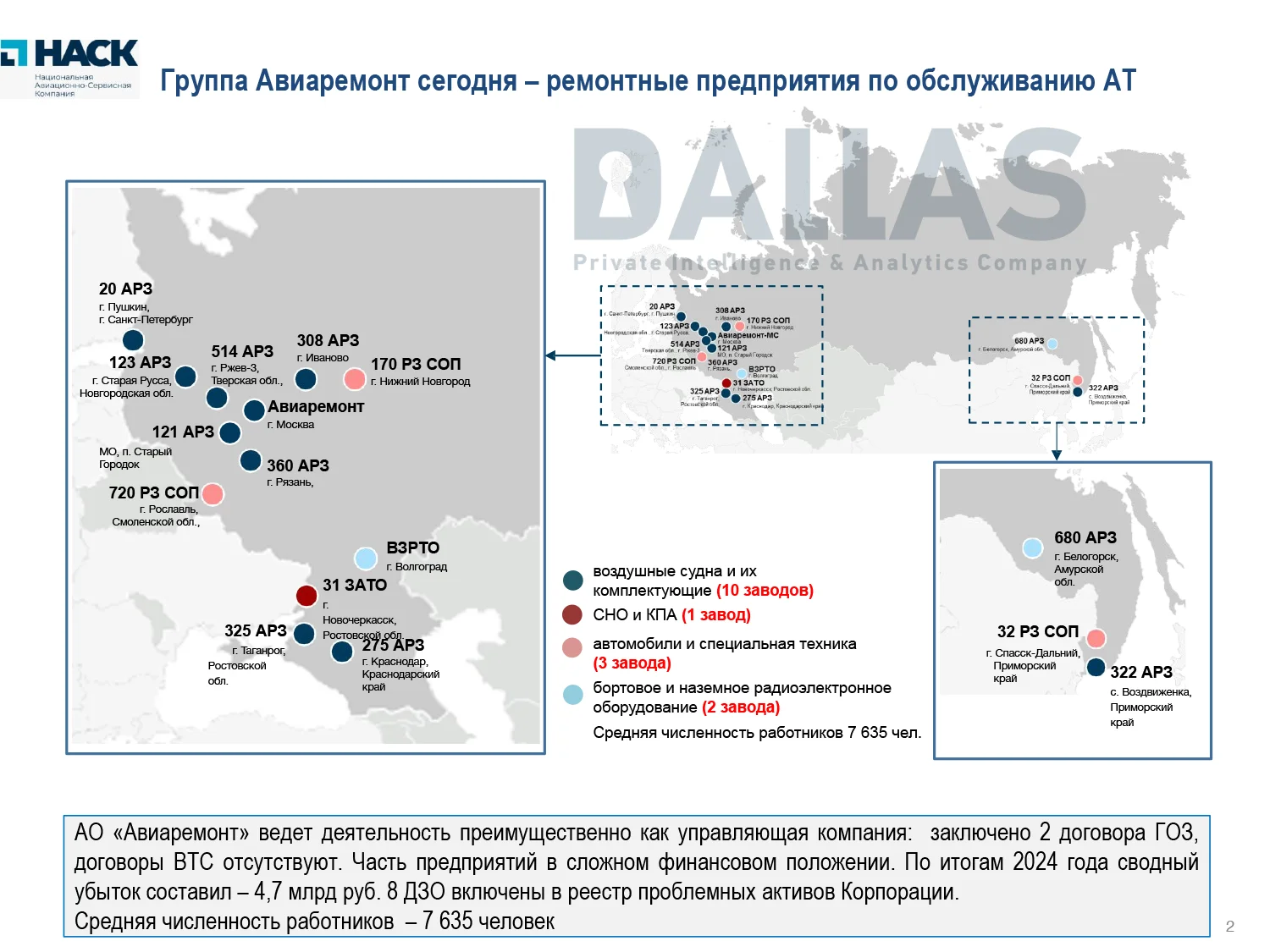
Behind every Russian military aircraft stands state company JSC Aviaremont, the repair monopoly operating under Rostec and its subsidiary, the United Aircraft Corporation. Dallas obtained internal company documents dating to December 2025 that expose an industry in deep crisis — most visibly in the An-series fleet, Soviet-era transports designed by the Kyiv-based Antonov design bureau that Russia can no longer produce, replace, or properly maintain.
Russia's connections to Ukraine's Antonov design bureau collapsed virtually overnight after the 2014 annexation of Crimea. Moscow lost access to Ukrainian engineering expertise, spare parts, and production lines simultaneously. No new An-series aircraft have entered production anywhere in the world since 2016, leaving Russia with an aging fleet and nowhere to turn.

Russia’s secret aviation report: fighter jet clipped its own gate, a 500 kg bomb fell on takeoff, a gunship came home with a printer-paper-sized hole. Nine engine failures in three weeks
The crash that was covered up
The consequences became visible in December 2025. An An-22 — the world's largest turboprop, and a plane that had already exceeded its anticipated service life — broke apart in midair during a test flight and fell into a reservoir in Russia's Ivanovo Oblast, killing all seven people on board. Russia's Investigative Committee opened a criminal case into possible violations of flight preparation regulations.
The crash occurred in the same city as the 308th Aircraft Repair Plant (308 ARZ), Aviaremont's primary facility for An-series overhaul. The plant moved quickly to distance itself, stating the aircraft had last passed through its workshops in 2007. Dallas obtained a document proving otherwise: 308 ARZ performed repair work on the same aircraft in August 2025, four months before it fell out of the sky. The plant's denial does not hold up.

The next fatal crash was impossible to quietly bury. On 31 March 2026, a military An-26 transport went down during a routine flight over occupied Crimea, killing all 29 people on board. Among the dead was Lieutenant General Aleksandr Otroshchenko, commander of the Mixed Aviation Corps of the Northern Fleet. Russia's Defense Ministry stated the preliminary cause was a technical malfunction with no external impact.

Russia lost two military aircraft in one day — an An-26 military transport killing all 29 aboard and an unconfirmed Su-34 fighter-bomber
Russia's own officials wrote it all down
Dallas reviewed a frank internal report submitted by Aviaremont director-general Albert Bakov directly to Rostec chief Sergei Chemezov — addressed by his initials, SVC — in late December 2025. The report concerns 308 ARZ's condition and states plainly that the plant cannot carry out An-series repairs for three reasons: no import substitution has been implemented for key components, complete design documentation is absent, and no domestic production of spare parts has been established in Russia. Bakov further notes that Russia's Ministry of Defense has failed to implement the comprehensive An-series maintenance schedules that its own minister approved in 2023.
Trending Now

A separate internal Aviaremont letter addressed to Rostec deputy director-general Aleksandr Nazarov in August 2025 reveals that Russia was operating approximately 368 An-series aircraft — An-12, An-26, and An-72 variants — across the Defense Ministry, Rosgvardia, and FSB Aviation, with 143 requiring repair. Russia's Ministry of Industry and Trade officially confirmed to Aviaremont that domestic production of components and assemblies for An-series aircraft does not exist, making it impossible to fulfill repair contracts on schedule.
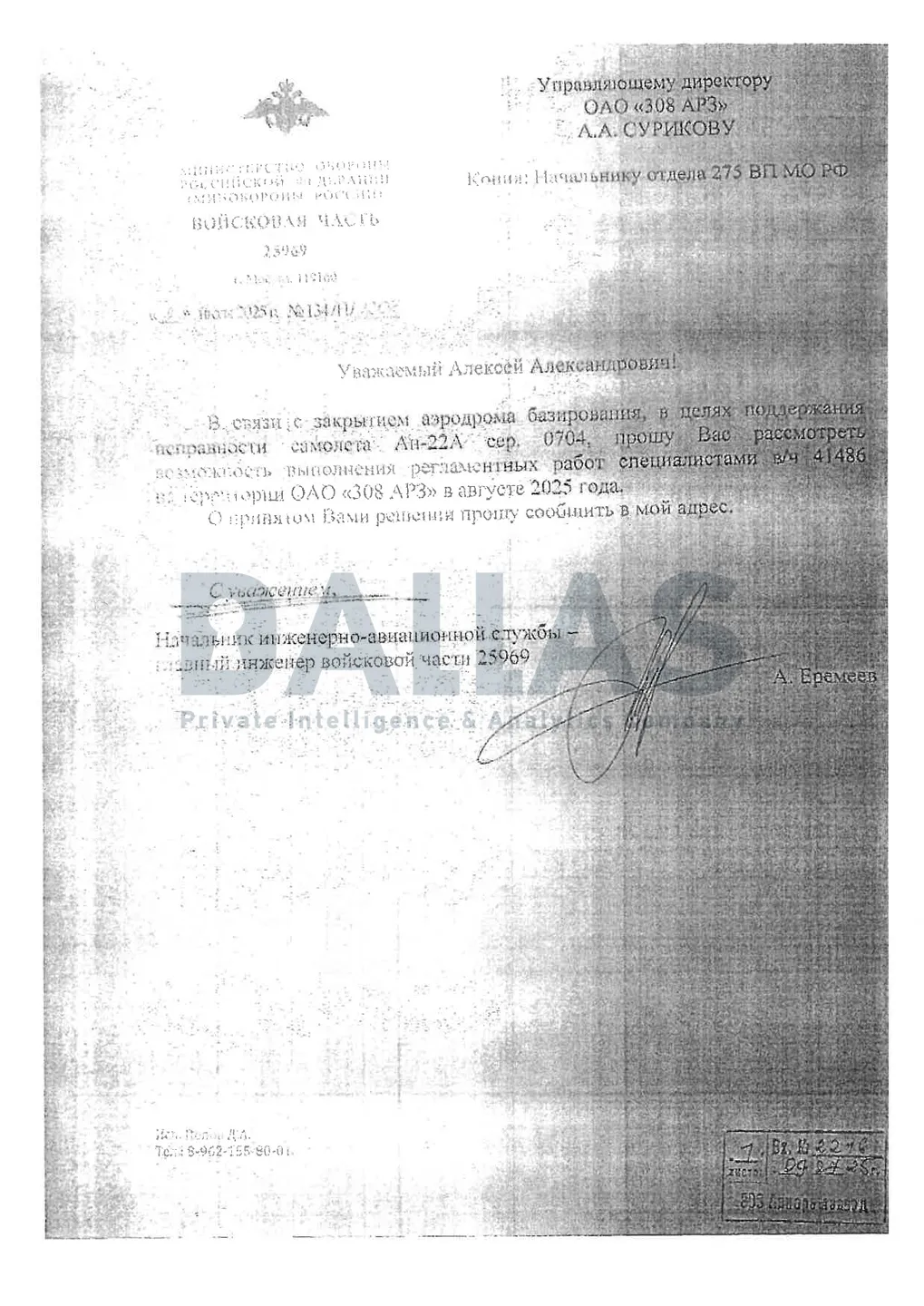
A third document from May 2025 goes further still: unless urgent measures are taken, An-series repairs will become impossible within 18 to 24 months, and the fleet's operation will cease entirely.

Russia’s 14th general killed since war began. His An-26 may have been shot down by Russia’s own air defense
No parts, no plan, no money — and a film director's son-in-law in charge
The 308 ARZ is working on 11 state defense contracts covering 14 An-series aircraft, but all advance payments have already been spent, and the plant has no other income. RT-Capital loans cleared wage arrears, and remaining funds covered employee advances only through 25 January 2026. A spare-parts program under development by the V.M. Myasishchev plant needs about $300 million, yet funding is not set to begin until 2029 — well after the collapse window in Dallas’s documents.
Rostec worsened the problem by appointing Albert Bakov to lead Aviaremont in October 2022 despite his lack of aviation experience. An economist by training, he had already led several defense enterprises into acute financial trouble. His main asset appears to be connections: he is the son-in-law of Kremlin-linked film director Nikita Mikhalkov and close to Rostec deputy chief Igor Zavyalov.
Time running out
Aviaremont's 2024 consolidated loss totaled $60 million, and eight subsidiaries are on Rostec's distressed assets register. The risks extend beyond military aviation. In Siberia and Russia's Far East, the An-26 and An-24 remain the backbone of civilian air links to remote communities. Those passengers face the same maintenance failures. Ukraine's Foreign Intelligence Service has forecast that Russia could lose nearly half of its civilian fleet by 2030 as sanctions continue to bite.
Dallas's analysis calls the aviation sector a rare clear proof of sanctions working: unlike economic statistics, planes either fly or they don't.
Read also
-
Russian Su-30 fighter crashes in occupied Crimea — fourth Russian military aircraft loss in four days
-
March from hell: Ukraine hits 10 refineries, 12 air defense systems, 5 Russian factories, halting missile chip supply for 6 months (MAP)
-
Ukraine hit a second Russian aviation plant in two days — after Aviastar in Ulianovsk, now the 123rd plant in Novgorod Oblast


