
Brent crude fell 15% Wednesday—its biggest one-day crash since the 1991 Gulf War—after the United States and Iran reached a ceasefire and announced the partial reopening of the Strait of Hormuz.
The Strait’s “reopening” comes with terms that international maritime lawyers say are flatly illegal.
Iran was still firing on Gulf Arab states and Israel when the announcement came. And the Strait’s “reopening” comes with terms that international maritime lawyers say are flatly illegal.
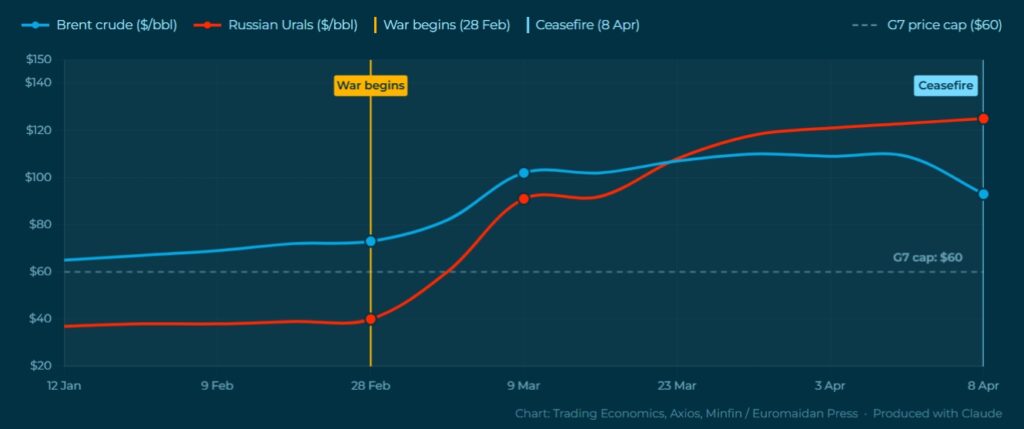
The global benchmark settled near $93 per barrel—down from a wartime record of $144.42 for physical crude and 27% above the $73 at which it traded before hostilities began on 28 February, according to Axios.
Two different texts
The markets moved on the announcement. The Gulf did not.
Hours after Iran’s Supreme National Security Council declared a halt to hostilities, missile alerts sounded in the UAE and Israel, AP’s live blog reported. Abu Dhabi’s Habshan gas processing facility caught fire from incoming Iranian strikes. An Israeli military official confirmed his country was still attacking Iran.
“Our hands remain upon the trigger, and should the slightest error be committed by the enemy, it shall be met with full force.”
The ceasefire’s Farsi-language version—circulated to Iranian domestic audiences—included the phrase “acceptance of enrichment” for Iran’s nuclear program, a term absent from the English texts Tehran’s diplomats handed to foreign journalists. Iran’s mission to the UN declined to explain the discrepancy.
“Our hands remain upon the trigger,” Iran’s National Security Council said in its statement, “and should the slightest error be committed by the enemy, it shall be met with full force.”
“A whole civilization will die tonight, never to be brought back again.”
Trump set an 8 pm deadline the previous evening, threatening that “a whole civilization will die tonight, never to be brought back again,” before pulling back with ninety minutes to spare. He called Iran’s 10-point plan “workable,” then described the same plan as “fraudulent”—without elaborating on either.
Iran’s open Strait comes with a $2 million entry fee
Iran’s foreign minister, Abbas Araghchi, said that passage would be “possible via coordination with Iran’s Armed Forces and with due consideration of technical limitations.” No further details on the limitations were provided.
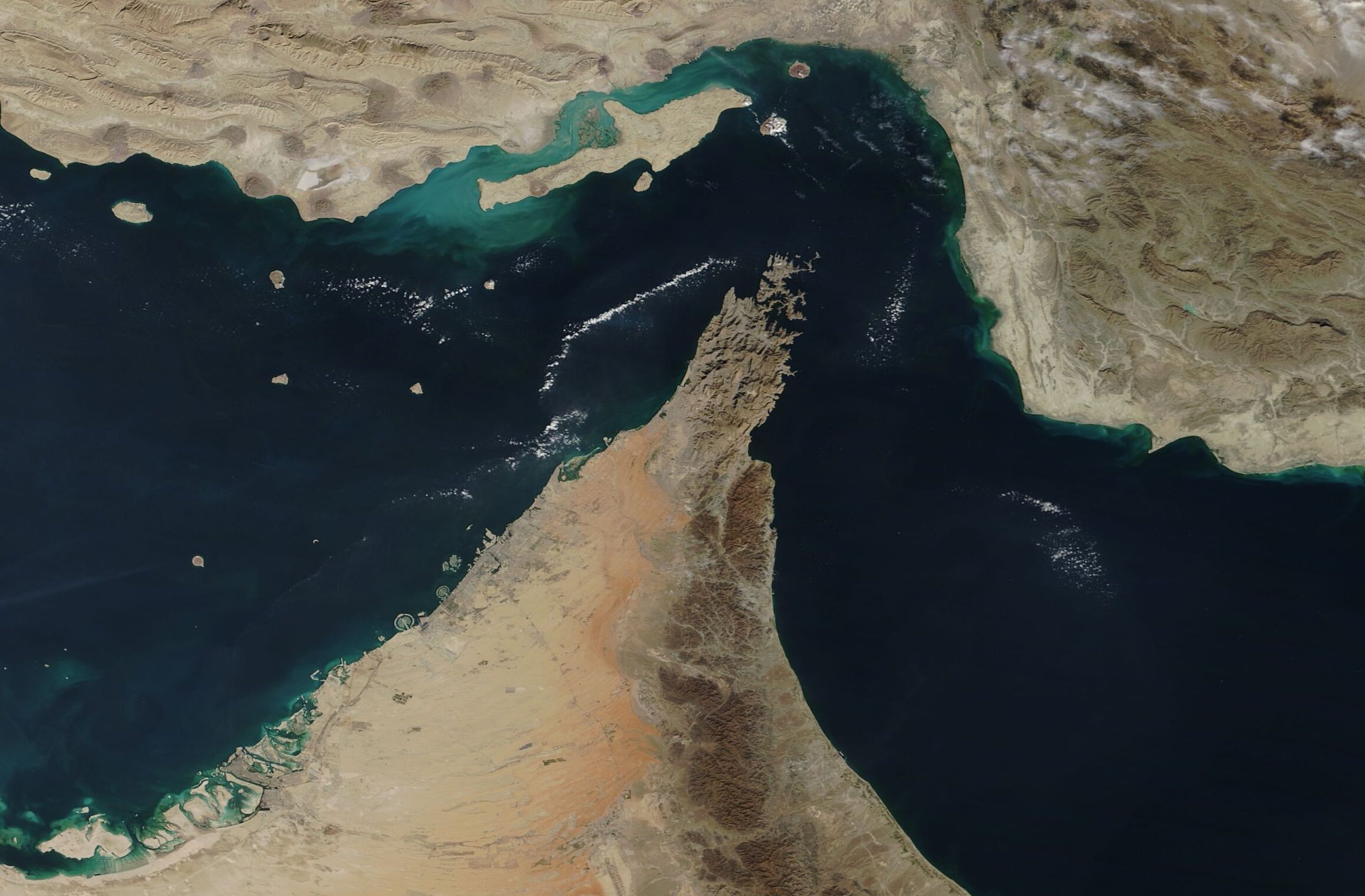
The arrangement is a toll system Iran’s Revolutionary Guard has been running since mid-March: charging vessels approximately $2 million each to transit a controlled corridor between Qeshm and Larak islands, with cargo manifests, crew names, and ownership details required from IRGC intermediaries in advance, while barring any ship linked to the US or Israel at any price.
At least two ships have paid, with fees settled in Chinese yuan.
At least two ships have paid, with fees settled in Chinese yuan, Shipping & Freight Resource reported. Iran’s parliament passed legislation last week formally codifying the arrangement.
Under the UN Convention on the Law of the Sea, this is illegal. UNCLOS Articles 37 through 44 guarantee continuous, free, and non-suspendable transit passage through international straits; Article 26 prohibits any charge levied “by reason only of passage.”
James Kraska, professor of international maritime law at the US Naval War College, said in Türkiye Today that “imposing transit fees is a violation of the rules of transit passage.” Jasem Mohamed al-Budaiwi, Secretary General of the Gulf Cooperation Council, told Shipping & Freight Resource that Iran’s fee collection was “an aggression and a violation of the United Nations agreement on the law of the sea.”
Both claim the same rules selectively.
Iran signed UNCLOS in 1982 but never ratified it; the United States never signed the convention at all. Tehran argues it cannot therefore be bound by the transit passage provisions. Washington invokes those same provisions as binding customary international law—maintaining that the transit passage regime has crystallized into custom applicable to all states, including non-parties. Both claim the same rules selectively.
What the ceasefire’s English text describes as “reopening” the Strait of Hormuz is a managed toll corridor under IRGC supervision—whose legal status remains disputed, whose fees remain in place, and whose daily transit count of four or five vessels is a fraction of the pre-war 150.
Trending Now
What the markets bought—and what they didn’t
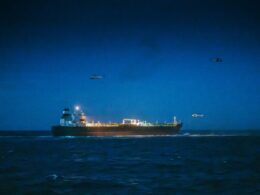
Brent had spent six weeks above $100 after Iran effectively closed the Strait of Hormuz—the 21-nautical-mile chokepoint through which a fifth of the world’s seaborne oil trade passes. Gulf producers—Saudi Arabia, the UAE, Kuwait, Iraq, Qatar, and Bahrain—collectively shut in 7.5 million barrels per day of crude output as Iran’s blockade cut off export routes.
Tanker traffic through the Strait collapsed from roughly 150 vessels a day to four or five, with approximately 3,200 commercial vessels and some 20,000 seafarers stranded in Gulf waters.
“We’ll know from tracking platforms and anecdotal reporting of tanker movements whether they get it.”
Clayton Seigle, an oil analyst at the Center for Strategic & International Studies, told Axios that “ship operators’ confidence that they won’t be attacked is the one and only litmus test to assess whether energy flows are likely to resume.”
He expected operators to seek direct assurances from Tehran before resuming sailings. “We’ll know from tracking platforms and anecdotal reporting of tanker movements whether they get it,” he said.
What this changes—and doesn’t—for Russia and Ukraine
For six weeks, the Hormuz disruption delivered an unintended subsidy to Moscow. Urals crude—which Western sanctions had driven below $40 per barrel in early 2026—surged to $125 per barrel by 8 April, more than tripling from early-year lows.
Kyiv had been escalating drone strikes on Russia’s Baltic oil export infrastructure in the same weeks.
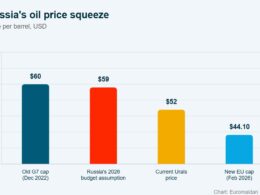
Russia’s average daily fossil fuel export revenues hit $270 million in March—twice January’s level and a four-year high. Urals still traded at more than double the G7’s $60 price cap, the threshold above which Western insurance and shipping access is supposed to be denied.
Ukraine felt it in the other direction. Ukrainian diesel rose to 90 hryvnias ($2.09) per liter by 7 April—10–15% above pre-crisis levels and the sharpest pump price spike since the early months of the full-scale invasion, with no strategic petroleum reserve to cushion the blow. Kyiv had been escalating drone strikes on Russia’s Baltic oil export infrastructure in the same weeks, trying to shrink Moscow’s windfall through the one tool available to it.
Talks between US and Iranian delegations are set for Islamabad on Friday.
Talks between US and Iranian delegations are set for Islamabad on Friday, with Iran’s nuclear program, its ballistic missiles, and its regional proxies all unresolved—the same issues Washington cited as justifications for launching the war on 28 February.
A key bridge linking Saudi Arabia and Bahrain reopened early Wednesday after hours of closure over possible incoming Iranian fire.
An Iranian cluster munition missile exploded over northern Israel at the same hour.