

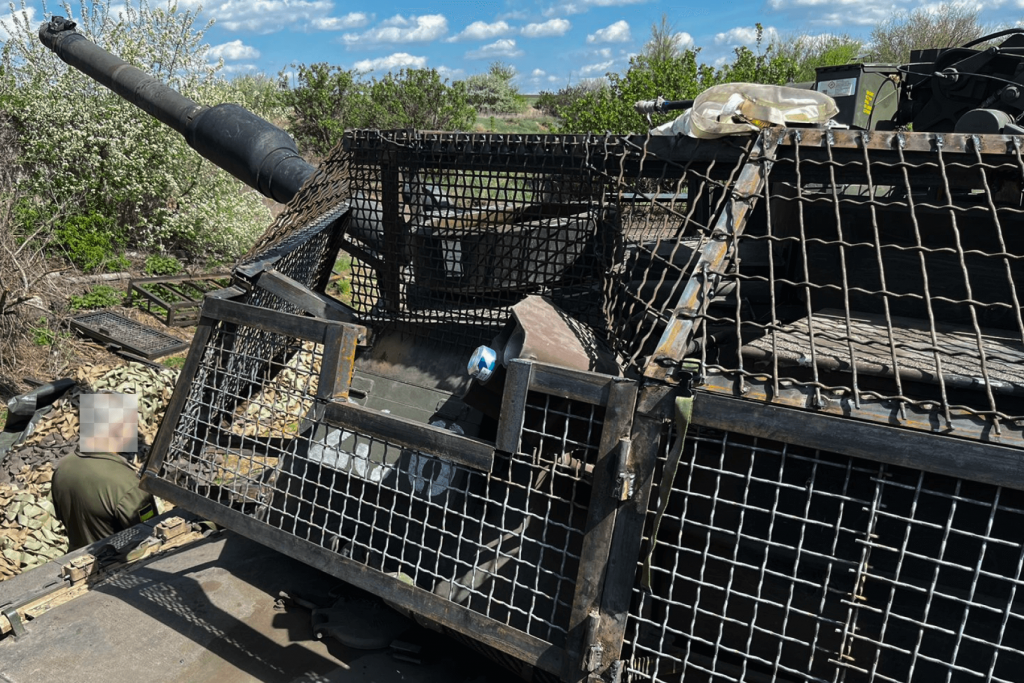
In February 2026, a Ukrainian Leopard 1A5 tank survived an astonishing 52 strikes from Russian FPV drones and Molniya-type UAVs in a single day. The crew emerged unharmed, and the tank was successfully repaired and returned to service, Mezha reports.
This vehicle belongs to the 1st Tank Battalion of the 5th Separate Heavy Mechanized Brigade, and its story highlights that modern warfare demands not only advanced hardware but also exceptional bravery from its crew.
Nearly a full day under fire: crew saves tank under enemy observation
"The enemy spotted our tank in position and fired continuously. One FPV hit while another corrected the fire. Then a third would strike — and this cycle continued for almost a full day," company commander Vyacheslav Khodak with a callsign “Spartan" recounts.
The crew remained under cover, but once the firing subsided, they risked starting the engine to move the tank out from under enemy fire, demonstrating both courage and professionalism.
Tanks have evolved: modern battles turn positions into fortresses
Khodak says that today’s combat differs dramatically from 2022.
"Every mission is now a full-scale special operation, with dozens of people involved," he explains.
Tank crews can no longer rely on traditional maneuver warfare; static defenses now resemble artillery fortifications, where every centimeter and every structural detail is critical for survival.
Invisible barriers and “death grill”: Leopard 1A5 as impregnable fortress
The tank is in a closed position, covered with camouflage nets to reduce detectability.
Side nets, known among crews as “Rabitsa,” block FPV drones, while a turret-mounted grill, combined with grids on the engine deck and reactive armor on the glacis, sides, and turret, allows the vehicle to withstand repeated attacks.
The “Hedgehog” system, mounted on top and sides, shears the blades of attacking quadcopters, preventing their munitions from reaching the hull. Each component integrates into a unified defense system, turning the Leopard 1A5 into an almost impregnable combat platform.
Tank as a striking force: infantry support and repelling breakthroughs
Some Leopard 1A5s operate from covered positions, acting as self-propelled artillery and providing fire support to infantry at ranges up to 12 km.
Other tanks are prepared to counter massed armored assaults, with crews engaging targets with precision, including destroying enemy boats during river crossings in Donetsk.
Due to these upgrades, Leopard 1A5s remain a key defensive asset, demonstrating remarkable adaptability to the demands of modern warfare.


