

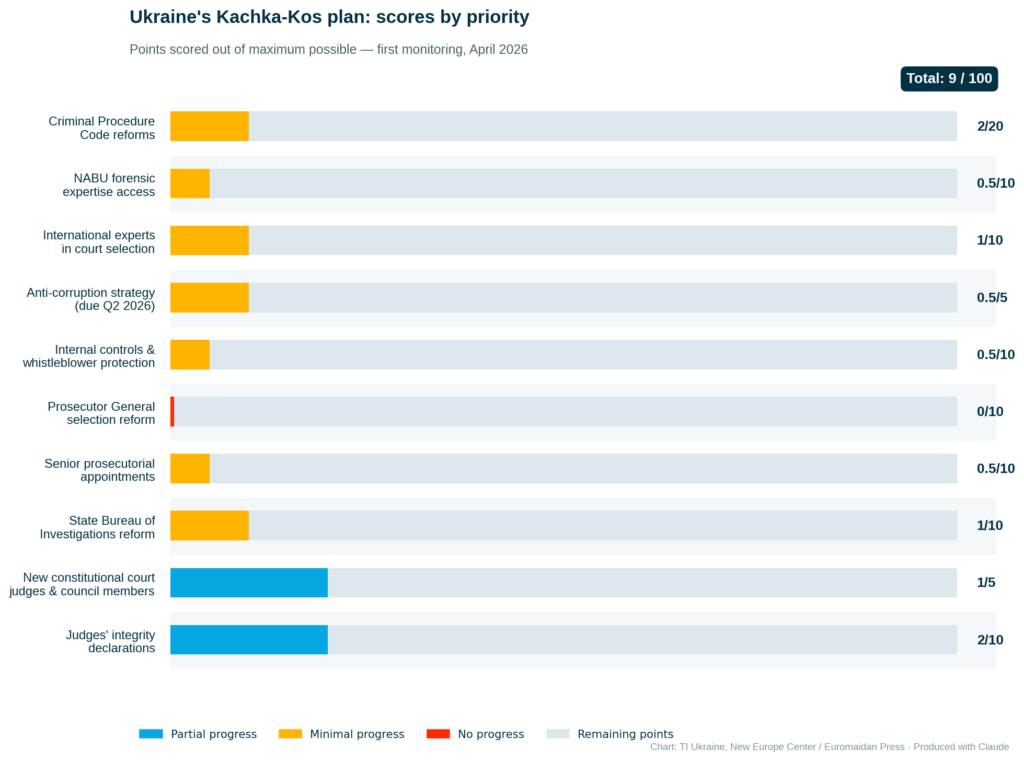
Ukraine attends the summits, signs the agreements, and—three months into the year that was supposed to prove it was serious about EU membership—a coalition of eight independent organizations led by the New Europe Center has counted the results: 9 out of 100 points on the 10-priority reform plan agreed with Brussels in December.
The bills had already cleared European Commission review and were ready for a vote. Parliament left them untouched.
The coalition applied the EU’s own standard—only actual adoption and implementation earns full credit, not announcements or working groups—which means Ukraine has used 25% of its allotted year to deliver roughly 9% of the required work.
In late March, EU Commissioner for Enlargement Marta Kos wrote directly to Ukraine’s parliament: pass 11 reform bills and unlock up to €4 billion ($4.6 billion) in EU funding. The bills had already cleared European Commission review and were ready for a vote. Parliament left them untouched.
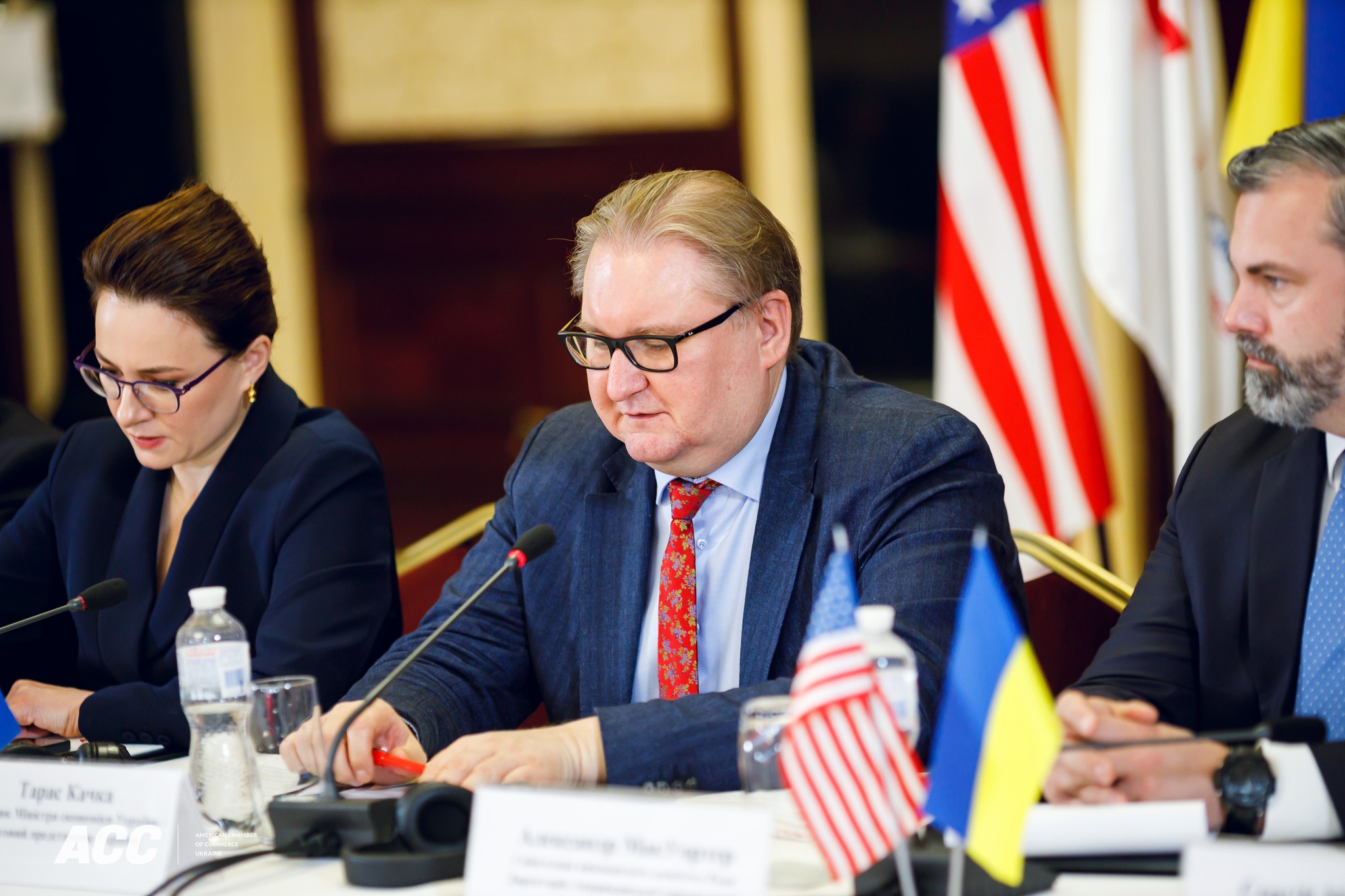
The plan under review—informally named for Deputy Prime Minister Taras Kachka and Commissioner Kos, who signed it in Lviv in December 2025 in front of ministers from every EU member state except Hungary—was already a repair job.
A repair job, not a roadmap
In July 2025, President Zelenskyy signed legislation subordinating Ukraine’s main anti-corruption agencies (National Anti-Corruption Bureau and the Specialized Anti-Corruption Prosecutor’s Office) to political control—the same week Brussels had secretly scheduled the opening of Ukraine’s first EU negotiating cluster.
The December agreement was the reset.
Brussels canceled the plan. Tens of thousands of Ukrainians took to the streets, and parliament reversed the law in nine days. The December agreement was the reset. EU member state capitals now treat it as a proxy for something more fundamental: whether Ukraine can be trusted to deliver reforms under pressure at all—the baseline requirement for any path to membership.
Trending Now
9 points
Transparency International Ukraine analyzed the anti-corruption priorities within the plan—five of the 10 points—and found the same pattern everywhere: declarations without legislation.
The reform of Prosecutor General selection received a flat 0 out of 10: no movement at all. Criminal Procedure Code amendments scored 2 out of 20: a draft exists but hasn’t been published, and the process is closed to outside scrutiny.
The National Anti-Corruption Bureau’s access to independent forensic expertise scored 0.5 out of 10; the center created for this purpose lacks safeguards against interference. International expert participation in judicial appointments—meant to ensure independent vetting of new judges—scored 1 out of 10: a related bill hasn’t moved in parliament since June 2025.
“The overall low score is primarily due to the declaratory character of many steps and the absence of public access to the texts of key draft laws.”
The national Anti-Corruption Strategy, due by the second quarter of 2026, is stuck in interdepartmental clearance and received 0.5 out of 5. None scored higher than 2 points.
“The overall low score is primarily due to the declaratory character of many steps and the absence of public access to the texts of key draft laws,” Andriy Borovyk, executive director of Transparency International Ukraine, told TI Ukraine. “The government must abandon behind-closed-doors preparation of documents, and parliament must finally adopt the necessary laws.”
Ukraine informally opened all six EU negotiating clusters in mid-March—a real milestone achieved through a technical workaround while Hungary’s formal veto holds. Weeks later, monitors released a different number.
Nine out of 100, with nine months left.


