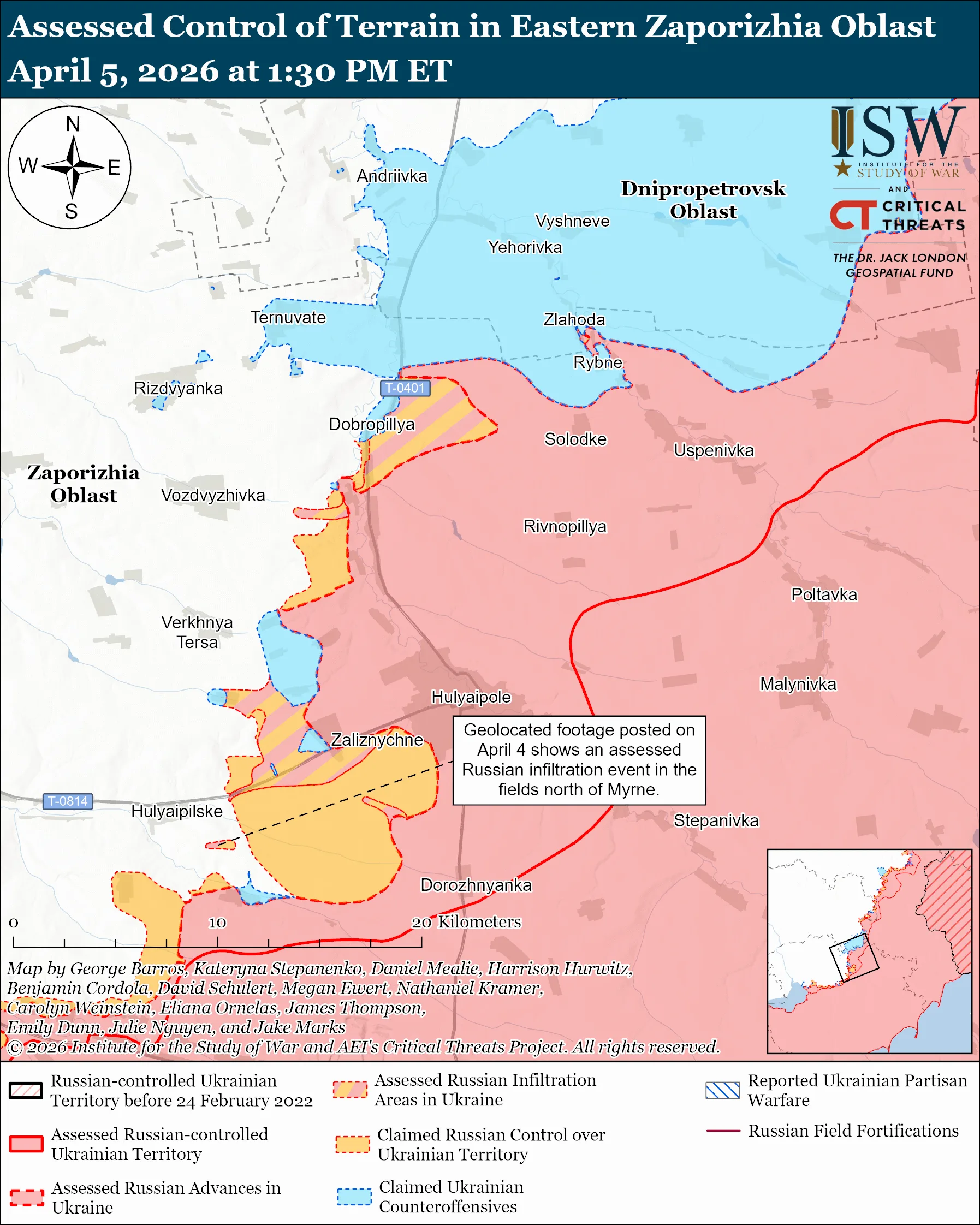
Ukrainian counterattacks in the Huliaipole and Oleksandrivka directions are forcing Russia to redeploy naval infantry away from the Dobropillya tactical area, degrading Russian offensive capacity across the broader Pokrovsk direction, the Institute for the Study of War (ISW) reports.
The Huliaipole direction runs through central Zaporizhzhia Oblast, where Russian forces have pressed westward with the broader aim of advancing on Zaporizhzhia city — Ukraine's sixth-largest city and a major industrial hub on the Dnipro River.
The Oleksandrivka direction runs along the Zaporizhzhia–Dnipropetrovsk Oblast border, an area where Russian forces advanced in summer 2025 with the stated goal of liberating Dnipropetrovsk Oblast. Russian advances there were intended to complement operations near Hulyaipole, allowing Russian forces to approach Zaporizhzhia city from multiple directions and bypass Ukraine's heavily fortified east–west defensive lines in Zaporizhzhia Oblast.
Ukrainian military observer Kostyantyn Mashovets reported on 5 April that the counterattacks have compelled Russian forces to divert "a significant part of the 120th Naval Infantry Division (Baltic Fleet) and the 40th Naval Infantry Brigade (Pacific Fleet)" from the Dobropillya tactical area to the Oleksandrivka direction. ISW had already been tracking the pattern: as of late February 2026, elements of the 40th Naval Infantry Brigade and the 55th Naval Infantry Division — both Pacific Fleet — had shifted from Dobropillya to the Huliaipole direction. In early March, elements of the 68th Army Corps (Eastern Military District) followed the same route, moving from near Pokrovsk and Dobropillya toward Huliaipole.
The redeployments are compounding strain on an already-taxed grouping. Mashovets noted on 5 April that "heavy losses that Russian forces have suffered in the seizure of Pokrovsk and in the Dobropillya tactical area have forced the Russian Central Grouping of Forces to reduce the intensity of its operations in these areas," adding that the removal of naval infantry elements "further weakens the Russian effort against Dobropillya."
ISW assesses that continued Ukrainian pressure in the two directions confronts Russian command with a dilemma its overstretched forces appear challenged to resolve: divert manpower and materiel to contain Ukrainian counterattacks, or preserve momentum for the Russian spring-summer 2026 offensive against Ukraine's Fortress Belt — which ISW assessed had likely begun as of 19 March.
Russia's chemical weapons use: 400 instances in March alone
Russia continues to deploy chemical agents on the frontline in violation of the Chemical Weapons Convention (CWC), to which it is a signatory. The Ukrainian General Staff reported on April 4 that it has documented approximately 400 instances of Russian forces using ammunition equipped with chemical agents in March 2026 alone, and over 13,000 instances since February 2022.
According to the General Staff, Russian forces frequently use drone-dropped K-51 and RG-Vo aerosol gas grenades, along with makeshift containers dispersing chlorobenzylidenemalononitrile (CS) and chloroacetophenone (CN) — riot control agents prohibited under the CWC for use in warfare — to force Ukrainian soldiers out of cover and into the line of fire.
The findings align with a growing body of corroborating documentation: a June 2025 report by the Organization for the Prohibition of Chemical Weapons (OPCW), assessments by Dutch and German intelligence agencies in July 2025, and a May 2024 determination by the US Department of State. Russia's own 810th Naval Infantry Brigade (Black Sea Fleet) acknowledged on its Telegram channel in December 2023 the deliberate use of K-51 gas grenades in Ukraine.