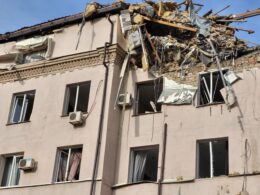


Russian forces killed at least one person and wounded at least eight others across Kharkiv, Sumy, Zaporizhzhia, Donetsk and Dnipropetrovsk oblasts in overnight attacks on 3 April. This is reported by regional military administrations, local officials, and police.
Unlike Russia’s daily strikes involving 100-200 drones against civilian infrastructure, Moscow sometimes escalates to assaults with several hundred drones and missiles of different types in a single wave. This was one of such massive attacks. Previously, Russia launched such massive attacks roughly once a month. The previous one came just last week.
According to the Ukrainian Air Force, this night’s large-scale attack involved 37 missiles of various types and more than 542 drones. None of the 10 ballistic missiles was shot down, pointing to a shortage of Patriot interceptors. The Air Force said 11 missiles and 27 strike drones hit targets at 20 locations, while debris from downed drones fell at 22 more.
A guided aerial bomb—known by the Russian acronym KAB—struck a residential apartment block in Shostka, Sumy Oblast, killing one resident, Suspilne Sumy reported. Ballistic missiles hit Kharkiv and Zaporizhzhia, wounding five people in Kharkiv—including a months-old infant—while monitoring channels reported a separate ballistic strike on Pavlohrad in Dnipropetrovsk Oblast. Two people were killed and three injured in Donetsk region.
Shostka: Glide bomb collapses apartment building
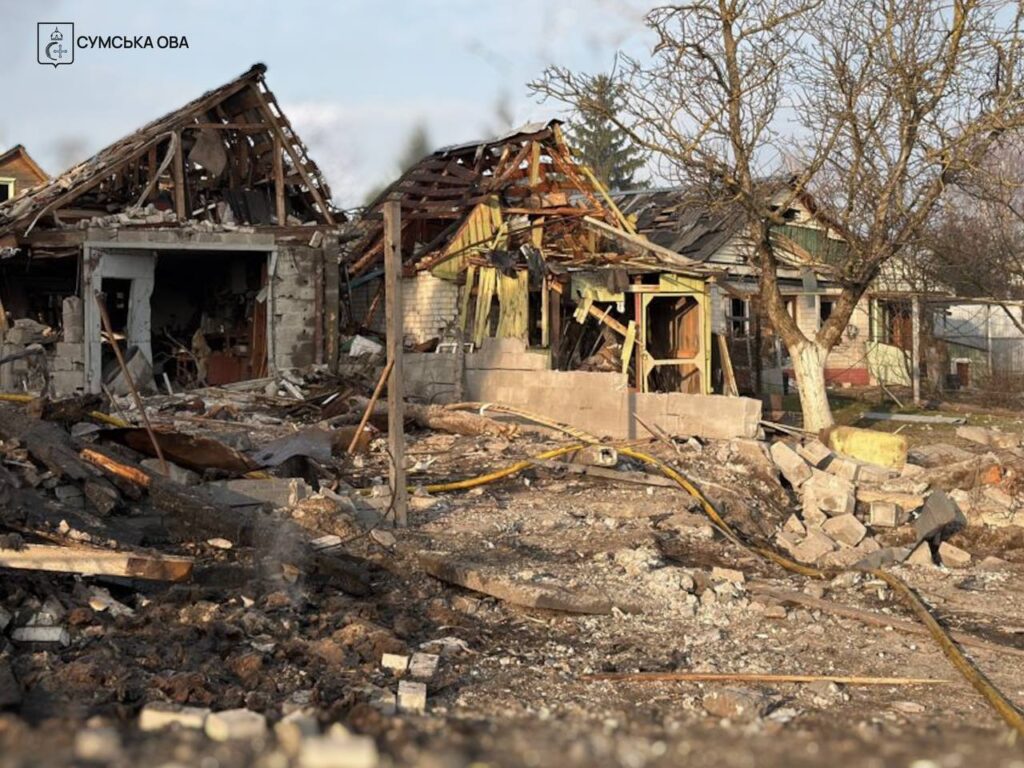
A Russian guided aerial bomb struck a residential apartment block in Shostka, Sumy Oblast, on the night of 3 April, killing a 69-year-old woman and wounding three others, Suspilne Sumy reported. Monitoring sources tracked at least four KABs directed at Shostka and surrounding areas overnight, alongside Shahed attack drones.
A KAB is a Soviet-era unguided bomb retrofitted with GPS navigation and fold-out gliding wings, giving it a range of up to 60–70 kilometers when released from a Su-34 or Su-35 at 12–15 km altitude.
Shostka sits roughly 50 kilometers from the Russian border and has been struck repeatedly in recent weeks. On 27 March, Russian drones hit critical infrastructure in the Shostka community, injuring two. The city's railway station was attacked in October 2025, killing one and injuring 30 others.
Kharkiv: Four ballistic strikes wound five, including newborn
Russian forces struck Kharkiv with ballistic missiles in the early hours of 3 April, firing at least four rockets into Kyiv district. Five people were wounded across three districts—Osnov'yansky, Kyiv, and Shevchenkivsky—according to Kharkiv Mayor Ihor Terekhov, Kharkiv Oblast Military Administration head Oleh Syniehubov, and the Kharkiv Oblast Police. A gas line was severed in the attacks. A 27-year-old woman and her infant son—born earlier in 2026—suffered acute stress reactions after their home in Kyiv district was hit.
Kharkiv, Ukraine's second city, lies roughly 30 kilometers from the Russian border. Ballistic missiles travel on high-arcing trajectories at speeds that leave civilians seconds of warning time—far less than against cruise missiles or drones.
Zaporizhzhia: Ballistic missiles strike city
Russian forces launched ballistic missiles at Zaporizhzhia overnight on 3 April, according to Zaporizhzhia Oblast Military Administration head Ivan Fedorov, as cited by RBC Ukraine. The full extent of damage and casualties was still being established at the time of reporting. On the evening of 2 April, Zaporizhzhia had already been struck
Pavlohrad: Ballistic wave reaches Dnipropetrovsk Oblast
Monitoring channels and RBC Ukraine reported that Pavlohrad in Dnipropetrovsk Oblast was targeted as part of the same overnight ballistic strike wave, with a fast-moving target tracked approaching the city before impact. Dnipropetrovsk Oblast Military Administration head Oleksandr Hanzha had already reported a separate drone strike on Pavlohrad's industrial infrastructure earlier on 2 April, with no casualties.
Pattern: a two-weapon, multi-day campaign
The attacks across 2–3 April combined at least three distinct weapon types: Shahed kamikaze drones, which struck Kharkiv continuously throughout 2 April; ballistic missiles (likely Iskander-M variants), which hit Kharkiv and Zaporizhzhia in the early hours of 3 April; and guided aerial bombs, which struck Shostka on the same night. The simultaneous use of different systems across multiple cities tests Ukrainian air-defense resources and warning networks simultaneously.
Russia's daily use of 200–300 guided aerial bombs was acknowledged in March by Ukrainian Commander-in-Chief Syrskyi, who noted that no effective interception method has yet been found.