
Ukraine's military intelligence has named seven Russian archaeologists and historians operating in occupied Ukrainian territory, publishing their identities and institutional affiliations through the War&Sanctions portal's dedicated database.
Russia has stolen over 1.7 million items of Ukrainian cultural heritage from occupied territories, with ongoing looting documented in regions like Kherson (over 1,200 artifacts) and Zaporizhzhia (170+ artifacts since 2022. Russia continues this to erase Ukrainian identity, appropriate artifacts for its museums, and sell them on black markets, in violation of international law.
Permits, projects, and excavations in occupied territory
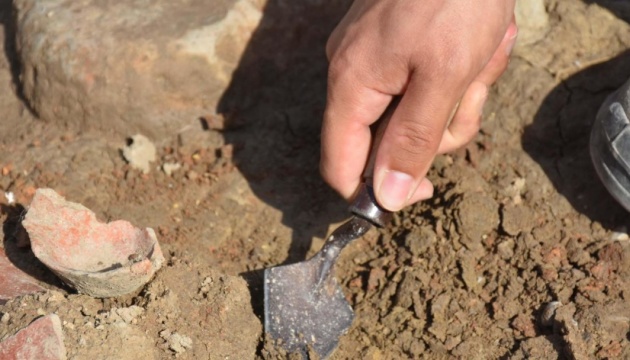
The details were released in the "Stolen Heritage" section of the War&Sanctions portal, according to Ukraine's Main Intelligence Directorate (GUR). The agency states that Russia has for centuries sought to destroy or appropriate Ukrainian history — and is now doing so systematically through excavation teams working under official cover in occupied land.
"To this end, the aggressor conducts archaeological excavations in temporarily occupied territories, steals cultural heritage objects from museums, appropriating our culture," GUR states.
Three of the named individuals are directly linked to fieldwork. Eduard Kravchenko led expeditions at two sites in occupied Donetsk region — the Pryazovia settlement of Obriv-2 (2016–2018) and Velyka Shyshivka on the Donetsk Ridge (2019–2021). Russia's Ministry of Culture issued him a permit in September 2024 for work in occupied Donetsk and Zaporizhzhia regions; further permits for Crimea followed in 2025 and 2026. Vitaliy Voytenko participated in the same Velyka Shyshivka digs and is identified as a direct participant in the war against Ukraine.
Oleksandr Kolesnyk heads a project titled "Archaeology of New Territories: from Donetsk to Krasnoyarsk," funded through Russia's presidential grants foundation. Its stated purpose is to spread narratives about the "history of the lands of Donbas as an inseparable part of historical Russia." Kolesnyk received three Ministry of Culture permits for work in occupied Donetsk region in 2024 and 2025.
The Russian historical society's occupation network
The remaining four individuals are linked not to excavation sites but to the institutional infrastructure of historical propaganda inside the occupied territories, operating through branches of the Russian Historical Society.
Oksana Syvak heads a branch that co-organized a September 2024 "international conference 'History of Novorossia'" at the occupation-administered Mariupol State University. The event was attended by representatives of the Russian Historical Society and occupation authorities of the so-called DNR, including Denis Pushilin.
Kostiantyn Mohylevskyi visited the Russian Historical Society branch in the so-called LNR in February 2024, where he stated that "victory over Nazism" would "definitely be with Russia." In early 2023 he participated in the opening of an exhibition titled "Formation of LNR Statehood" at the Luhansk Regional Museum.
Artem Rubchenko — identified as a participant in Russia's war — attended the Russian Historical Society congress in Moscow in November 2022, where he personally thanked Putin "for assistance in the Luhansk Regional Museum's collection of evidence of 'crimes of the Kyiv regime.'" He regularly organizes events at his branch dedicated to the war.
Vitaliy Rozumnyi chairs the Russian Historical Society branch in the so-called DNR. Under his leadership, a 2024 council session resolved to produce a collective publication titled "Essays on the History of the DNR." He also periodically arranges meetings between Donetsk University students and what the occupation authorities call "heroes of the SVO."
Twenty stolen objects
In addition to naming individuals, GUR published data on 20 cultural valuables taken from archaeological sites in occupied Crimea — including the Kyz-Aul necropolis and the Hospitalny burial mound — as well as items removed from the Novokakhivska City Art Gallery and the Kamiana Mohyla nature reserve, the agency adds.


