

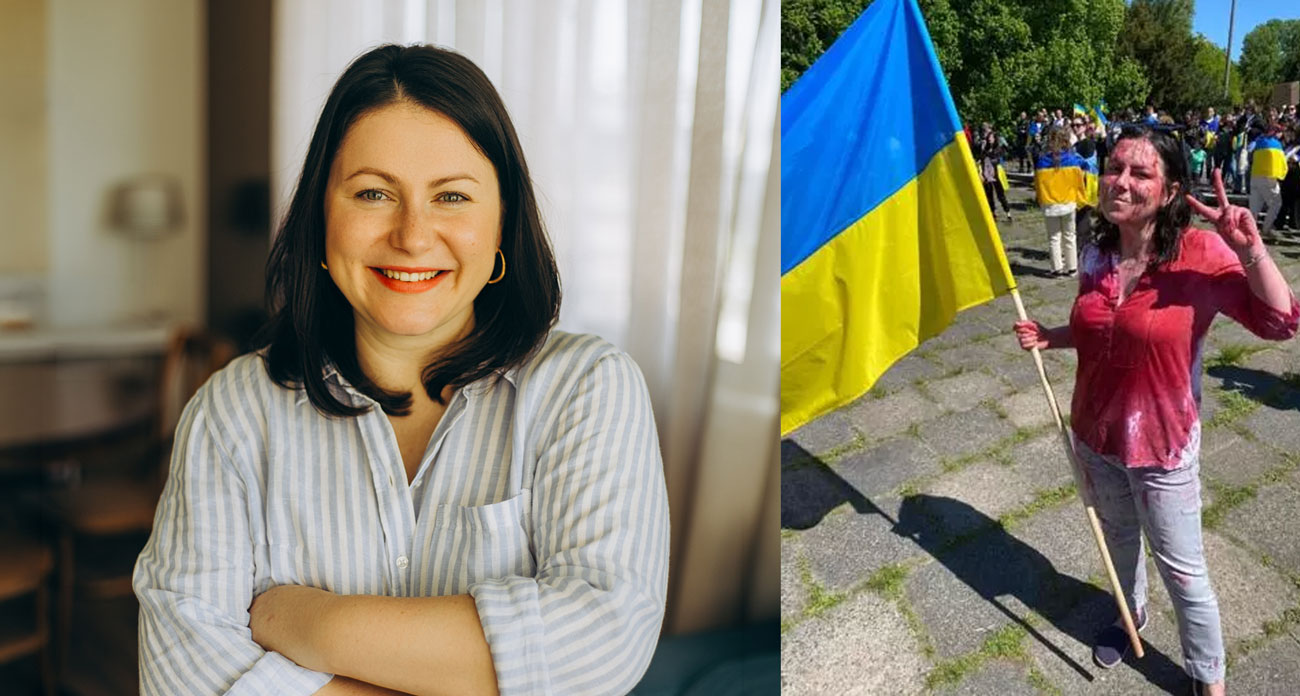
Euromaidan Press has joined 20 other Ukrainian media organizations and civil society groups in a joint statement condemning Russia's in absentia conviction of journalist and media expert Iryna Zemlyana. The Moscow City Court sentenced Zemlyana to 13 years in a general regime colony over a 2022 protest in Warsaw — a verdict the signatories call a politically motivated fabrication.
The statement warns that Russia is now attempting to use international law enforcement mechanisms to pursue her internationally, and that her case is a template for targeting any anti-war activist in Europe.
The joint condemnation
Signed by the Institute of Mass Information (IMI), Detector Media, Lviv Media Forum, the Center for Democracy and Rule of Law, Ukraїner, and 16 other organizations, the statement calls the verdict "politically motivated persecution for professional activity, public stance, and spreading the truth about Russia's crimes." The organizations call on Ukrainian authorities and international press freedom bodies to formally recognize the verdict as political persecution, and to take all possible steps to prevent Russia from weaponizing international legal mechanisms against Zemlyana.
The signatories single out Russia's use of "incitement of hatred" and "spreading fakes about the army" charges — the same articles Russian authorities also deploy systematically to silence journalists and critics inside Russia.

What Zemlyana is accused of
On 9 May 2022 — weeks after the world learned of Russia's massacre of civilians in Bucha — Ukrainian activists blocked Russian then-Ambassador to Poland Sergey Andreyev and pelted him with red liquid as he attempted to lay flowers at the Soviet military cemetery in Warsaw — participants used beet juice to symbolize the blood of Ukrainians killed by Russia's forces. Poland investigated the incident and found no crime, closing the case in June 2023.
Within hours after the incident, Russian Telegram channels published her passport number, phone number, home address, and social media accounts, calling for her to be "exterminated." She received tens of thousands of threats and was forced to leave Warsaw.
Russian outlet Mediazona reported the ruling on 10 March 2026. Russia charged Zemlyana under three articles of its criminal code: attacking a representative of a foreign state with the aim of complicating international relations; inciting hatred and enmity through violent means; and publicly spreading "false information" about the Russian army. The court also banned her from administering websites for four additional years.
Russia declared Zemlyana wanted in November 2022. In February 2024, it added her to its Rosfinmonitoring "terrorists and extremists" list at number 7191. The Basmanny District Court of Moscow issued an arrest warrant for her in absentia in March 2024. Zemlyana said she had no contact with Russian authorities throughout.
Trending Now
"Everything I know about my own case comes exclusively from Russian propaganda media," she told RFI.
Zemlyana denies throwing anything at Andreyev and says she only poured juice on herself during the 2022 protest rally.
"Obviously, this verdict is a political signal, not real justice," she said to IMI. "The case is completely fabricated — just look at the photos and videos to understand I didn't do it. Polish law enforcement also cleared me."
Russia is seeking to add Zemlyana to Interpol's Red Notice wanted list, according to her. Her name does not currently appear in Interpol's public database, but Interpol does not always disclose such information, RFI noted. Zemlyana says Russia deliberately framed the case as a criminal matter — an attack on a diplomat rather than a political protest — specifically to clear Interpol's bar.
Moscow cuts another lifeline to Europe’s human rights system as Putin moves to exit anti-torture convention
On 23 March, Ukrainian MP Yaroslav Yurchyshyn, chair of the Verkhovna Rada Committee on Freedom of Speech, appealed to the National Police in its capacity as Ukraine's official Interpol representative. The National Police responded that it had taken measures to prevent Russia from using the Interpol system to persecute Zemlyana, citing Article 3 of the Interpol Statute, which prohibits the organization from intervening in matters of a political character.
Read also
-
Ukrainian journalist Victoria Roshchyna posthumously named World Press Freedom Hero
-
Children informing on parents, teachers beaten, collaborators later jailed — researcher details Russia’s occupation playbook
-
337 Ukrainian POWs “consciously and brutally” executed by Russia – nearly all others tortured


