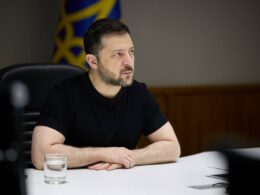


Ukrainian President Volodymyr Zelenskyy criticized Israeli Prime Minister Benjamin Netanyahu for his stance on the war between Russia and Ukraine. Netanyahu is still trying to sit on the fence between Russia and Ukraine—even as Moscow passes satellite intelligence on American military bases to Iran, Zelenskyy said in an interview with Axios published on 31 March.
Zelenskyy has not spoken to Netanyahu in two years. Ukraine, he said, is ready for defense cooperation. Israel has not asked.
"My feeling is that Netanyahu always wants to balance between Russia and Ukraine, even when Russia is helping Iran. He is the prime minister of his country he has to [decide] what to do."
What Russia gave Iran
Ukraine has shared evidence with partner governments that Russia provided Iran with satellite imagery identifying the locations of US and European military bases in Saudi Arabia, Qatar, Jordan, and the UAE, Zelenskyy said. Those four countries collectively host tens of thousands of American troops and anchor the US military posture across the Gulf.
Moscow also transferred operational knowledge from Ukraine's front line to Iranian forces—specifically, tactics for deploying FPV attack drones. FPV drones, guided in real time by a pilot wearing video goggles, became a defining weapon of Russia's war on Ukraine; Iran has since produced and exported its own variants. Russia's decision to share the battlefield lessons it learned fighting Ukraine with the country that supplies it weapons completes a loop that runs directly through Israeli security interests.
The offer Israel hasn't taken
Zelenskyy framed the absence of Israeli engagement as a deliberate choice rather than a missed opportunity. The two countries have complementary needs, he said: Ukraine is running a chronic shortage of air defense systems, the kind Israel has developed and deployed against Iranian missiles and drones. Israel, in turn, lacks things Ukraine has—he did not specify, but three years of direct experience fighting Iranian drone systems and the intelligence gathered from captured Iranian hardware are the obvious candidates.
After fighting broke out between Israel and Iran, other countries approached Ukraine for assistance, Zelenskyy said. Israel did not.
"We have what he needs and he has what we need... we have big deficit with air defense. But we have things Israel doesn't have and we are ready for this dialogue."
Israel's position on the full-scale invasion
Israel condemned Russia's full-scale invasion in February 2022 and voted with Western nations at the UN General Assembly. But it refused to supply lethal weapons to Ukraine, including its Iron Dome air defense system, which Kyiv requested repeatedly.
Israel provided humanitarian aid and assistance for Jewish refugees while positioning itself as a potential mediator. Prime Minister Naftali Bennett even traveled to Moscow in March 2022 to meet Vladimir Putin.
Military cooperation came quietly, and later than Ukraine wanted. In May 2023, an Israeli-made missile alert system began operating in Kyiv; Ukraine's ambassador to Israel, Yevhen Korniichuk, credited Netanyahu with personally advancing the project. Israel also allowed the transfer of Patriot air-defense interceptors to Ukraine via the United States—a fact officials initially denied. In September 2025, Zelenskyy confirmed a Patriot battery had been delivered and was operational, the first official acknowledgment of direct Israeli military assistance to Ukraine.
At the diplomatic level, Israel’s positioning remained ambivalent. In February 2025, it joined the United States and Russia in voting against a UN General Assembly resolution reaffirming Ukraine’s territorial integrity. Israeli Foreign Minister Gideon Sa’ar said the vote was intended to give diplomatic initiatives aimed at ending the war a chance.
Zelenskyy’s remarks frame Israel’s neutrality as increasingly difficult to sustain. As Russia transfers battlefield experience and intelligence to Iran, the war in Ukraine is no longer a distant conflict for Israel — but one that increasingly intersects with its own security environment.