

With Hungarian parliamentary elections less than two weeks away and Ukraine’s central bank warning the country may need to start printing money again by early June, the EU’s €90 billion loan package for Ukraine remains in limbo.
“The European Parliament is a soft power instrument. It has no weapons, no ammunition stockpiles. Real decisions happen in Berlin and Paris.”
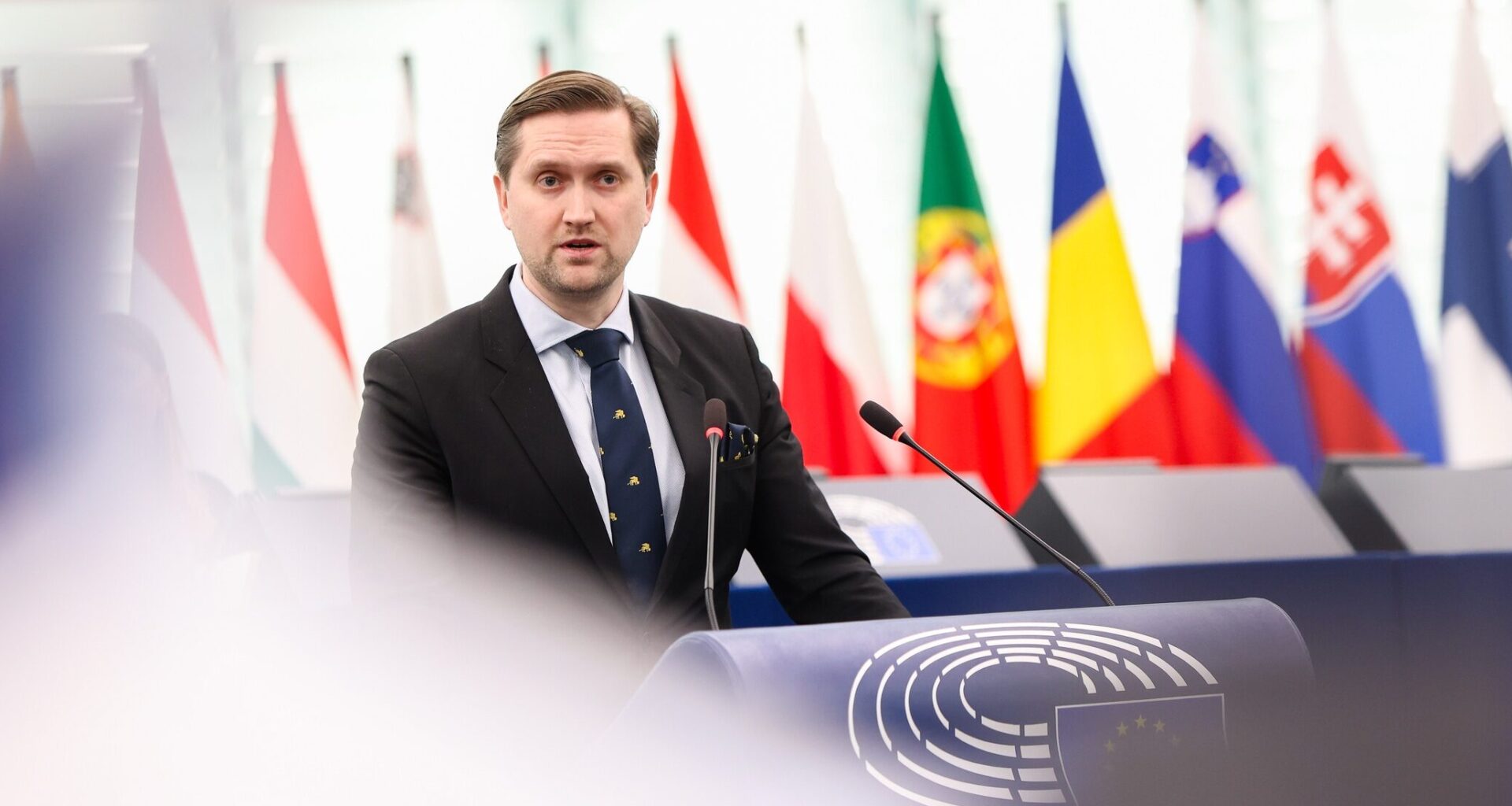
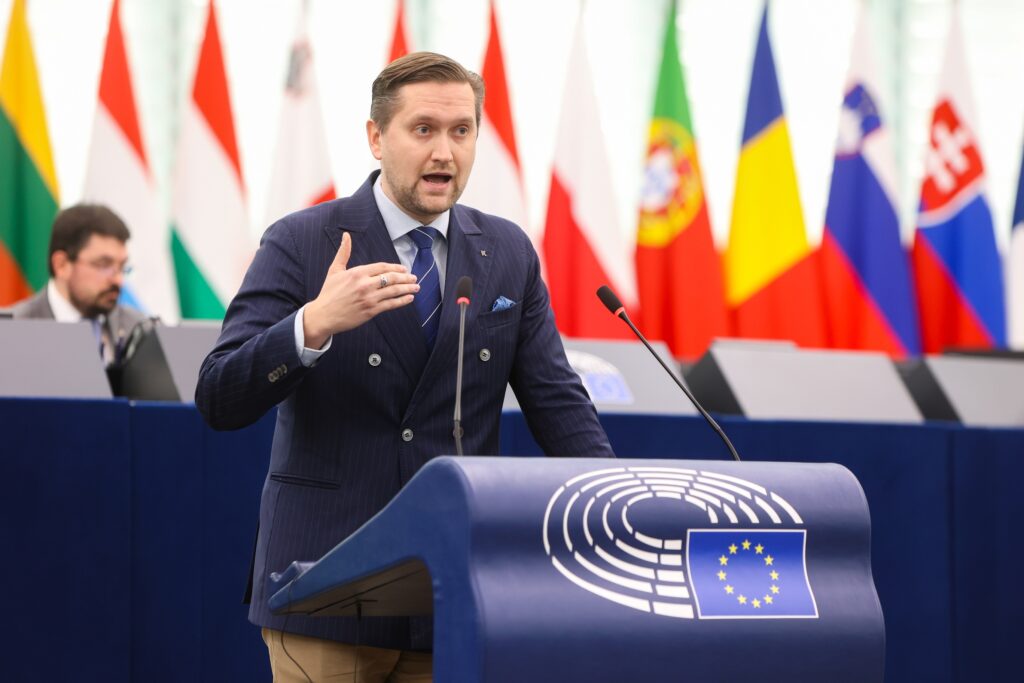
Euromaidan Press spoke to Jaak Madison, an Estonian Member of the European Parliament representing the Estonian Centre Party (Eesti Keskerakond) and sitting in the European Conservatives and Reformists group, to find out what Brussels can actually do about it.
His answer is blunt: not much. “The European Parliament is a soft power instrument,” he says. “It has no weapons, no ammunition stockpiles. Real decisions happen in Berlin and Paris.”
He watched a Hungarian colleague complain that Ukraine won’t repair the oil pipeline Russia destroyed and called it an upside-down world.
Madison has been vocal on Ukraine in the European Parliament, including on Hungary. At a Foreign Affairs Committee session on 17 March, he watched a Hungarian colleague complain that Ukraine won’t repair the oil pipeline Russia destroyed—cutting off Hungary’s Russian oil supply—and called it an upside-down world.
Budapest, Brussels, and the view from the bar
Peeter Helme: How does Ukraine’s confrontation with Hungary look from the European Parliament—a distant border squabble, an energy dispute, or a genuine EU credibility crisis?
Jaak Madison: It depends on where you’re standing in Europe. The further you are from the Ukrainian border, the fewer emotions it stirs. In Brussels, over a beer in some central square, people sympathize with Ukraine and look at Hungary with a certain contempt. The closer you get to Hungarian and Ukrainian territory, the more charged it becomes.
Hungary isn’t the most beloved country within the EU, and there are reasons for that.
When elections are close, national interest comes first. That’s not unique to Hungary. Every society has historical undercurrents—old disputes, territorial grievances—that surface under pressure.
Hungary isn’t the most beloved country within the EU, and there are reasons for that. They’ve clashed with both the European Parliament and the Commission on immigration redistribution schemes, for instance, where many conservative forces across Europe actually backed Hungary and Slovakia.
Hungary’s squabbling with Ukraine doesn’t affect how much military aid Spain or Italy could give if they wanted to.
But on Ukraine, that conservative camp has clearly split. Those who feel the Russian threat most acutely have lined up as critics of Hungary. Those who were quietly sympathetic to Russia—though they tried to hide it, especially after 2022—are once again drifting back toward the Hungarian position.
That said, Hungary’s squabbling with Ukraine doesn’t affect how much military aid Spain or Italy could give if they wanted to. Those things aren’t connected. Spain is a good example—in words, always a great supporter of Ukraine. In practice, their aid is very modest relative to their GDP.
What the EP can actually do
Peeter: So, if the decisions are made at the member state level, then what can the European Parliament actually do here?
Madison: The European Parliament is a soft power instrument. It has no weapons, no ammunition stockpiles. Real decisions happen in Berlin and Paris. What you often see is a double game: MEPs vote for aid packages in Brussels that their own parties back home refuse to provide.
Hungary’s veto and the €90 billion
Peeter: Budapest has tied Ukraine’s funding to the Druzhba pipeline question, making veto power a political pressure instrument across the whole EU. How does that play out in practice?
Madison: If the EU wants to take a joint loan—backed on paper by frozen Russian assets—to cover that €90 billion, you need all member states’ consent. But technically, a similar decision can be made without full EU agreement, backed instead by the guarantees of the willing countries.
Most of those assets are in Belgium, and Belgium was the most skeptical.
The original plan was to go after the frozen Russian assets directly. That would have been the most logical approach. But there are legal risks—potential court challenges. Most of those assets are in Belgium, and Belgium was the most skeptical for exactly that reason: they don’t want to put their financial system under threat.
Peeter: It’s a question of credibility?
Madison: Exactly. If Belgium agreed that Russian assets held on their soil could be transferred to Ukraine, other countries with assets in Belgium or Luxembourg might start moving them out quickly. A Middle Eastern country with a poor human rights record, for instance, might decide it’s no longer safe to keep assets in the EU—and transfer them elsewhere. A credibility deficit gets created in the financial system.
The solution is that the EU takes a joint loan—essentially prints money—with frozen Russian assets as collateral.
It’s a beautiful plan on paper. In practice, many countries won’t agree because they don’t want to risk their financial systems. So another mechanism had to be found.
The agreed solution is that the EU takes a joint loan—essentially prints money—with frozen Russian assets as collateral. But if those assets aren’t ultimately used to cover the €90 billion, member states repay the loan in proportion to the size of their economies. The interest earned on the frozen assets goes toward repayment in the meantime.
Nobody knows the final figure. But every country must consent to the scheme.
In Estonia’s case, the bill is estimated somewhere between €500 million and €1 billion. Nobody knows the final figure. But every country must consent to the scheme.
Hungary’s position is that it won’t agree unless the Druzhba oil pipeline is restored and Russian oil transit through Ukraine resumes. And yes, technically, the other 26 countries could proceed without them—Hungary wouldn’t sign, wouldn’t be responsible for repayments.
If support turns too critical, it becomes very hard for governments to sell the idea of covering billions in loans for Ukraine.
But then comes the political problem. Voters in Italy, Cyprus, or Greece will start asking: why does Hungary stay out and not pay its share, while we do? Technically, it’s possible. Politically, it’s messy.
And there’s another layer: Russian information operations are running anti-Ukrainian messages—about corruption, about the sons of ministers living safely in the West—that affect public opinion in those countries. If support turns too critical, it becomes very hard for governments to sell the idea of covering billions in loans for Ukraine.
War fatigue is real
Peeter: How does public opinion on Ukraine look to you right now? Is it turning critical?
Madison: Turning critical, badly.
No matter how many fine words are said, it’s something like what Solzhenitsyn wrote in The Gulag Archipelago—it’s easy for Western European intellectuals to sympathize with victims until they’ve lived through the hardship themselves. We say, “as long as it takes,” that we’re ready to do everything.
One’s own shirt is closest to the body.
Trending Now
But then the average European—who simply has to pay more for food and fuel—starts talking about war fatigue and hoping for a peace deal. These people go to the ballot box and vote for politicians who promise to put their own nation first and pay less attention to a war 2,000 kilometers away.
Peeter: The further from the eastern border, the more different the view.
Madison: Of course. It’s like asking an average Ukrainian how much they’re emotionally affected by a civil war in Sudan, where thousands are dying. One’s own shirt is closest to the body.
If Hungary keeps blocking
Peeter: Hungary is blocking the €90 billion. Ukraine’s central bank says the country has money only until early June, then it starts printing again. Merz and von der Leyen say they’ll find a solution without Hungary. What is actually going to happen?
Jaak Madison: Nobody knows. We can’t see into the heads of Merz, Macron, or von der Leyen.
Peeter Helme: What would bypassing Hungary mean for the EU going forward?
Jaak Madison: I’m fairly certain the EU will move toward a multi-speed model—separate groups of countries with different levels of integration. That’s understandable. Financial policy in Greece looks very different from Germany or the Netherlands.
A unified immigration policy doesn’t work—it just creates tension.
Immigration is the same: immigrants arriving in Greece from Türkiye across the sea isn’t really a concern for Estonia or Finland if the external borders aren’t being held. A unified immigration policy doesn’t work—it just creates tension and gives pragmatic parties the opportunity to come to power by telling Brussels to get lost.
Security is the same. In 10 years, we might have a union with a free market and Schengen, but participation in aid to third countries might be based on voluntary agreements between willing states.
Every Russian soldier killed in this war is one less soldier who could threaten Narva.
For Estonia, it’s pragmatically beneficial to keep Russia occupied in Ukraine. It sounds grim, and some Estonian MPs say it’s immoral to cheer on the blood of Ukrainian soldiers.
But whether we like it or not, every Russian soldier killed in this war is one less soldier who could threaten Narva. Estonia understands this. But why should a voter in Luxembourg agree to pay for an aid package to a country that Russia doesn’t threaten in the slightest?
This can’t last indefinitely. In 2017, Jean-Claude Juncker released a White Paper outlining five scenarios for the EU’s future, including full federalization or a rollback of integration. One variant was a multi-speed Europe, with sovereign policies on finance and immigration, participating in joint projects where they choose to. That’s the most pragmatic scenario, and I think it’s where we’re heading.
Hungarian elections: does it change anything?
Peeter Helme: Elections in Hungary are less than two weeks away. What changes if Péter Magyar’s Tisza party wins?
Jaak Madison: A new government could change political decisions in the Council. We don’t know what Péter Magyar and the Tisza party would actually do, but it’s possible Hungary would stop vetoing Ukraine-related initiatives.
The Commission has signaled it would treat a new government more leniently.
Orbán is campaigning on the line that the opposition would let Zelenskyy take money from Hungarian pockets. Meanwhile, the Commission has signaled it would treat a new government more leniently.
Brussels has always been irritated by Hungary’s independence. Hungary has held its ground against genuinely nonsensical things from the Commission—the COVID recovery package, for instance, which was completely idiotic money printing tied to conditions like the green transition and gender rights that had nothing to do with economic recovery. That’s caused years of friction between Brussels and Budapest.
Ukraine’s EU membership illusions
Peeter Helme: So, Ukraine may end up joining a very different union than the one it imagines.
Jaak Madison: It’s inevitable. When I visited Kyiv in 2015 and 2017, the dream there was to join the EU for lots of money.
I told the Ukrainians even then: the EU means joining federal directives and losing independent tax policy — control over VAT and excise rates goes, to ensure market competition. Property and farmland must be opened for sale. Larger German and French producers will come and buy resources cheaply, and eventually, local farmers will be complaining about foreign owners.
Without corruption, Ukraine would be one of Europe’s richest countries—it has the resources and the farmland for it.
New members from Eastern Europe have always joined during transition periods that restrict their rights—such as freedom of movement—to protect Western European labor markets from cheap competition. Even if Ukraine joined tomorrow, there would be protective clauses limiting how much milk or pork it can export.
Without corruption, Ukraine would be one of Europe’s richest countries—it has the resources and the farmland for it. Look at Switzerland—they’d never join the EU. Why open your market to German producers when you already have a free trade agreement? Pragmatically, I don’t see why Ukraine would want to tie itself that tightly to the EU economy.
Ukraine’s internal problems
Peeter Helme: And my final question: is there anything important that isn’t being said loudly enough?
Jaak Madison: We have to be honest about what’s happening inside Ukraine. There’s a morale problem when ordinary people see that elite families are avoiding mobilization while they themselves are sent to the front.
That inequality gets amplified by Russian propaganda. When I raised this question with the EU Commission, I was told it’s Russian propaganda. But we can’t ignore objective facts.
If we genuinely want to support Ukraine, we have to be honest about these problems.
In Estonia alone, there are some 7,500 Ukrainian men of mobilization age with temporary protection, and Ukraine hasn’t asked for them back. I raised this with the Ukrainian ambassador to Estonia, but Kyiv wasn’t interested.
When you lack human resources, and soldiers have been at the front for years without a break, the system isn’t sustainable. If we genuinely want to support Ukraine, we have to be honest about these problems. You can’t close your eyes to corruption or to failures in mobilization.


