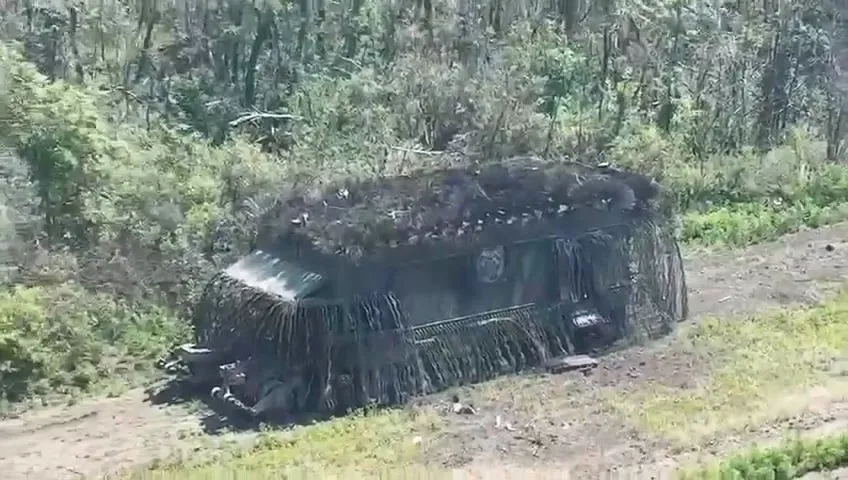
- Ukraine has spread its dozens of American-made M-1 tanks across at least three brigades and regiments
- Each unit is adding anti-drone protection to the tanks' baseline armor
- The 1st Assault Regiment's add-on protection might be the best
- It allows the tanks to fight as tanks, aiming and firing their powerful main guns
The Ukrainian 1st Assault Regiment is transforming at least one of its ex-Australian M-1 Abrams tanks into a drone-proof turtle tank with many of the latest innovations. And it clearly aims to use it. We've seen 1st Assault Regiment tanks in action recently as part of Ukraine's ongoing southeastern counteroffensive.
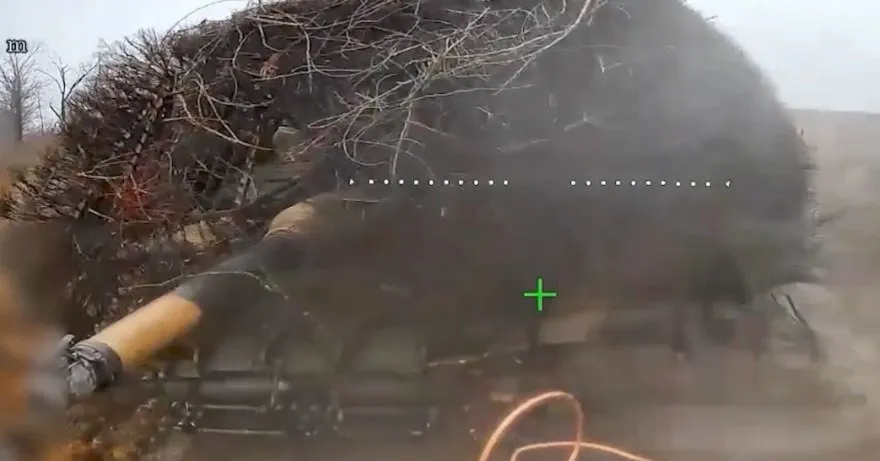
On or just before Monday, a 1st Assault Regiment tank was observed rolling up on a Russian infantry position outside the village of Pryluky in southeastern Ukraine's Zaporizhzhia Oblast, and blasting that position at close range with its 120-millimeter main gun.
Unlike most drone-caged tanks on both sides, which sacrifice their main guns for protection, the 1st Assault Regiment's design shields only the turret—letting the crew rotate and fire. If it works, it solves the central dilemma of armored warfare in the drone age: how to survive and fight.
The footage of that Monday tank assault, along with earlier imagery of a 1st Assault Regiment workshop, seems to confirm that the regiment is the third Ukrainian unit to operate the 69-ton, four-person M-1—after the 47th Mechanized Brigade and the 425th Assault Regiment.
When Elon Musk's Starlink abruptly bricked Russia's thousands of stolen and smuggled satellite communications terminals around two months ago, throwing Russian communications into disarray, it wasn't a foregone conclusion that the Ukrainians would seize the opportunity—and counterattack.
But they did, and tanks led the way in many of the assaults. This was a risky choice on the part of Ukrainian commanders.
Russia parked its tanks. Ukraine didn't.
For much of 2025, drone-battered Russian forces in Ukraine parked their own tanks and other armored vehicles, instead opting to send in infantry on foot or on motorcycles or all-terrain vehicles. The idea, it seems, was that small teams of infantry, spread out over a wide area, would be able to slip past Ukraine's drones much more easily than vehicles could do.
Ukrainian forces were less reluctant to deploy their own tanks, occasionally mustering them for swift counterattacks in areas where the Ukrainians had the aerial edge. That Ukrainian brigades and regiments could deploy tanks at all last year speaks to Ukraine's enduring advantages in drone and counter-drone technologies and tactics.
And when the drone gap widened amid the one-sided Starlink shutdown, Ukrainian tankers grew even bolder—and pushed across the wide contested "gray zone" to assault Russian defenses in Zaporizhzhia. They were clearly betting on the collapse in Russian comms to ground many of the most dangerous Russian drones.
If the footage of that apparently successful M-1 assault around Pryluky is any indication, it was a winning bet. Ukraine's tanks are back.
Trending Now

Ukraine has received 80 of the 2000s-vintage M-1s: 31 from the United States in 2023 and 49 from Australia last year. The analysts at the Oryx collective have confirmed the destruction or capture of at least 11 M-1s. Another 12 M-1s have been damaged or abandoned, potentially resulting in additional permanent losses.
The 57 to 69 survivors are spread across three brigades and regiments—and fighting hard. The 425th Assault Regiment lost one M-1 during the initial attacks that kicked off Ukraine's southeastern counteroffensive in Zaporizhzhia and neighboring Dnipropetrovsk Oblasts starting in early February.
But the tankers have taken every prudent precaution, heaping all the latest anti-drone innovations on their M-1s and other tanks. The 47th Mechanized Brigade was the first to add layers of explosive reactive armor and rubber skirts to stiffen the built-in composite armor on its roughly 30 M-1s.
The 425th Assault Regiment later added, to its own dozen or so M-1s, a large metal frame supporting thousands of drone-detonating metal spines. For its part, the 1st Assault Regiment seems to be applying a new variant of the metal frame that only surrounds the M-1's turrets, allowing the turrets to rotate left and right to aim their main guns.
The concept first appeared in Russian blueprints from the Omsk tank factory earlier this year—Ukrainian engineers quickly adapted it for the M-1. It's unclear whether the 425th Assault Regiment M-1s can traverse their turrets.
Many Russian and Ukrainian tanks have metal frames that surround both the turret and the hull and effectively trap the gun, preventing it from rotating and aiming. These tanks can function as heavily-armored assault vehicles that can clear mines and transport infantry under their add-on armor. Unable to aim their guns, they can't close with and engage enemy troops—they can't function as tanks.
But the 1st Assault Regiment clearly wants its M-1s to work as tanks—so it can continue deploying them for attacks even after the Russians restore their comms and launch more drones over the gray zone.