


Alexander Shohin, chairman of Russia’s main business lobby, told reporters after the 27 March meeting that Vladimir Putin had discussed artificial intelligence regulation, the platform economy, and his assessment of the Middle East crisis.
Putin asked the country’s most powerful oligarchs to make “voluntary” contributions to fund the war in Ukraine.
What Shohin did not mention: Putin had asked the country’s most powerful oligarchs to make “voluntary” contributions to fund the war in Ukraine, The Bell’s Irina Malkova reported on 27 March, citing two sources familiar with the meeting’s contents.
The Bell is designated a “foreign agent” by Russian authorities—a label Moscow applies routinely to independent outlets.
Russia’s official defense spending hit 15.5 trillion rubles (approximately $190 billion) in 2025, and the government is separately weighing a 10% cut to all non-defense budget lines. For the first time since the full-scale invasion began, the Kremlin appears to be supplementing war financing with private capital that it is asking—not commanding—its billionaires to provide.
What was pledged
Billionaire Suleiman Kerimov committed 100 billion rubles (about $1.2 billion) at the meeting, two sources confirmed to The Bell. Metals magnate Oleg Deripaska also agreed to contribute when asked by Putin. At least one other major businessman expressed support without disclosing an amount, The Bell reported.
“It was his family’s decision,” he said.
Kremlin spokesman Dmitry Peskov disputed the framing. The initiative was “not his [Putin’s],” Peskov told journalists; one businessman had simply offered a large donation of his own accord. “It was his family’s decision,” he said. The Kremlin declined to name the donor.

How the ask was prepared
The idea did not emerge in the room. The day before the meeting, Igor Sechin—Rosneft’s chief and one of Putin’s closest allies—sent Putin a letter proposing the contribution scheme, with military bonds as the financing mechanism, two sources told The Bell.
The men at the 27 March meeting knew the cost of saying no.
By the time oligarchs sat down with the president on 27 March, Sechin’s proposal was already in place.
Mikhail Khodorkovsky, once the country’s richest man, resisted Kremlin political pressure in the early 2000s. He spent a decade in prison. The men at the 27 March meeting knew the cost of saying no.
Trending Now
What the money is for
Putin told the gathering Russia would press on until it captured the remaining parts of Donbas not yet under its control, two sources paraphrased to The Bell. “We will fight,” said one. “We will go to the borders of Donbas,” said the other. Russia illegally annexed both oblasts in 2022 but has never fully controlled either.
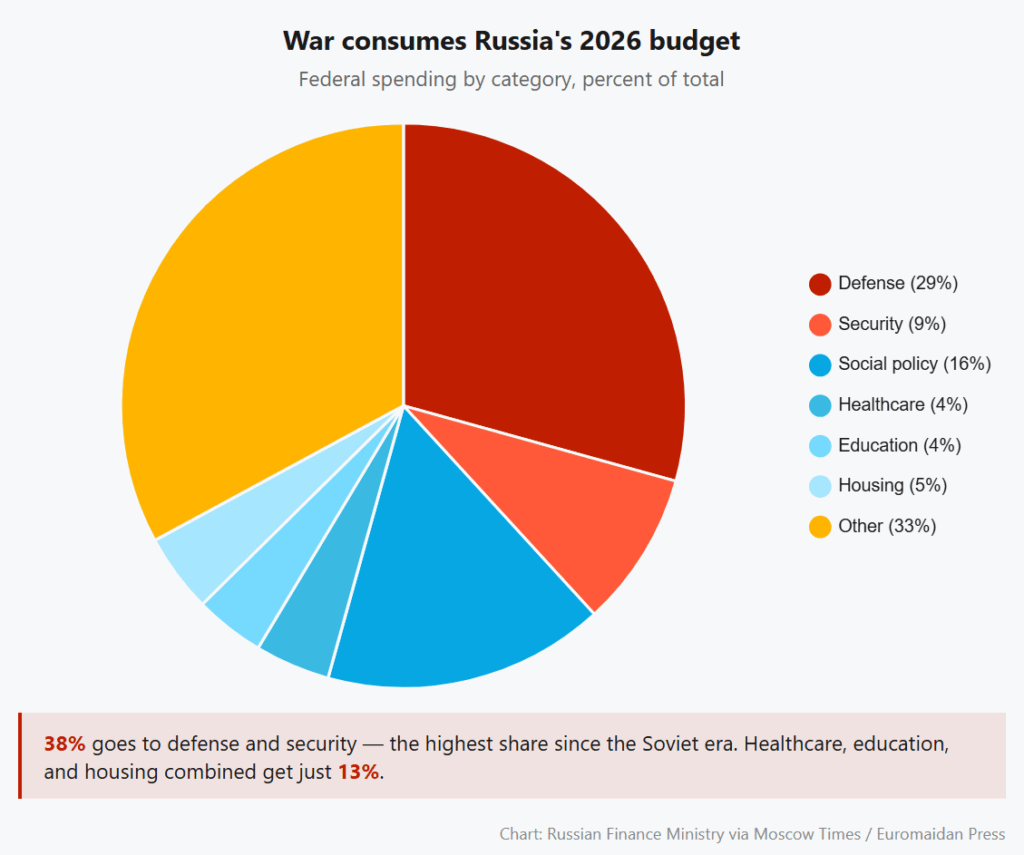
Russia’s 2026 federal budget already dedicates 38% of all spending to defense and security, while healthcare, education, and housing combined receive 13%.
Russia’s 2026 federal budget already dedicates 38% of all spending to defense and security, the highest share since the Soviet era, while healthcare, education, and housing combined receive 13%, Euromaidan Press reported. Energy revenues, long the war’s primary financial engine, are shrinking as sanctioned crude sells at deepening discounts to China and India.
The fundraiser came at a moment when Russia’s finances were strained on one side, unexpectedly flush on the other. In January, Urals crude had slid to $53 a barrel, well below the $59 Moscow needed to balance its war budget without emergency reserves.
How long the windfall lasts depends on whether Washington’s relief outlasts the quarter—and whether further easing follows.
By the time Putin sat down with oligarchs on 26 March, Urals was trading above $90—after US-Israeli strikes on Iran sent prices soaring and Washington eased sanctions on Russian oil for 30 days on 13 March. How long the windfall lasts depends on whether Washington’s relief outlasts the quarter—and whether further easing follows. The Kremlin is already pushing for more.
Kerimov’s pledge alone amounts to roughly 0.65% of Russia’s 2025 defense budget—a gap-filler, not a solution.


