


- Ukrainian drones flew hundreds of kilometers to strike a Russian shipyard
- It seems unmanned sport plane bombers took part in the raid on the Vyborg shipyard
- A paramilitary icebreaking patrol ship apparently suffered heavy damage
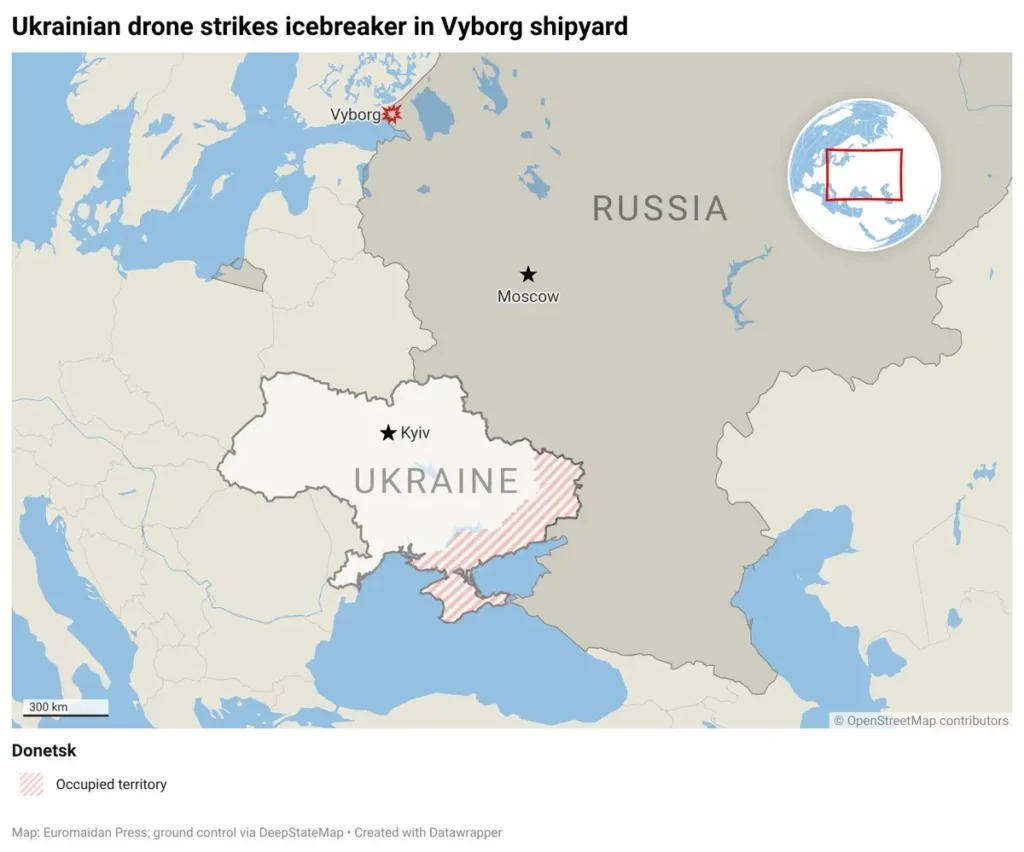
Ukrainian drones flew nearly 1,000 km and struck a shipyard in Leningrad Oblast in western Russia. The attack apparently heavily damaged an icebreaking patrol ship belonging to the Russian border security agency. Post-raid imagery depicts the 114-m Project 23550 patrol ship heavily listing at its pier.
The strike marks the first known successful hit on a Russian military ship in the Baltic—nearly 1,000 km from Ukrainian territory. The Purga is one of only four Project 23550 combat icebreakers Russia is building to enforce its claim over Arctic shipping routes, and can be armed with Kalibr cruise missiles capable of striking targets 2,000 km away.
"The Ukrainian Defense Forces will continue to hit important enemy targets both in the temporarily occupied territories of Ukraine and in the territory of the Russian Federation until the armed aggression against Ukraine is completely stopped," the Ukrainian general staff stated.
Notably, the 25 March attack involved at least one civilian-style sport plane that Ukrainian forces modified into an autonomous bomber. The A-22 and similar E-300 sport plane bombers are the first Ukrainian deep strike drones that can strike targets inside Russia and then return to base—assuming, of course, they don't crash or get shot down.
To be clear, not all A-22s and E-300s are designed to be reusable. Some are one-way "kamikaze" models that explode on contact. But there are good reasons to believe the sport plane drone that bombed the Vyborg shipyard in Leningrad Oblast was a reusable variant. A video that circulated on social media depicts the sport plane cruising over Vyborg without a bomb under its fuselage.

The absence of a bomb may be telling. Many of Ukraine's one-way sport plane bombers get their explosive firepower from 250-kg bombs fixed to their bellies. Others carry their explosive payload inside their cabins.
It's not impossible for a sport plane kamikaze to appear without an underbelly payload if it's carrying its payload internally. But the absence of a bomb could also indicate the sport plane is a there-and-back bomber. After all, the reusable models carry jettisonable bombs under their bellies. Once a reusable sport plane bomber drops its bomb, it appears clean and unencumbered as it turns around and flies home.
Navigate how?
Sport planes are simple and cheap, often costing less than $100,000. But their simplicity and low cost belie their sophistication when they're converted into armed drones. It's unclear exactly how Ukraine's A-22 and E-300 drone bombers navigate. Whichever navigation system they use, it's strikingly accurate if it can guide a drone over hundreds of kilometers to drop a bomb on a target as small as a ship.
There are several technologies that could do the job, each with advantages and disadvantages.
Satellite navigation works, but it's vulnerable to jamming.
Inertial navigation systems, which calculate an aircraft's position by knowing its starting point and carefully tracking its speed and direction over time, are unjammable but tend to lose accuracy over time and distance.
Trending Now
Some Ukrainian drones send and receive signals over Russia's own 5G cellular network, but the Russians take pains to shut off suspicious SIM cards in order to throw the 5G drones off course.
It's possible the best Ukrainian deep strike drones actually include more than one navigation system, each backing up the others. Redundancy helps ensure more drones reach their targets.
The FSB's contract with the Vyborg Shipyard for the Purga's construction was worth around 18 billion rubles ($222 million), Russian business daily Kommersant reported. A sport plane bomber costs less than $100,000—meaning Ukraine could build 2,200 of them for the price of the ship they just damaged.

The 25 March raid on Vyborg was part of a broader campaign.
That same night, Ukrainian drones hit the Novatek oil condensate processing plant at Ust-Luga—a facility that exports 650,000 barrels of oil and 150,000 barrels of gas condensate daily. The Primorsk oil terminal, struck two days earlier, was still smoldering. Russia claimed it shot down 359 drones across 13 regions. Ukrainian forces reportedly launched hundreds of deep strike munitions along several vectors that morning—targeting Baltic energy and military infrastructure simultaneously.
We don't know for sure whether a sport plane bomber was responsible for the hit on that Russian patrol ship, but it would make sense if it was.
After all, many of Ukraine's long-range attack drones carry very small warheads—sometimes just a few tens of kilograms—in order to maximize their fuel load and thus their flying range. A paucity of explosive firepower explains why many Ukrainian deep strikes produce dramatic videos for social media but don't actually inflict lasting damage.
But a 250-kg bomb can cause the kind of significant damage that's evident in Vyborg. It takes more than few kilograms of explosives to punch a hole in the thick hull of an icebreaker and cause it to take on water.
Only one of the four planned Project 23550 ships has entered service. Russia is the only country building icebreakers armed with cruise missiles, and Ukraine may have just delayed the second FSB hull by years.


