


A joint investigation by Slidstvo.Info and OCCRP, published on 24 March, traces more than 54,000 tonnes of wheat exported from occupied Mariupol to Türkiye between 2023 and 2024 by a Russian family that simultaneously manufactures combat drones.
Part of that grain reached Erisler—a Turkish milling company listed as a supplier to the UN World Food Programme (WFP).
“Türkiye will not allow illegal trade in Ukrainian grain.”
The case exposes a specific gap in international commodity certification: falsified paperwork that erases a cargo’s origin is enough to move stolen goods into UN supply chains undetected. It also tests a promise.
In June 2022, Türkiye’s then-Foreign Minister Mevlüt Çavuşoğlu told a press conference alongside his British counterpart: “Türkiye will not allow illegal trade in Ukrainian grain.” A Turkish WFP supplier has since received at least one documented shipment from occupied Mariupol.
The family that builds drones and trades stolen grain
Roman Gurov and his 75-year-old mother, Lyudmila Gurova, run two businesses. One is Nika, a grain trader whose compliance declarations list production sites in occupied Mariupol for every shipment from July 2022 through early 2026.
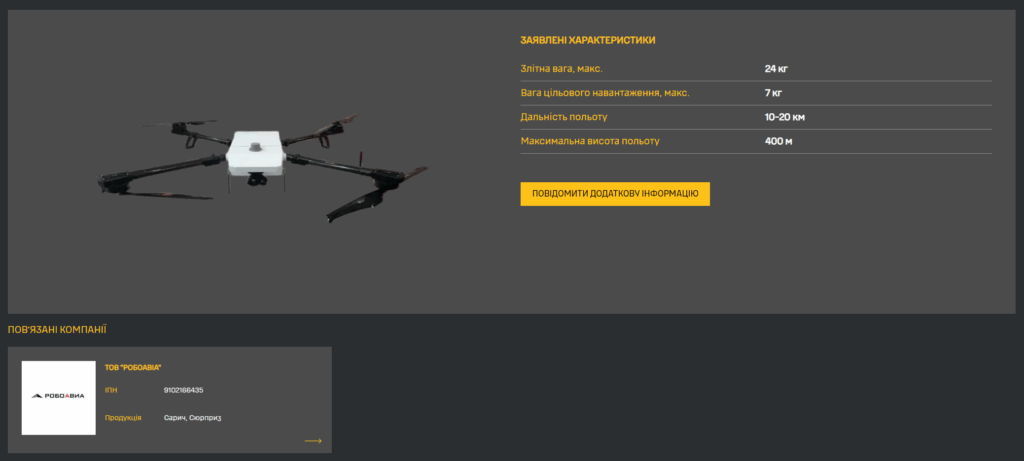
The other is Roboavia—a drone manufacturer whose Sarych reconnaissance drones and Surpriz attack drones are used against Ukrainian forces, per Ukraine’s Military Intelligence Directorate. Roboavia has been under US and Ukrainian sanctions since 2024, the investigation found.
“We consider them nominees for the reason that the Gurovs never previously had any systematic business related to UAV production,” Valentyna Samar, head of Ukraine’s Centre for Investigative Reporting, told the investigation.
How Mariupol wheat becomes “Russian” grain
In April 2024, the sanctioned vessel Alfa M loaded 7,857 tonnes of Nika wheat in Mariupol. It did not sail directly to Türkiye. Instead, it stopped at Temryuk—a Russian port on the Azov coast—where Russian export documents were drawn up.
“The consignment of wheat removed by the Alfa M from occupied Mariupol effectively has the status of contraband.”
Those documents listed Mariupol as a Russian city, erasing the grain’s Ukrainian origin. From Temryuk, the cargo traveled to Türkiye. Shipping manifests obtained by the investigation list the final recipient as Erisler Gida Sanayi Ve Ticaret A.S., with Global Commodities and Logistics Limited acting as intermediary.
“The consignment of wheat removed by the Alfa M from occupied Mariupol effectively has the status of contraband,” said Kateryna Yaresko, a journalist at the SeaKrime project of Ukraine’s Myrotvorets Centre. “Such systematic disinformation, conducted at state level in Russia, undermines the economic security of participants in international trade.”
A lab test in Odesa
The laundering would likely have remained invisible were it not for a quality inspection. A Ukrainian employee of Swiss certification company Cotecna, speaking anonymously to the investigation, said the April 2024 batch was tested in a laboratory in Odesa.
The sample had arrived from Türkiye marked “country of origin: Russia.” Its volume matched the Alfa M manifest exactly—7,857 tonnes, to the kilogram.
Cotecna denied providing services for goods from Ukrainian territory under occupation, but acknowledged it had “no independent means to verify” origin claims beyond the documentation its counterpart supplied—documentation that did not mention Mariupol.
Trending Now
Erisler and Nika did not respond to the investigation’s requests for comment.
Global Commodities denied purchasing grain from Mariupol and said it worked “in strict accordance with internationally recognized trade standards.” Erisler and Nika did not respond to the investigation’s requests for comment.
Erisler also manufactures instant noodles containing wheat flour—sold in Ukraine. The investigation does not establish what share of Erisler’s flour stock came from Nika, but the possibility that stolen Ukrainian wheat traveled from occupied land to a Turkish mill and back as packaged food cannot be excluded.
One shipment in a $12.9 million trade
The April 2024 voyage is one documented shipment in a larger trade. Nika’s wheat exports grew from $3.7 million in 2023 to almost $13 million in 2024—nearly a fourfold increase in a single year, according to the investigation citing a source in the Russian customs service.
Euromaidan Press reported in 2024 that Russia stole more than 180,000 tonnes of grain through Mariupol port alone. Total Russian grain theft from occupied Ukrainian territories between 2022 and August 2025 reached approximately 15 million tonnes, the investigation reported.
Russia generated at least $1 billion in profits from stolen grain.
Russia generated at least $1 billion in profits from stolen grain, The Wall Street Journal reported in September 2024. Ukraine’s Foreign Intelligence Service estimated the 2025 figure alone at more than 2 million tonnes.
The Temryuk rerouting scheme—load in Mariupol, re-document in Russia, ship as “Russian” grain—is the mechanism behind all of it.
The grain funds the war. The drones fight it. The same family runs both.


