


Trump announced a five-day pause on US strikes against Iran on Monday. Oil prices fell 13% within hours. Iran denied any negotiations had taken place. Nothing about the underlying crisis changed.
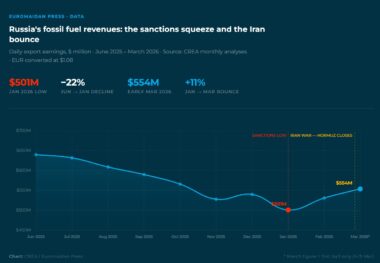
For Russia, the numbers are simple. Oil prices have surged around 50% since the Iran war began, partially reversing what had been Moscow’s worst quarterly energy revenues since the pandemic—handing the Kremlin an unexpected cushion for its war budget just as Western sanctions pressure was mounting.
A genuine de-escalation would strip that windfall away. A five-day pause, denied by one side, does not.
Trump posted on Truth Social on 23 March that the US and Iran had held “very good and productive conversations regarding a complete and total resolution of our hostilities in the Middle East” and that he had “instructed the Department of War to postpone any and all military strikes against Iranian power plants and energy infrastructure for a five day period.”
Brent crude—the international oil benchmark—had opened Monday’s session at $113.65 per barrel before dropping to around $100 on the announcement.
“Critical infrastructure and energy and oil infrastructure throughout the region will be considered legitimate targets and will be irreversibly destroyed.”
Markets had already been volatile before Trump’s post. Over the weekend, he had threatened to obliterate Iranian power plants unless Tehran reopened the Strait of Hormuz—the waterway through which 20% of the world’s oil and gas flows—within 48 hours.
Iran’s parliament speaker, Mohammad Baqer Qalibaf, warned on X that if Iran’s own infrastructure were struck, “critical infrastructure and energy and oil infrastructure throughout the region will be considered legitimate targets and will be irreversibly destroyed, and oil prices will remain high for a long time.”
Iran’s Fars News Agency rejected Trump’s account entirely.
Amrita Sen told Reuters that markets betting on Iranian concessions were mistaken: “This clearly means further escalation, and that means higher oil prices.”
Iran’s Fars News Agency rejected Trump’s account entirely, attributing the pause to Tehran’s threat to strike power plants across West Asia—not to any negotiations.
Trending Now
When the pause ends, the same pressures will be exactly where they were.
The announcement resolves nothing. As Euromaidan Press reported earlier Monday, the Strait of Hormuz remains closed, the last pre-war Gulf gas tankers are docking this week, and Qatar’s damaged LNG terminal faces years of repairs.
When the pause ends, the same pressures—on energy markets, on fertilizer prices, on Ukrainian farmers—will be exactly where they were. So will Moscow’s windfall.


