


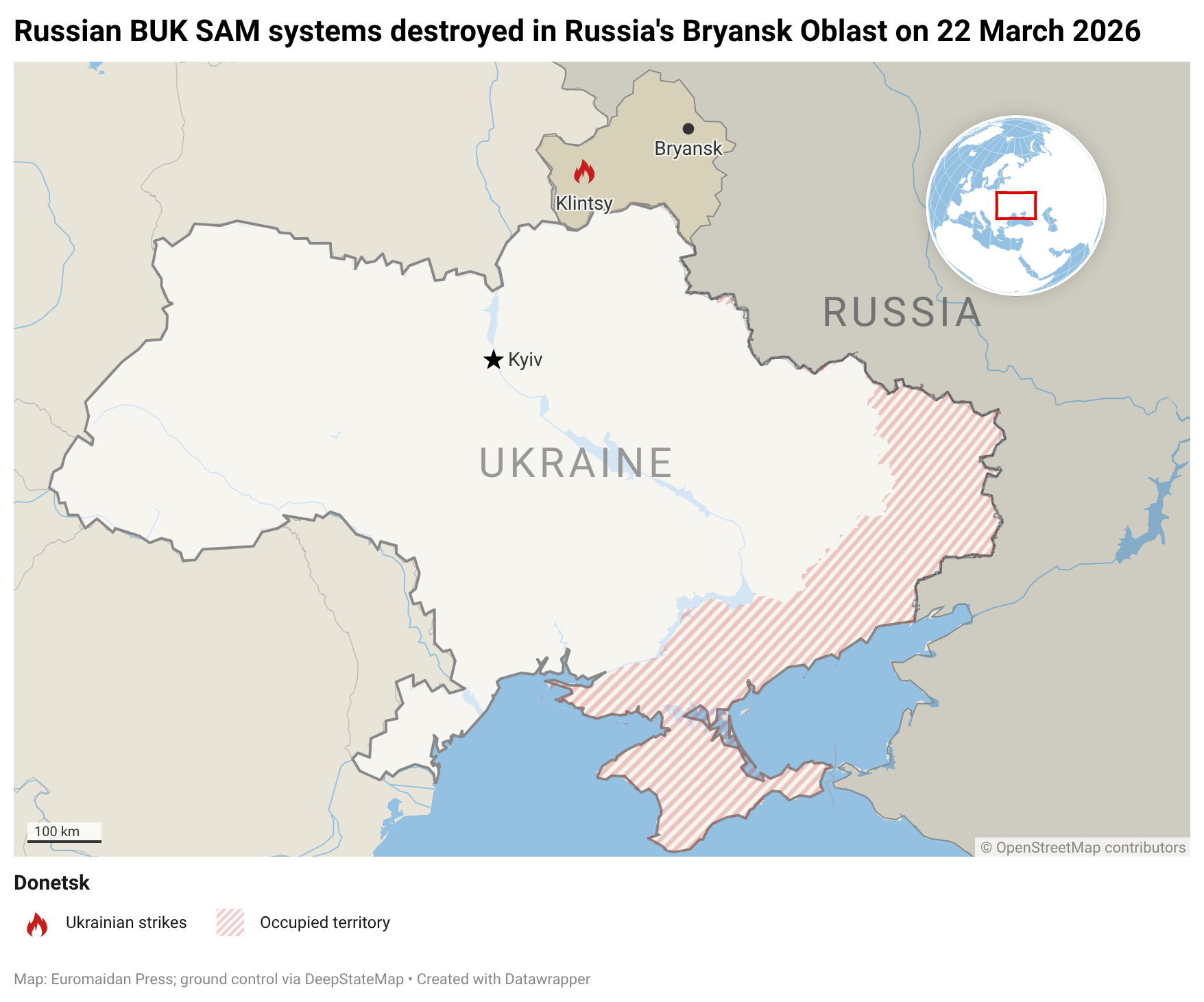
Ukraine's Unmanned Systems Forces (SBS) destroyed a Russian Buk-M3 self-propelled firing unit together with its crew and a Buk-M2 transporter-loader in Bryansk Oblast overnight on 21-22 March, SBS commander Robert "Magyar" Brovdi reported on Telegram. The strike pushed the SBS's March tally of Russian air defense elements destroyed to 26, as Ukraine's systematic campaign to degrade Russia's air defense network reached 50 km inside Russian territory.
Strike in the Bryansk swamps: secondary detonation does the work
Pilots of the 413th Separate "Raid" Regiment of the Unmanned Systems Forces carried out the strike. OSINT analyst @99Dominik_ pinpointed the location to coordinates 52.748437, 32.177750 — the Pervoe Maya area near Klintsy in Bryansk Oblast, approximately 50 km from the Ukrainian border.
Militarnyi reported that drone operators caught the two systems during movement or deployment, both parked directly next to each other and fully loaded with ammunition. The operator aimed the kamikaze drone not at the launcher body but directly into the missiles on the Buk-M2 transporter-loader, triggering a powerful secondary detonation and fire that destroyed both systems. Ukrainian Telegram channel Exilenova+ reported that local residents near Klintsy filmed active detonations and explosions overnight, which Militarnyi cited as additional confirmation of the strike location.
In the same operational period, pilots of the 1st Separate Center of the SBS reportedly struck a Triumf radar from an S-400 system on temporarily occupied territory in Donetsk Oblast, Brovdi reported. Militarnyi noted the radar was likely a mock-up.
26 air defense elements in 22 days
Between 1 and 22 March, SBS drones destroyed 26 elements of Russian air defense at operational depth, along with 7,073 Russian personnel and 25,612 unique targets in total, Brovdi reported. The Bryansk strike is the latest in an accelerating SBS campaign against Russian air defense across multiple tiers. The 422nd "Luftwaffe" drone regiment also recently struck two Buk-M1 systems in a separate operation.
What the Buk-M3 can do — and why it matters to destroy it
The Buk-M3 is Russia's most capable Buk variant and serves both air defense and missile defense functions, covering ground troops from Ukrainian aviation and engaging targets beyond the front from rear positions. Its missiles — stored in sealed cylindrical transport-launch containers, distinguishing it visually from the older Buk-M2 — intercept aerodynamic targets at ranges of up to 70 km and altitudes of up to 35,000 m. The Buk-M2 transporter-loader, destroyed alongside it, carries additional missiles to reload self-propelled firing units and can serve as an auxiliary launcher, but, unlike the firing unit, has no onboard radar and requires external targeting to engage.


