


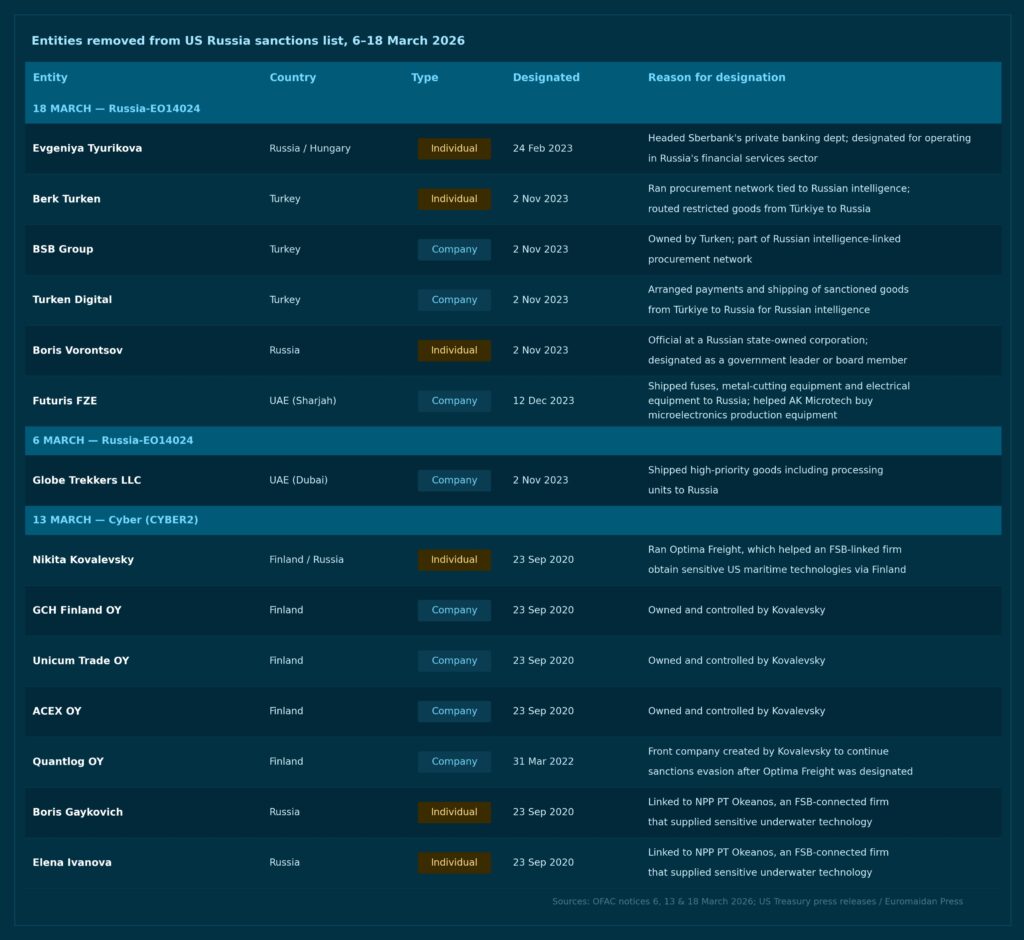
The US Treasury’s Office of Foreign Assets Control (OFAC)—the federal agency that administers America’s sanctions by freezing the US-held assets of designated parties and barring American firms from doing business with them—has removed six Russia-linked entities from its Specially Designated Nationals (SDN) list on 18 March, issuing no press release and giving no stated reason.
Among those unblocked: a Russian national who headed private banking at the US-sanctioned Sberbank; a Turkish businessman whose network Treasury designated for enabling Russian intelligence services to acquire restricted technology; and a UAE company that Treasury said shipped fuses and microelectronics manufacturing equipment to Russia.
Three waves have lifted US sanctions from individuals and companies drawn from four separate enforcement packages, each originally announced with a press release.
The 18 March action is the third Russia-connected removal in 12 days. Earlier OFAC notices—a 6 March removal and a 13 March action—cleared additional Russia-linked entities, also without explanation.
Together, the three waves have lifted US sanctions from individuals and companies drawn from four separate enforcement packages, each originally announced with a press release describing the disruption of networks supplying Russia’s war economy.
This is not the first time. In December 2025, Alexandra Buriko—Sberbank’s former chief financial officer and one of eight Sberbank executives sanctioned in 2022—was quietly removed from the SDN list in an update headlined about Iran. Her removal also carried no press release and no stated reason.
Who was removed on 18 March
Treasury designated Evgeniya Tyurikova on 24 February 2023—the first anniversary of Russia’s full-scale invasion of Ukraine—describing her as a “long-time finance professional” who had operated in Russia’s financial services sector in her role heading Sberbank’s private banking department. Her SDN file listed addresses in both Moscow and Hungary; Sberbank itself remains under full US blocking sanctions.
Also removed were Boris Vorontsov, a Russian national identified as an official at a Russian state-owned corporation, and Futuris FZE, a Sharjah-based UAE company.
Treasury’s November 2023 action designated Berk Turken and his two Turkish companies—BSB Group and Turken Digital—after finding that the network had worked with a sanctioned Moscow technology company and its procurement operative, both identified as acting under Russian intelligence services’ direction, to arrange payments and route shipments of restricted goods from Türkiye to Russia.
Also removed were Boris Vorontsov, a Russian national identified as an official at a Russian state-owned corporation, and Futuris FZE, a Sharjah-based UAE company. Treasury’s December 2023 notice found that Futuris had shipped fuses, metal-cutting equipment, and electrical equipment to Russia, and that the already-sanctioned Russian firm AK Microtech had specifically used Futuris to purchase microelectronics production equipment needed for weapons manufacturing.
The two earlier actions
On 6 March, OFAC published a notice removing Globe Trekkers LLC, a Dubai-registered company sanctioned in November 2023 for shipping high-priority goods to Russia.
On 13 March, a batch of cyber-related designations was removed, clearing Nikita Kovalevsky, a Finnish-Russian dual national, along with three Finnish freight companies he controlled: GCH Finland, Unicum Trade, and ACEX.
Two Russian nationals linked to the same FSB-connected network were cleared in the same action.
US Treasury records show that Kovalevsky was designated in 2020 after his logistics company, Optima Freight, helped a firm linked to Russia’s Federal Security Service (FSB) obtain sensitive US maritime technologies by routing shipments through Finland. Two Russian nationals linked to the same FSB-connected network were cleared in the same action.
A quiet pattern
The delistings fit a trend documented by researchers at the Center for a New American Security: 38 persons designated under Russia-related authorities were removed from the SDN list across the first year of Trump’s second term—without the press releases that accompanied the original designations.
Trending Now
The administration had “refrained from sanctioning new Russian entities while it prioritized negotiations to end the conflict.”
A Corporate Compliance Insights review found that the administration had “refrained from sanctioning new Russian entities while it prioritized negotiations to end the conflict.”
OFAC has not commented.
The Hungarian detail
Tyurikova’s original SDN file listed two addresses: one in Moscow, one in Hungary, with no city specified. OFAC’s listing practices reflect information gathered at the time of designation rather than necessarily current residence, and the removal itself confirms nothing about any active Hungary connection.
A former Sberbank official with a listed Hungarian address was unblocked from the US financial system three weeks before Hungary’s parliamentary elections.
The file does show, however, that a former Sberbank official with a listed Hungarian address was unblocked from the US financial system three weeks before Hungary’s parliamentary elections on 12 April—an election the OSCE is observing and which commentators have described as consequential for European unity on Russia policy. Whether those facts bear any relation is not established.
Postscriptum
Hours after Treasury removed Russia-linked entities from the SDN list, Secretary Scott Bessent told Fox Business that Washington may also lift sanctions on 140 million barrels of Iranian oil stranded on tankers—citing the need to stabilize global energy markets disrupted by Iran’s closure of the Strait of Hormuz.
This time, at least, Treasury said so openly, on television.
Bessent noted that Treasury had recently taken “a similar step” with sanctioned Russian oil. This time, at least, Treasury said so openly, on television. Removing sanctions to manage commodity prices, with no formal designation process in reverse. The pattern now extends well beyond Russia.


