


Before dawn, under curfew, an elderly woman in Russian-occupied Ukraine walks to the hospital to stand in line in hope of a pie: she has no food left at home. An FPV drone drops an explosive. There is no time to hide. People rush her to the hospital in a wheelbarrow, but it is too late. Later, she is buried in that same wheelbarrow, as there are no coffins and no transport. This is life in the coastal villages by the Dnipro River in Russian-occupied Oleshky, Kherson Oblast.
Several towns and villages on the occupied left bank of the Dnipro face an acute humanitarian catastrophe. Russian forces have mined access routes, cutting off food, medicine, and fuel. Civilians are nearing starvation. And Russian FPV drone pilots conduct what residents call "human safari" attacks—hunting people who step outside. A former Ukrainian serviceman told Euromaidan Press the strikes may be linked to drone training: beginner operators positioned inland cannot fly far enough to reach Ukrainian positions across the Dnipro, so they practice on the local population instead.
The occupying authorities control communication in the occupied areas; sharing information can mean arrest or torture, so names and details are withheld. Information in this report is based on local sources and documentation collected by the Kherson Non Fake Telegram channel, which has consistently monitored conditions in the occupied territories.
"Human safari"
In the hope of obtaining provisions, residents gather near the hospital each morning, with Russian police monitoring the crowds. A few residents sell pirozhki, drawing long lines, sometimes during curfew. These groups are targeted by drones.
On 6 February, before dawn, a drone equipped with a thermal imager detected a woman walking to stand in line and dropped ammunition, killing her on the spot. On 6 March, after rumors spread that a shop owner had brought food, drones struck a group of civilians waiting for a possible delivery at 5 a.m., killing a man and a woman and wounding up to ten others. The wounded were taken to the hospital in a wheelbarrow, covered in blood.

Inside Human Safari: the film that captures Russia’s drones hunting Ukrainians like prey
An anonymous source reported to Zla Mavka, a women's resistance network in the occupied territories, that residents have learned to walk along fences, stop under trees, and hide beneath awnings—not from rain but from the camera. Even children know to drop into the nearest ditch when they hear buzzing.
"Here, they call it simply a safari," she wrote. "In the morning, we look at the sky not to check the weather, but to understand whether today's 'hunt' has begun."
A Euromaidan Press source, a former Ukrainian serviceman, suggested that these attacks are linked to Russian drone training exercises using local populations as live practice targets. About 90% of training is done with Mavics—inexpensive Chinese FPV drones with a 7–8 km range in fair weather, extendable to 10–12 km if the battery is doubled.
Trainees are positioned 5–10 km inland from Oleshky or Hola Prystan, in forests behind the Melitopol highway. From there, Mavics cannot fly far enough to cross the Dnipro. Reaching the riverbank would also put the drones at risk, as Ukrainian forces on the western bank conduct counter-battery operations. Beginner operators, unable to reach Ukrainian-controlled territory, practice on the trapped civilian population.
All drone operators measure sortie efficiency by whether they hit a target. Ukrainian pilots train by dropping Snickers bars on their infantry. Russians drop explosives. Although they avoid wasting costly FPV drones, dropping grenades on civilians is standard practice.
According to Tetiana, whose relatives live in Oleshky, Russians stage attacks and blame the Ukrainian military, turning civilians in occupied territories against Ukraine. Negotiations are underway to evacuate Oleshky residents to Ukrainian-controlled territory with Red Cross participation. But residents do not register—they fear buses might be attacked by Russian drones and the blame placed on Ukraine.

A town under siege
Oleshky, formerly Tsiurupynsk, sits directly opposite Kherson city on the eastern bank of the Dnipro. The city had 25,000 residents before the full-scale invasion. Thousands fled or died after the Russian military engineered the Nova Kakhovka dam explosion and flood in summer 2023. Russian soldiers have conducted interrogations and searches for people with pro-Ukrainian views since then. An estimated 2,000–3,000 civilians remained in fall 2025–winter 2026. According to other sources, only about 600 remain.
Roads to and from Oleshky are mined and in some places blocked with barbed wire. In winter, the mines were hidden under snow, leading to numerous injuries. Only one main road still functions, connecting the town from a checkpoint to the hospital. Russian troops are sealing the area by banning civilians from traveling outside Oleshky.
In January 2026, food and medicine deliveries stopped. Residents melted snow for water. Leaving was next to impossible. On 17 January, evacuation from Oleshky was halted after a car attempting to leave hit a mine at the city's entrance. The driver and an elderly woman suffered severe injuries, losing legs. Another passenger was killed.
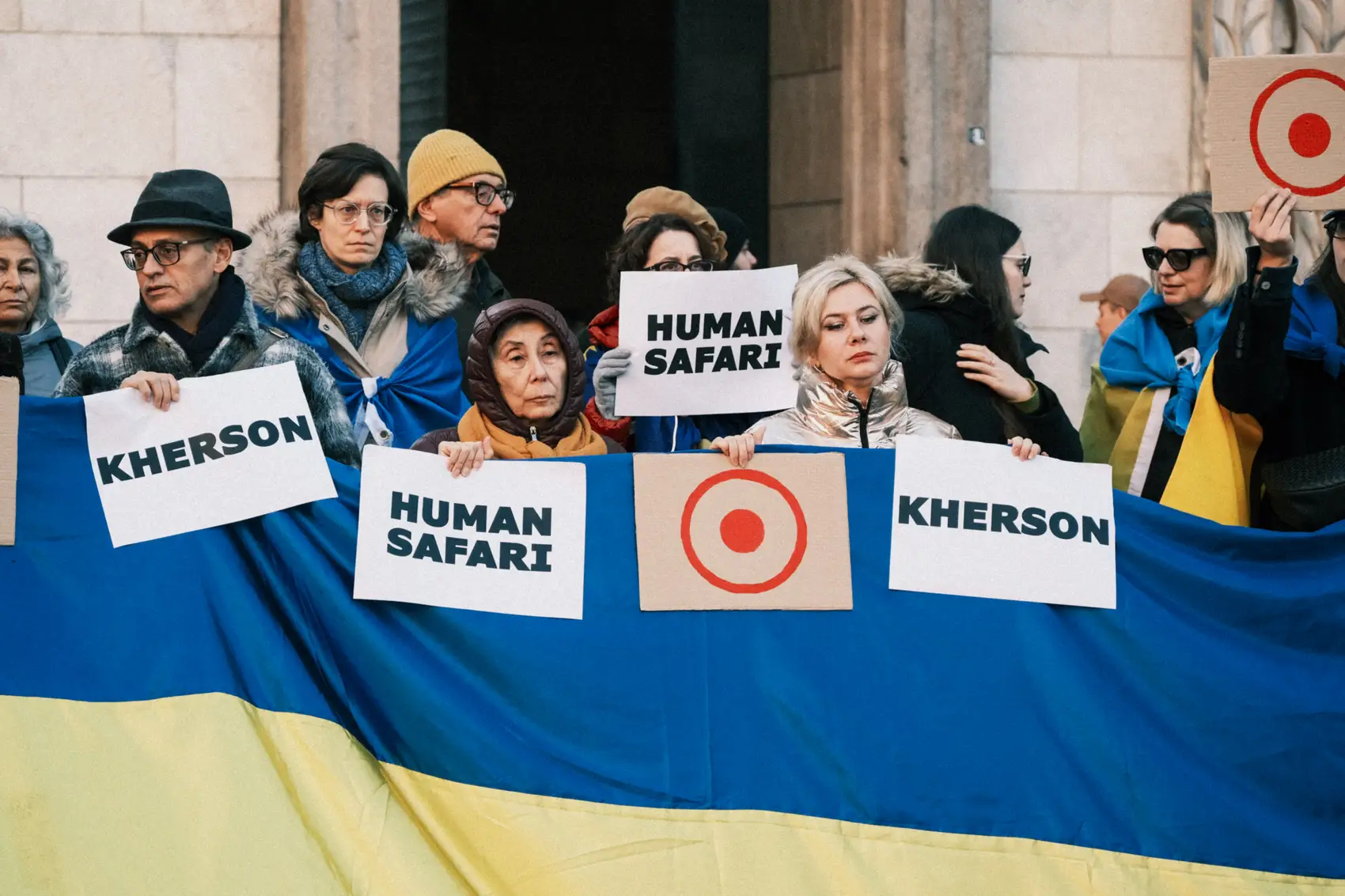
Global protests demand end to Russia’s “human safari” as lawmakers propose new sanctions bill
Those who leave to get supplies are often barred from returning. When a couple managed to buy food for neighbors, Russian soldiers at the checkpoint refused reentry, saying, "Go back, let them die there."
By 18 February, Oleshky had gone without stable food or medicine deliveries for more than a month. Russian troops delivered supplies at night. Soldiers at the Hola Prystan checkpoint continued to block most vehicles except an ambulance carrying food for hospital staff. When one or two cars made it through, delivered goods were distributed within minutes, and most residents received nothing.
Food prices skyrocketed. Although Oleshky is just over 22 km from Radensk, potatoes cost roughly 20 rubles (about $0.25) per kilogram in Radensk and around 200 rubles (about $2.50) in Oleshky—ten times higher. A Kherson resident in Ukrainian-controlled territory reported that his grandmother and about ten neighbors survived by catching pheasants and eating preserved beef. Many have run out of food and rely on bartering or sharing.
Since November 2025, Oleshky has faced a severe crisis burying the dead. A proper burial costs 80,000–100,000 rubles ($1,000–$1,300) and includes transporting the body for examination, but residents lack the money or access. Quite a few died during the severe winter from hypothermia. Bodies are left in the street for weeks and buried in bags under serial numbers or with simple name plaques.
Killing roads
At least four people were killed on 10 February during an attack on vehicles on the highway between Hola Prystan and Oleshky. The first car was struck by a drone; the driver escaped, but the passengers burned inside. People in the second car managed to flee. The third vehicle carried food, fuel, and pensions, and was found empty—doors open, all goods removed, trash scattered around. The driver's body was found nearby with gunshot wounds, in another situation strongly resembling robbery.
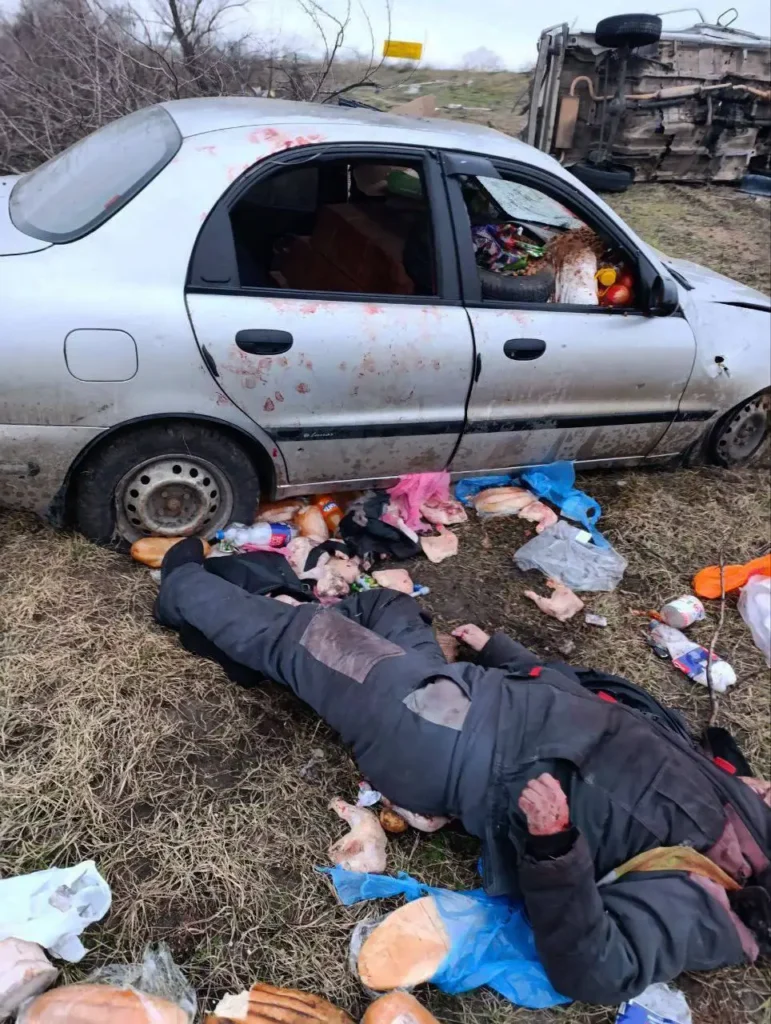
On 24 January, Russian state media reported a vehicle responding to a medical call near Oleshky was struck by an FPV drone, but key details were distorted. According to the Kherson Non Fake channel, the vehicle—belonging to the Oleshky hospital—was transporting food and diesel fuel from Skadovsk for the hospital's generator. The hospital had dismissed much of its staff, with only the surgery department still operating and serving the Russian authorities.
Reports suggested the hospital guard, nurse, and local driver may have been killed not by a drone, but by automatic weapons in an armed robbery.
On 12 February, more vehicles attempted to bring food along the highway near occupied Hola Prystan but were stopped and turned around by Russian soldiers.
Beyond Oleshky
The situation extends across settlements along the left bank of the Dnipro opposite Kherson city. Hola Prystan, located opposite Bilozerka downstream from Nova Kakhovka, has seen its population drastically reduced after the 2023 dam flooding. The remaining inhabitants are mostly elderly or pro-Russian. The situation resembles Oleshky: entrances and exits are mined, emergency services no longer operate, pensions are not delivered, and the remaining pharmacy has almost no medicines. There is no power or running water. Eyewitnesses describe instances of dogs eating the dead; Russians do not allow residents to pick up bodies. Burial conditions are similar to Oleshky.
Life begins roughly 10 km from the Dnipro. In Kapani, inland from Hola Prystan near forests, some residents remain, and limited farming continues. At Kinburn Spit, far southwest on the Black Sea, all villages are deserted. In Nova Kakhovka, upstream from Oleshky, people live mostly in a distant microdistrict 5–7 km from the river in high-rise buildings; the coastal areas are abandoned. Hospital capacity is extremely limited.
Russian administrative presence across these areas is minimal. Governance is conducted from Henichesk, about 200 km away on the Azov Sea. Henichesk and another coastal town, Skadovsk, still have relatively normal conditions. Most pro-Ukrainian activists were pushed out. The Russian FSB controls activities, but repression is less brutal than in Oleshky or Hola Prystan.
At the negotiating table, Russia demands international recognition of its sovereignty over Kherson, Donetsk, Luhansk, and Zaporizhzhia oblasts—including territory it never captured militarily. In Oleshky, the largest town on the occupied bank, the dead are buried in wheelbarrows, and drone pilots practice on civilians waiting for food.


